
 30Apr
30Apr
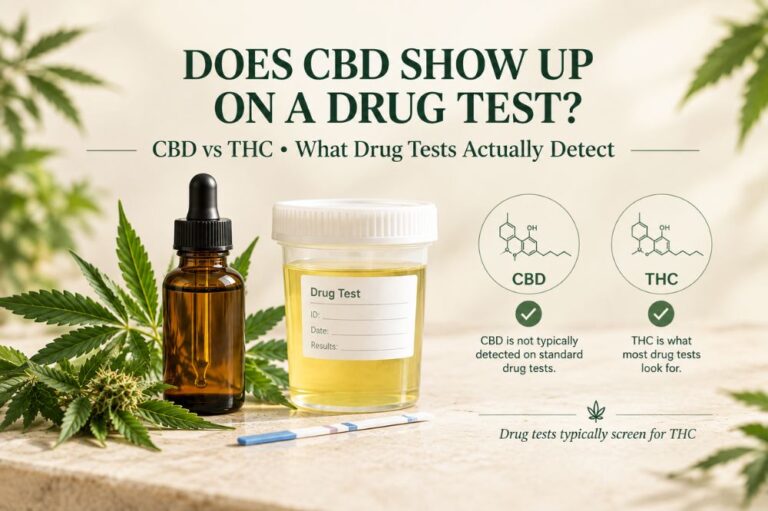
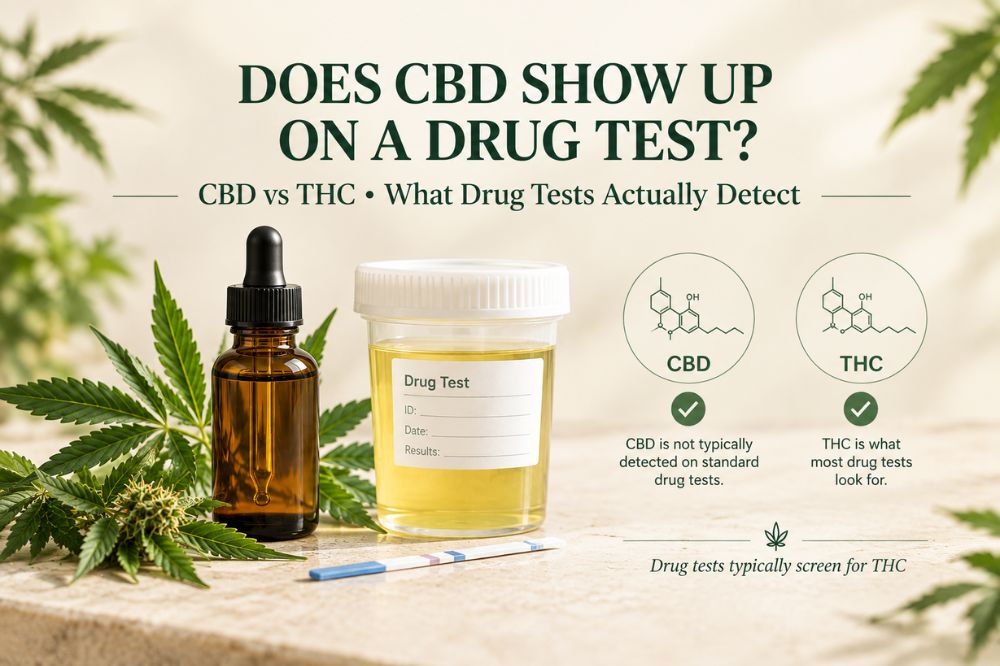
No. Standard drug tests do not screen for CBD. They look for THC-COOH, the metabolite your body produces from THC, and CBD does not create it. The real risk comes from the trace THC present in full spectrum products, which can build up with heavy daily use and, in a small number of cases, push a urine screen over the cutoff.
What a drug test is actually looking for
The standard workplace urine panel tests for five substance groups, and the cannabis marker in it is 11-nor-9-carboxy-THC, usually shortened to THC-COOH. There is no CBD panel, because CBD is not a controlled substance in most jurisdictions and no employer is screening for it.
Federal testing in the United States uses two thresholds: an initial immunoassay screen at 50 nanograms per millilitre, and a confirmatory GC-MS test at 15 nanograms per millilitre. Both measure the THC metabolite, not CBD.
So the question is never whether CBD shows up. It is whether enough THC came along with it.
Where the actual risk comes from
Legal hemp can contain up to 0.3% THC in the United States and 0.2% in most of Europe. In a single serving that is a very small amount, often a fraction of a milligram. The complication is that cannabinoids are fat soluble, so they are stored in fatty tissue and released slowly rather than flushed straight out. Take a high strength full spectrum oil every day for months and those fractions of a milligram stop being irrelevant.
Researchers at Johns Hopkins gave six adults a single dose of vaporised CBD-dominant cannabis containing 100mg of CBD and 3.7mg of THC. Two of the six produced positive urine screens afterwards. Pure CBD on its own produced none. That is a small sample, but it demonstrates the mechanism clearly: it was the THC riding along, not the CBD.
Risk by product type
| Product type | THC content | Drug test risk |
| Full spectrum | Trace, under the legal limit | Low, but genuinely not zero with daily heavy use |
| Broad spectrum | None detectable | Very low |
| CBD isolate | None | Effectively zero |
| Unverified “hemp oil” with no lab report | Unknown | Unknown, which is the problem |
We make full spectrum oils because keeping the whole plant profile intact is the point of the product. That also means being straight with you: a full spectrum oil contains trace THC by definition, and no honest brand can promise you a clean test result from one.
The other test types
Urine is the standard, but it is not the only method in use.
| Test | What it detects | Typical detection window |
| Urine | THC-COOH metabolite | 3 days to several weeks, depending on frequency |
| Blood | Active THC | Hours to a couple of days |
| Saliva | Recent THC | Roughly 24 to 72 hours |
| Hair | THC and metabolites | Up to about 90 days |
None of the four screen for CBD. Hair testing has by far the longest window and is the least forgiving of a daily full spectrum routine, although it is also the least common in routine workplace screening.
The risk people underestimate
The bigger danger is not regulated trace THC. It is products that contain more THC than the label admits.
A 2017 study published in JAMA tested 84 CBD products bought online from 31 companies. Almost 70% were mislabelled: 26% contained less CBD than claimed, over 42% contained more, and THC turned up in a number of samples that were sold as CBD-only. Anyone taking one of those products would have had no way of knowing what they were consuming.
This is the practical case for buying only from brands that publish a batch certificate of analysis. A lab report showing the THC result, matched to the batch number printed on your bottle, is the only evidence that means anything here.
If you are subject to workplace testing
Choose a product with a lab report showing THC at non-detect, which in practice means broad spectrum or isolate. Endoca’s 99% pure CBD crystals contain no THC at all.
Match the certificate to your batch number rather than accepting a generic PDF on the website. Keep a copy, along with the product details, in case you ever need to explain a result.
Bear in mind that a positive screen is a positive screen. Many employers apply a zero-tolerance policy regardless of the source, and an explanation after the fact rarely undoes it. If your job depends on testing, check your employer’s policy before you start taking anything, and speak to a doctor if you are unsure.
If you test positive and believe CBD is the cause
Ask for the confirmatory result rather than the screen. Immunoassay screens are built to be sensitive and are expected to produce some presumptive positives; the GC-MS or LC-MS confirmation at 15 ng/mL is the number that decides the outcome.
Produce the batch certificate of analysis along with the product itself. That will not automatically overturn a result, but it is the difference between an explanation and an assertion.
Stop taking the product until the matter is settled, and treat your employer’s written policy as the governing document rather than anything you read online, including this page.
Frequently asked questions
Can CBD itself cause a positive drug test?
No. CBD is chemically distinct from THC and does not produce the THC-COOH metabolite that tests detect.
Will full spectrum CBD oil fail a drug test?
Usually not, but it is possible with high daily servings over a long period. Broad spectrum or isolate removes that risk.
How long before a test should I stop taking CBD?
There is no reliable universal figure, since how long CBD stays in your system depends on how much you have taken and for how long. Occasional users often clear THC metabolites within a few days; frequent heavy users can take several weeks.
Does CBD show up on a hair follicle test?
Hair tests look for THC and its metabolites, not CBD, over a window of roughly 90 days.
Can second-hand exposure cause a positive test?
It is very unlikely at standard cutoffs, outside of extreme and unventilated conditions.
Does the test type matter more than the product?
Both matter. A hair test looks back far further than a urine screen, and a full spectrum product carries more risk than isolate on any of them.
Is CBD tested for in military or DOT testing?
No, but both operate strict THC policies and neither accepts a CBD product as an explanation for a positive result.