



No products in the cart.

The entourage effect is the idea that the compounds in cannabis work better together than on their own. Instead of CBD acting alone, the theory holds that other cannabinoids, terpenes and flavonoids in the plant shape and strengthen its effects. It is the main reason people choose full spectrum CBD over isolate. The idea is plausible and has some supporting evidence, but parts of it are still unproven, and it is worth knowing which parts.
Where the term comes from
The phrase was coined in 1998 by Israeli researchers Shimon Ben-Shabat and Raphael Mechoulam, who noticed that inactive fatty compounds made by the body boosted the activity of its own cannabinoid messenger, 2-AG. The concept was later applied to the cannabis plant itself, most influentially by neurologist Ethan Russo in a 2011 review in the British Journal of Pharmacology, which proposed that terpenes and minor cannabinoids could modify the effects of THC and CBD.
What is in the “entourage”?
Hemp produces hundreds of compounds. The ones usually discussed in relation to the entourage effect fall into three groups.
Cannabinoids
Beyond CBD and THC, hemp contains more than 100 other cannabinoids, including CBDA (the raw, acidic form of CBD), CBG, CBN and CBC. Each has its own activity in laboratory studies. A full spectrum extract keeps these alongside CBD, including a trace of THC within legal limits.
Terpenes
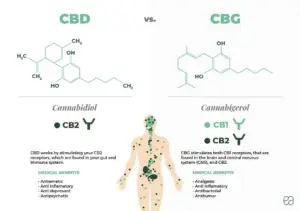
Terpenes are the aromatic oils that give hemp, citrus, pine and pepper their smell. Common ones in hemp include myrcene, limonene, pinene, linalool and beta-caryophyllene. Beta-caryophyllene is a notable example because it binds directly to the body’s CB2 receptor, which makes it one of the few terpenes with a clear link to the endocannabinoid system.
Flavonoids
Flavonoids are plant pigments with antioxidant activity, found in many fruits and vegetables. Hemp contains several, including some, such as the cannflavins, that are unique to cannabis. Their role in any entourage effect is the least studied of the three groups.
What the research supports
Some findings point in favour of a whole-plant effect:
- Full extract vs pure CBD in animals. A 2015 study in mice by Gallily and colleagues found that purified CBD reduced inflammation and pain only within a narrow dose range, with a bell-shaped response, while a CBD-rich whole-plant extract kept working as the dose increased.
- Epilepsy observations. A 2018 meta-analysis by Pamplona and colleagues, pooling observational data on treatment-resistant epilepsy, reported that patients using CBD-rich extracts appeared to need lower average doses than those using purified CBD. The authors cautioned that the data was not from controlled head-to-head trials.
- Individual compounds are active. Minor cannabinoids and some terpenes, such as beta-caryophyllene, have measurable activity of their own, so combining them could plausibly change the overall effect.
What the research does not support (yet)
Other studies have been less encouraging:
- Terpenes and cannabinoid receptors. Laboratory studies by Santiago and colleagues (2019) and Finlay and colleagues (2020) tested common cannabis terpenes and found they did not change how THC acts at the CB1 and CB2 receptors. If terpenes contribute, it is probably through other mechanisms, not by boosting cannabinoids at those receptors.
- Few human trials. Most of the evidence comes from cell studies, animal work or observational data. There are very few controlled human studies comparing a full spectrum extract with isolate at matched doses.
- Dose matters. Terpenes in a typical CBD oil serving are present in small amounts, and it is not clear how much of them reaches the body.
The fair summary is that the entourage effect is a reasonable hypothesis with partial support, not an established fact. Be wary of any brand that presents it as settled science.
Full spectrum vs broad spectrum vs isolate
The entourage effect is the main argument for choosing one type of CBD over another.
| Type | What it contains | Entourage potential | THC |
|---|---|---|---|
| Full spectrum | CBD plus other cannabinoids, terpenes and flavonoids | Highest | Trace, within legal limits |
| Broad spectrum | Most of the plant profile with THC removed | Partial | Non-detectable |
| Isolate | Pure CBD only | None | None |
For a fuller comparison, see our guide to the types of CBD. If you are drug tested, the small chance that trace THC builds up matters more than any entourage benefit, and isolate or broad spectrum is usually the safer choice. Our guide to whether CBD shows up on a drug test explains why.
Does raw CBDA add to the effect?
Heating hemp converts CBDA into CBD, so most extracts contain very little CBDA. Raw, unheated extracts keep it. Early research suggests CBDA has its own activity and may be absorbed more readily than CBD, which would make it a meaningful part of the entourage in raw products. Our article on raw CBDA vs heated CBD goes into the detail.


How to choose a product if you want the entourage effect
- Pick full spectrum unless you need to avoid THC entirely.
- Check the lab report for more than CBD. A certificate of analysis that lists minor cannabinoids, and ideally terpenes, shows that the plant profile was kept, not just claimed.
- Look at the extraction method. Gentle, solvent-free methods such as supercritical CO2 help preserve the wider profile. Our guide to how CBD is extracted compares the methods.
- Consider raw extracts if you want CBDA in the mix.
Frequently asked questions
Is the entourage effect real?
It is supported by some animal and observational studies, but controlled human evidence is limited, and several laboratory studies found terpenes do not boost cannabinoids at CB1 and CB2 receptors. It is best described as a promising but unproven theory.
Does CBD isolate have an entourage effect?
No. Isolate contains only CBD, so there are no other compounds to interact with it. Some people still prefer it because it contains no THC.
Do you need THC for the entourage effect?
Not necessarily. Broad spectrum products keep many of the other cannabinoids and terpenes without THC. Whether the trace THC in full spectrum products adds anything meaningful at legal levels is not known.
Which terpenes matter most?
Beta-caryophyllene has the clearest link to the endocannabinoid system because it binds to CB2 receptors. Myrcene, limonene, linalool and pinene are also commonly discussed, though evidence for their role in an entourage effect is weaker.

Comments are closed