



 10Sep
Quick answer: Buy a single mushroom extract when you have one clear goal and want a known dose you can judge. Choose a mushroom complex when you want broad, everyday support in one capsule and accept smaller amounts of each mushroom. Either way, check the label shows how much of each mushroom you get, not just a total blend weight.
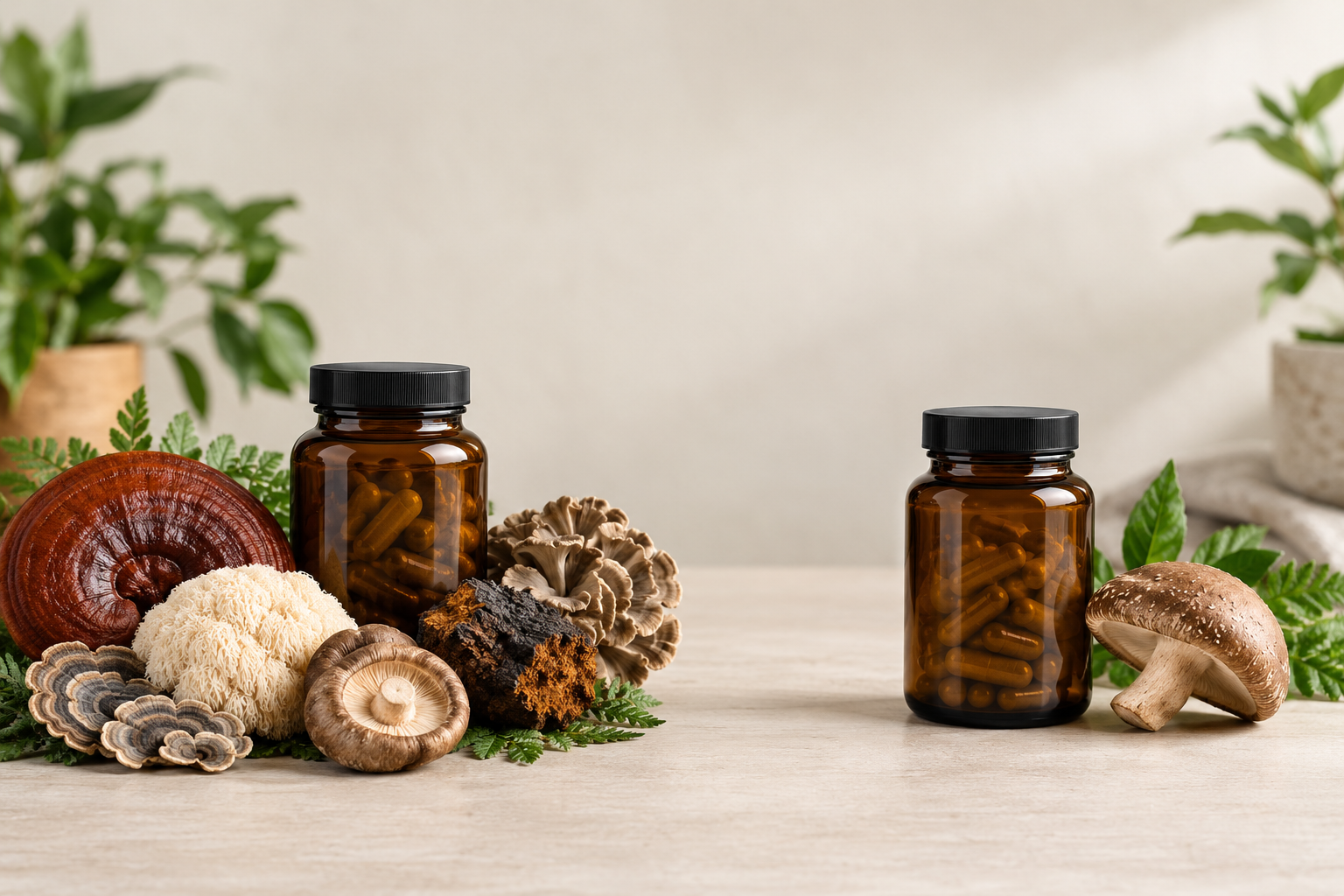
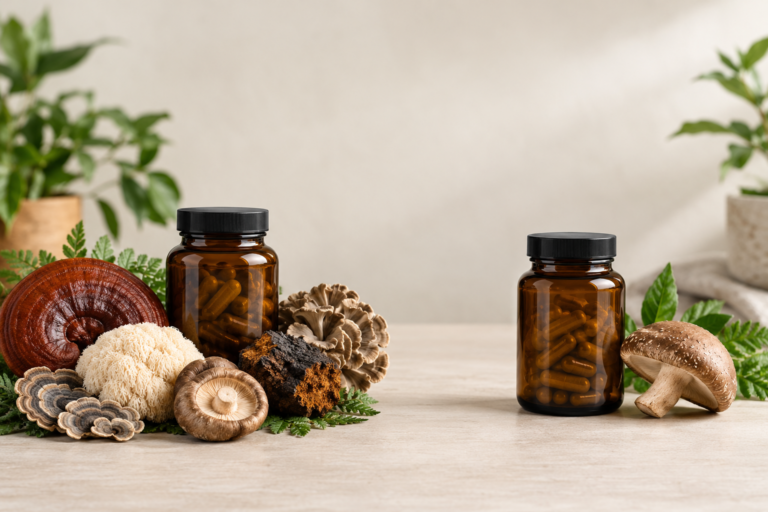
Walk through any functional mushroom collection and you will see two kinds of product side by side. Some bottles hold one mushroom, such as reishi or turkey tail. Others combine five, seven or even ten mushrooms in a single “complex”.
The blend sounds like better value. More mushrooms, one capsule. But a capsule only holds so much, and the more ingredients share that space, the less of each one you get. This guide explains how to tell whether a blend gives you meaningful amounts, when a complex is the sensible choice, and when single extracts work better.
What is the difference between a mushroom complex and a single extract?
A single extract contains one mushroom species at a stated dose. A mushroom complex combines several species in one product, so each mushroom gets a share of the total.
Single extracts are simple to read. If the label says 310 mg of turkey tail per capsule, that is what you get. You can compare it with the amounts used in research, and you know exactly what to credit (or blame) for how you feel.
Complexes trade that clarity for breadth. They are designed around the idea that different mushrooms bring different compounds, and that a little of several may suit general wellness. That idea is reasonable. The question is always how much of each mushroom the blend actually contains.
What is a proprietary blend, and why does it matter?
A proprietary blend is a group of ingredients listed under one combined weight. US rules require the total weight of the blend and the ingredients in descending order, but not the amount of each one.
Under the federal labelling rule for supplements (21 CFR 101.36), a blend must be identified as a proprietary blend, its total weight must be given, and the ingredients inside must be listed from most to least by weight. The FDA’s labelling guide confirms the same: the total weight is required, and the order shows which ingredient is most plentiful.
What the rule does not require is the weight of each individual ingredient. So a “1,000 mg Mushroom Blend” could, legally, be 900 mg of one mushroom and a few milligrams of six others. Brands use proprietary blends to protect their formulas, and many are honest. You simply cannot tell from the label alone.
How to read a blend label
Here is what to look for when you pick up a mushroom complex:
- Total blend weight per serving: Divide it by the number of mushrooms to get a rough average per ingredient. That is the best case for most of them, since the first few usually take the largest share.
- Ingredient order: The first mushroom listed is the largest by weight. Ingredients near the end may be present in very small amounts.
- Individual milligram amounts: Some brands list them even though they do not have to. That is a good sign.
- Extract or powder: Each ingredient should say “extract” and ideally name the part used (fruiting body or mycelium).
- Serving size: Check whether the stated amount is per capsule or per serving of two or more capsules.
When does a mushroom complex make sense?
A complex makes sense when you want general, everyday support, do not have one specific goal, and value the simplicity of taking one capsule instead of several.
Some situations where a blend is a sensible fit:
- You are new to mushrooms and want a gentle, broad starting point.
- Your goal is general immune support rather than one targeted area. Many immune-focused blends combine mushrooms such as reishi, maitake, shiitake and turkey tail, which are all traditionally used to support normal immune function.
- You already take several supplements and want to keep your routine short.
- You prefer one product to five separate bottles.
The trade-off is that you will not know which mushroom, if any, is doing the work for you. For many people that is fine. If you just want a simple daily habit, a well-made complex is a practical choice.
When are single mushroom extracts the better choice?
Single extracts are better when you have a specific goal, want a dose you can compare with research, or want to find out which mushroom actually suits you.
You have a clear focus
Different mushrooms are studied for different things. Lion’s mane is studied for cognition, cordyceps for energy and exercise, reishi for calm and evening routines, turkey tail for immune and gut health. If one of those is your focus, a full dose of the relevant mushroom usually makes more sense than a small share inside a blend.
You want a dose that matches the research
Human studies tend to use amounts that are hard to fit inside a multi-mushroom capsule. In a well-known Japanese trial, older adults with mild cognitive impairment took 3 grams a day of lion’s mane powder for 16 weeks. A 2023 pilot study in healthy young adults used 1.8 grams a day of lion’s mane, with mixed results: one faster reaction task, a trend towards lower stress, and several measures showing no change.
Those studies used different preparations from today’s extracts, so the numbers do not translate directly. But they show that research doses are often in the gram range, not a few milligrams. A blend that splits 300 to 500 mg across five or more mushrooms gives you a fraction of that for each.
You may need to avoid one ingredient
Some mushrooms carry specific cautions. Chaga is very high in oxalates, and a 2014 case report described kidney damage in a woman taking 4 to 5 teaspoons of chaga powder daily for six months. Reishi has rare reports of liver injury and may interact with blood thinners. If your doctor has flagged a concern about one mushroom, a blend that includes it is harder to manage.
How can you tell if each mushroom is at a meaningful dose?
You can tell by finding the milligrams per mushroom, checking whether each is an extract, and comparing the amount with what studies or the single-extract version of that mushroom provide.
Use this checklist:
- Find the per-mushroom amount. If it is not listed, divide the blend weight by the number of mushrooms for a rough upper limit on the smaller ones.
- Compare with a single extract. Endoca’s single extract capsules, for example, hold 280 to 400 mg of one species each. If a blend gives you 40 mg of that mushroom, you are getting a small fraction of a single capsule.
- Confirm it is an extract. “Mushroom powder” or “mycelium” is not the same as a concentrated extract.
- Look at beta-glucan, not just polysaccharide. Total polysaccharide tests can count starch from grain used to grow mycelium. A published method from McCleary and Draga separates starch from beta-glucan for exactly this reason.
- Ask for the Certificate of Analysis (COA). A batch report should confirm what the label says and test for contaminants. Our guide to reading a batch lab report walks through what to check.
- Count the “and more”. Long ingredient lists can look impressive while each ingredient is tiny.
Blend vs single extracts at a glance
| Factor | Mushroom complex | Single mushroom extracts |
| Number of mushrooms | Several in one capsule | One per product |
| Dose of each mushroom | Smaller share; may not be listed | Full stated dose of one species |
| Easy to match to research | Harder | Easier |
| Learn what works for you | Hard to tell which mushroom helps | Clear cause and effect |
| Routine | One capsule | One capsule per mushroom |
| Avoiding one ingredient | Difficult | Simple |
| Best for | Broad, everyday support | A specific goal or a personal trial |
Should you start with one mushroom at a time?
Yes, if you want to learn what actually works for you. Starting one mushroom at a time makes it far easier to notice benefits, spot side effects and decide what is worth keeping.
Here is a simple approach many people find useful:
- Pick one mushroom that matches your main goal. For a calm evening routine, that might be reishi. For focus, lion’s mane. Our lion’s mane benefits guide covers what the research does and does not show.
- Take it consistently for four to six weeks. Mushrooms are not fast acting in most people’s experience, and human trials usually run for weeks or months.
- Keep short notes. Sleep, energy, focus, digestion and anything unusual. A few words a day is enough.
- Add or swap one mushroom at a time. If you add two at once, you will not know which one made the difference.
- Then decide. If you end up wanting three or four mushrooms, a blend may be the tidier option. If one stands out, stick with it.
This approach also helps with safety. If something disagrees with you, you know which mushroom to stop.
Are mushroom blends and single extracts equally safe?
Neither format is automatically safer. A blend exposes you to more species at lower doses, while a single extract gives a higher dose of one. The real safety questions are your health, your medicines and the specific mushrooms involved.
Supplements in the US do not need FDA approval before they are sold, which is why quality checks matter. The NIH Office of Dietary Supplements points out that seals from USP, NSF International or ConsumerLab.com confirm quality testing, not safety or effectiveness.
Talk to a doctor or pharmacist before starting any mushroom product if you:
- Take blood thinners, diabetes medicines or immunosuppressants.
- Have a history of kidney stones or kidney problems (relevant to chaga).
- Have a liver condition (relevant to reishi).
- Are pregnant or breastfeeding, or have surgery coming up.
The NIH also recommends telling every healthcare provider about the supplements you take, including blends, since each ingredient counts.
How do Endoca’s mushroom complexes and single extracts compare?
Endoca makes both. Every Endoca mushroom extract is organic, made by hot water extraction, concentrated and dried into a powder, and filled into vegan cellulose capsules, with a COA available atlab.endoca.com.
The complexes
- Mushroom Immune Complex: a blend of maitake, reishi, turkey tail, shiitake, chaga and more, with 30 capsules per bottle (a month’s supply). It is positioned for immune support, with potential cognition and energy benefits.
- Organic Mushroom Immune Complex: organic maitake, reishi, shiitake, turkey tail and chaga, at 300 mg per daily serving, with 30 vegan capsules per bottle.
For the amount of each mushroom inside either complex, check the label or the batch COA rather than guessing.
The single extracts
If you prefer to go one at a time, Endoca’s singles include Red Reishi (280 mg per capsule), Turkey Tail (310 mg), Maitake extract (380 mg), Shiitake (350 mg), Chaga (370 mg), Cordyceps militaris (400 mg) and Lion’s Mane (350 mg).
A middle path
The Mushroom Mastery Ritual bundles separate jars of lion’s mane, the immune complex, turkey tail and red reishi. Because they come as individual jars, you can start with one, add the next when you are ready, and still end up with a broad routine.
Frequently asked questions
Is a mushroom complex better than a single mushroom?
Not automatically. A complex gives you several mushrooms in one capsule, which suits broad, everyday support. A single extract gives a larger, known dose of one mushroom, which suits a specific goal and makes it easier to tell what works. The better choice depends on your goal and on whether the blend lists meaningful amounts of each mushroom.
What does “proprietary blend” mean on a mushroom supplement?
It means several ingredients are grouped under one total weight. US labelling rules require that total and require ingredients to be listed in descending order by weight, but not the amount of each one. So you know which mushroom is most plentiful, but not how much of the others you get unless the brand chooses to list it.
How many mushrooms should a blend contain?
There is no ideal number. What matters is the amount of each mushroom, not the count. A blend of four or five mushrooms with listed milligrams per ingredient is often more useful than one with ten mushrooms sharing a small total weight. Divide the blend weight by the number of mushrooms to sense how thinly it is spread.
Can I take a mushroom complex and single extracts together?
Many people do, for example a complex for daily support plus a single extract for a specific goal. Check whether the same mushroom appears in both so you know your total intake. Add one product at a time, follow label directions, and speak with your doctor first if you take medicines or have a health condition.
Which mushroom should I start with?
Start with the one that matches your main goal. People often choose lion’s mane for focus, reishi for a calm evening routine, cordyceps for energy and activity, and turkey tail for immune and gut support. Take it consistently for four to six weeks and keep simple notes before adding another mushroom.