



 10Sep
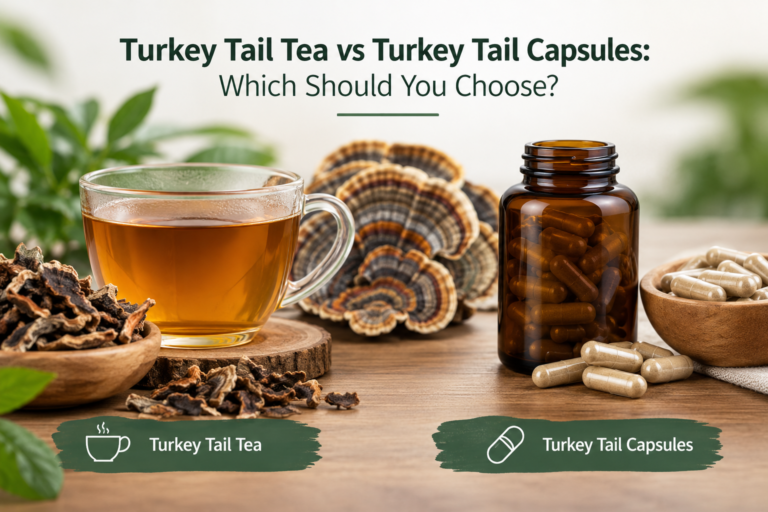
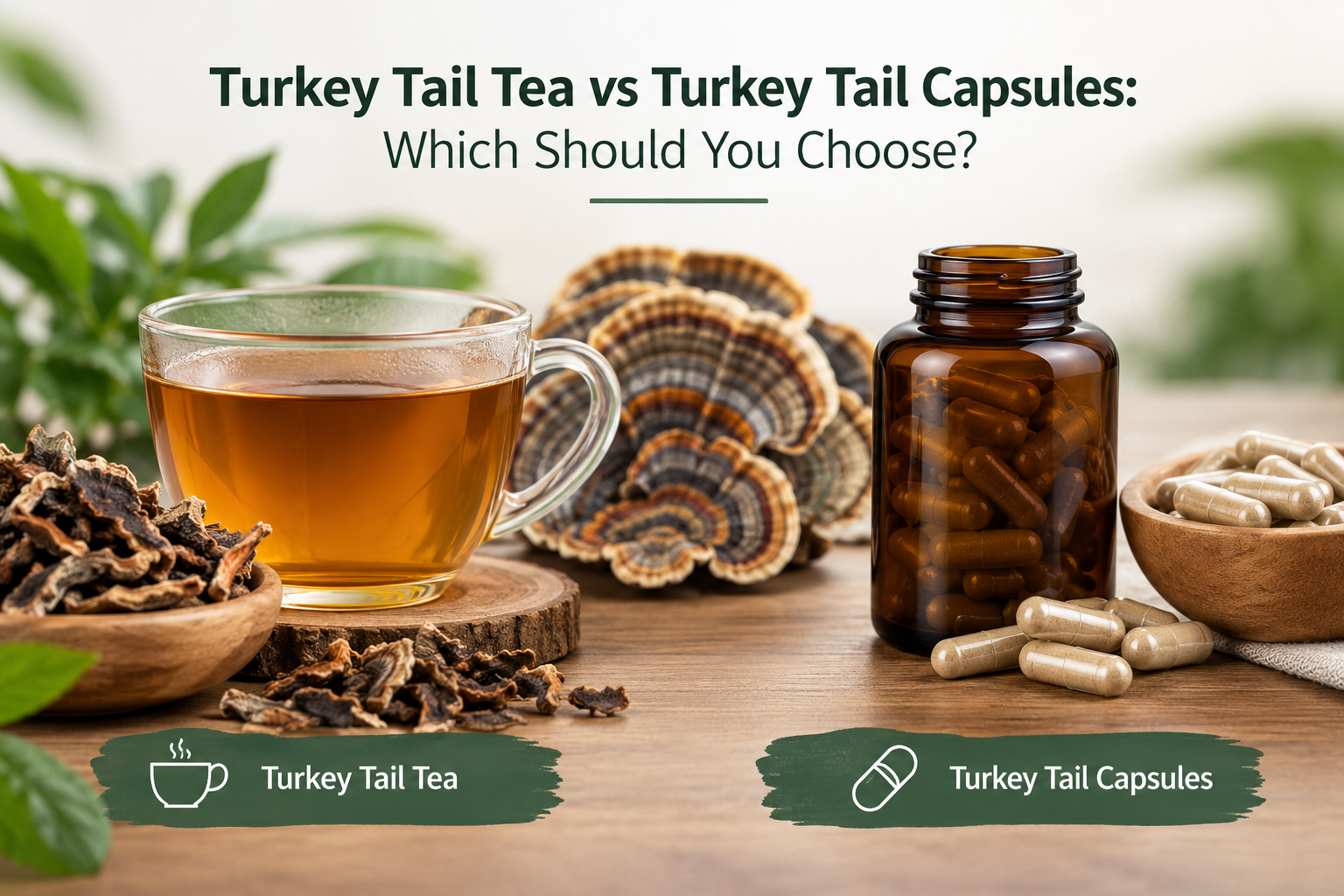
Quick answer: Choose turkey tail tea if you enjoy a slow ritual and want the traditional approach: dried mushroom simmered for an hour or more. Choose capsules if you want the same amount every day with no prep. Both rely on hot water to pull out polysaccharides, so a well-made tea and a hot water extract capsule are closer than most people think.
Turkey tail has been simmered into a dark, earthy brew for centuries, long before anyone put it in a capsule. Today you can still make that brew at home, or you can take a concentrated extract that has already done the simmering for you. If you have compared mushroom coffee with mushroom supplements, many of the same tradeoffs apply here.
A quick note before we start: Endoca sells turkey tail capsules, not turkey tail tea. We will still give you a genuinely useful tea method, because for some people tea is the better fit, and we would rather you choose the format that suits your life.
What is turkey tail tea, and how is it traditionally made?
Turkey tail tea is a decoction: dried pieces of the Trametes versicolor mushroom simmered in water for a long time, not steeped for a few minutes like green tea. In traditional Chinese practice, where the mushroom is called yun zhi, it was prepared this way because the fruiting body is too tough and woody to eat.
Why a decoction and not an infusion?
The useful compounds in turkey tail sit inside tough cell walls made largely of chitin and glucans. A quick steep in a mug barely touches them. Simmering gives heat and time a chance to soften the material and let water-soluble polysaccharides move out into the liquid.
A 2022 review of turkey tail polysaccharide extraction in the journal Foods explains this simply: heat causes the cells to swell, and through the combined effect of time and temperature, the polysaccharides slowly diffuse out. The same review notes that hot water extraction remains the most widely used method because it is simple and does less damage to the polysaccharides.
How long should you simmer turkey tail?
Plan on at least one hour at a gentle simmer, and up to two or three hours if you have the time. Longer, hotter extraction pulls out more polysaccharides, within limits.
In the laboratory studies summarised in that 2022 Foods review, hot water extractions of turkey tail ran at 80 to 100°C (176 to 212°F) for roughly 1.75 to 3 hours. The review also notes that, within a certain range, higher temperature and longer time improve the extraction rate. Some protocols extract the same material twice to get more out.
At home, that translates into a few practical habits:
- Keep the pot at a low simmer, not a hard rolling boil, so you do not boil it dry.
- Use a lid to limit evaporation, and top up with water if the level drops a lot.
- Try a second simmer with the same mushroom pieces and fresh water, then combine the two batches.
- Strain well through a fine sieve or cloth, since small fibres can be gritty.
How much dried turkey tail should you use per cup?
A practical starting point is about 3 to 5 grams of dried, chopped turkey tail per cup of finished tea. That is roughly one to two heaped teaspoons of small pieces, though weight is far more reliable than volume.
There is no official dose for turkey tail tea. For context, a clinical monograph from the Ontario Integrative Cancer Centre lists 9 to 15 grams of coriolus a day when decocted with water. Split across three cups, that works out to the same 3 to 5 grams per cup. The same document lists 2 to 6 grams a day for dried extracts, which shows how much more concentrated an extract is than raw mushroom.
If you are new to it, start with one cup a day at the lower amount and see how your stomach handles it. A simple batch method:
- Weigh 10 to 15 grams of dried, chopped turkey tail.
- Add it to about 4 cups (1 litre) of cold water in a lidded pot.
- Bring to a boil, then lower to a gentle simmer for 1 to 2 hours.
- Strain, return the pieces to the pot with fresh water, and simmer again if you like.
- Combine, cool and refrigerate. Use within a few days.
What does turkey tail tea taste like?
Turkey tail tea tastes mild, earthy and woody, with a faint bitterness. Most people describe it as more like a light broth than a herbal tea, and it is rarely unpleasant.
Because the flavour is gentle, it works well as a base. You can add a slice of fresh ginger, a cinnamon stick or a little lemon. Some people use it in place of water for soup or rice, which is a practical way to fit it into meals you already make.
If taste is a deal breaker for you, capsules sidestep the issue entirely. That is one of the most common reasons people switch.
Does tea or a capsule extract more polysaccharides?
It depends on how the capsule is made. A capsule of ground raw mushroom has not been extracted at all, so your gut has to do the work. A hot water extract capsule has already been through a process similar to a strong, well-controlled decoction, then concentrated and dried.
What a home decoction can and cannot do
Your tea will contain a share of the water-soluble polysaccharides, including beta-glucans. You cannot easily measure how much, and it will vary with the mushroom batch, your simmer time and the water to mushroom ratio. That is not a reason to avoid tea. It just means each cup is an estimate.
What a hot water extract capsule adds
A commercial hot water extract is made under controlled time, temperature and ratio, then concentrated into a powder. The quality depends on the maker, so look for products that report beta-glucan using a specific enzymatic test, such as the method published by McCleary and Draga in the Journal of AOAC International in 2016. That method separates true beta-glucan from starch, which a plain “polysaccharide” figure does not.
Turkey tail tea vs capsules: side by side
This table compares the two formats on the points people ask about most. It leaves out cost, since prices vary too much between sellers to compare fairly.
| Factor | Turkey tail tea (home decoction) | Turkey tail capsules (hot water extract) |
| Preparation | 1 to 3 hours of simmering, plus straining | None, swallow with water |
| Amount of mushroom used | About 3 to 5 g dried mushroom per cup | Concentrated extract, amount set by the label |
| Extraction | Hot water, at home, uncontrolled | Hot water, controlled and concentrated |
| Consistency | Varies batch to batch | Same amount per capsule |
| Taste | Mild, earthy, slightly bitter | Little or none |
| Testing | Usually none on your brew | Batch Certificate of Analysis possible |
| Travel and storage | Needs fridge, keeps a few days | Shelf stable, easy to carry |
| Ritual | Warm, slow, hands-on | Quick, easy to forget you took it |
Which format is more consistent and convenient?
Capsules win on both counts. Every capsule holds the same amount, you can carry them anywhere, and there is nothing to simmer or strain.
Consistency matters more than people expect. If you want to notice whether something is working for you, you need to take roughly the same amount every day for several weeks. Research on turkey tail tends to use fixed daily amounts for that reason. The 2014 gut microbiome trial by Pallav and colleagues, for example, gave volunteers a set amount of PSP from turkey tail over a period of weeks and found changes consistent with a prebiotic effect. That was a small study using an isolated compound, but it shows how research relies on measured, repeatable doses.
Tea, on the other hand, rewards people who enjoy the process. If making a pot on Sunday and drinking it through the week sounds pleasant, that routine can be its own form of consistency.
Is turkey tail safe in tea and capsule form?
Turkey tail is generally well tolerated in both forms. Memorial Sloan Kettering notes that it is generally safe to use in food and tea, and recommends talking with your healthcare provider before taking supplements, since supplements are stronger than culinary amounts.
Possible side effects
- Digestive upset such as nausea or loose stools
- Rarely, dark coloured stools or darkening of the fingernails, as listed by MSK
In a small phase I trial, Torkelson and colleagues gave women up to 9 grams a day of freeze-dried turkey tail mycelium for six weeks and reported that it was well tolerated.
Check with your doctor first if you
- Are pregnant or breastfeeding
- Are receiving chemotherapy, radiation or other cancer treatment
- Have an autoimmune condition or have had a transplant
- Take blood thinners, antiplatelet drugs or immunosuppressants
One more point worth knowing: the turkey tail research you see quoted online often involves PSK, a purified prescription extract used in Japan. The National Cancer Institute notes that the FDA has not approved medicinal mushrooms as a cancer treatment, and neither tea nor a supplement is a substitute for medical care.
Where does Endoca fit if you prefer capsules?
Endoca does not make turkey tail tea. We make an organic turkey tail mushroom extract in capsules, made from fruiting bodies, extracted with hot water, concentrated into a powder, with 310 mg per vegan cellulose capsule.
Every batch has a Certificate of Analysis at lab.endoca.com. We do not list a beta-glucan percentage on the product page, so check the label and batch COA for the details you care about, and our guide to reading a batch lab report will help you make sense of it.
If you want turkey tail alongside other mushrooms, the Mushroom Immune Complex blends it with maitake, reishi, shiitake, chaga and more. You can also learn how each of our mushroom extracts is made, or browse the full functional mushroom range.
Frequently asked questions
Can you make turkey tail tea from a capsule?
Some people open a capsule of hot water extract and stir it into warm water, but check the product label first, since directions differ between brands. An extract has already been simmered and concentrated, so you do not need to boil it again. It will taste mildly earthy. If the capsule contains plain ground mushroom rather than an extract, it will not dissolve well.
How long does turkey tail tea last in the fridge?
Homemade turkey tail tea is best used within about three to four days when kept covered in the refrigerator. It contains no preservatives, so treat it like homemade broth. If it smells sour, looks cloudy in an unusual way or grows anything on the surface, throw it out. Freezing it in portions is a good option for larger batches.
Can you reuse turkey tail pieces for a second batch?
Yes. Many people simmer the same pieces twice, and laboratory extraction methods often run a second extraction to pull out more polysaccharides. After the second simmer, the pieces have given up most of their water-soluble compounds and can be composted. Combining both batches gives you a more even tea than drinking them separately.
Is turkey tail tea or capsules better for gut health?
There is no direct comparison of the two. The main human gut study used PSP, an isolated turkey tail extract, which suggested a prebiotic effect in a small group of healthy volunteers. Both tea and hot water extract capsules deliver water-soluble polysaccharides, so the better choice is usually the one you will take consistently. Larger human studies are still needed.
Can you drink turkey tail tea every day?
Many people drink turkey tail tea daily, and Memorial Sloan Kettering describes it as generally safe in food and tea. Start with one cup a day, watch for digestive upset, and talk to your doctor first if you are pregnant, breastfeeding, taking blood thinners or immunosuppressants, or receiving cancer treatment. Long-term data in healthy adults remain limited.