 10Sep
10Sep
Quick answer: The best turkey tail supplement is a hot water extract of Trametes versicolor fruiting bodies, with beta-glucan (not just “polysaccharides”) measured by a specific enzyme test and a batch Certificate of Analysis you can read. Avoid products that rely on mycelium grown on grain without disclosing starch content, and remember that no supplement is the same as the Japanese drug PSK.
Turkey tail is one of the most researched mushrooms in the world, and also one of the most misunderstood on supplement shelves. If you have read our guide to how each functional mushroom extract is made, you already know that the part of the fungus used and the extraction method change what ends up in the capsule.
This guide walks you through what turkey tail actually is, why the famous research on PSK does not transfer neatly to a store-bought bottle, and the label checks that separate a quality extract from expensive powdered grain. We will also be honest about what the research shows and where it stops.
What is turkey tail, and why do people take it?
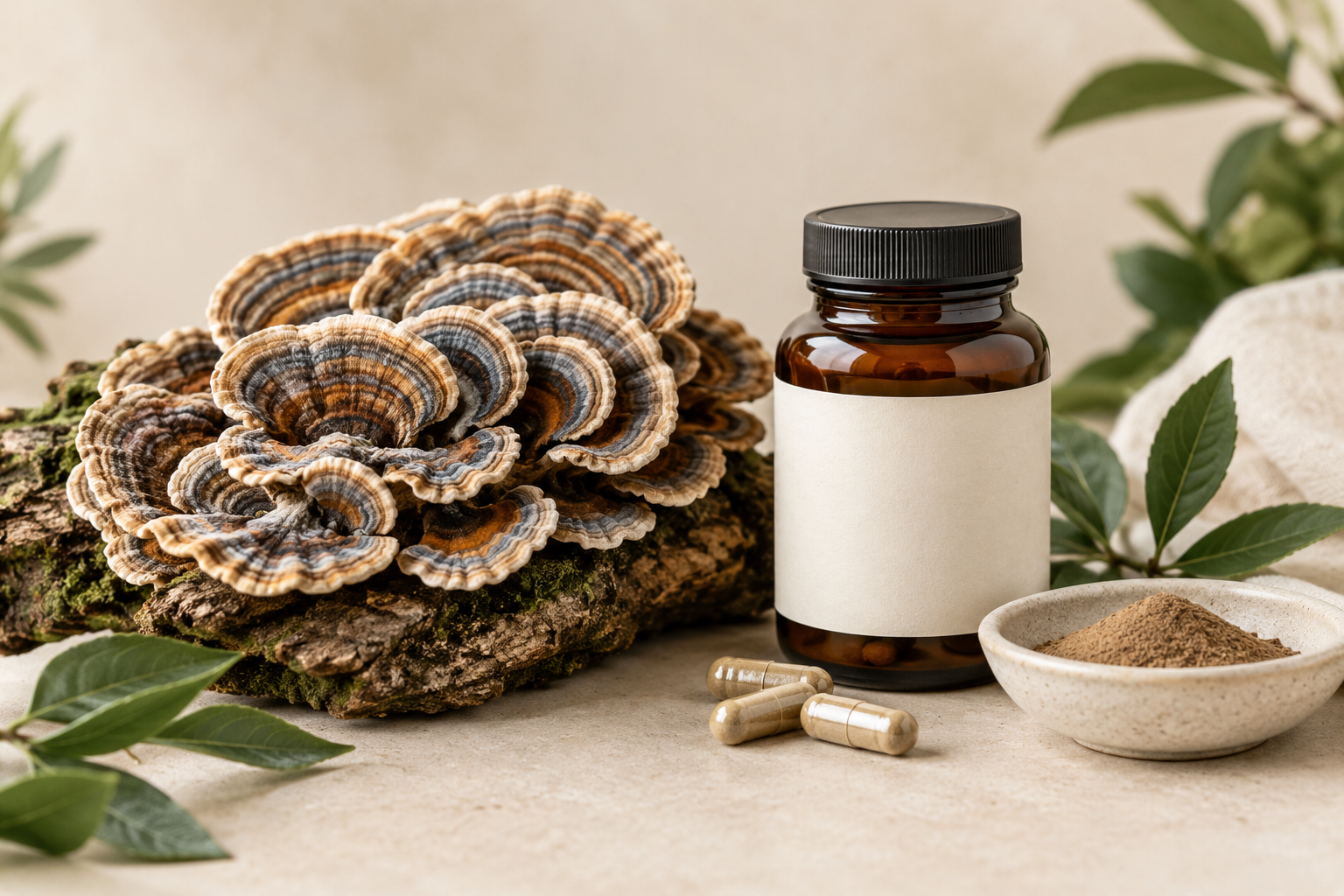
Turkey tail (Trametes versicolor, also sold as Coriolus versicolor or “yun zhi”) is a common shelf fungus that grows on dead hardwood. People take it mainly because it is rich in polysaccharides, including beta-glucans, that have been studied for their interaction with the immune system.
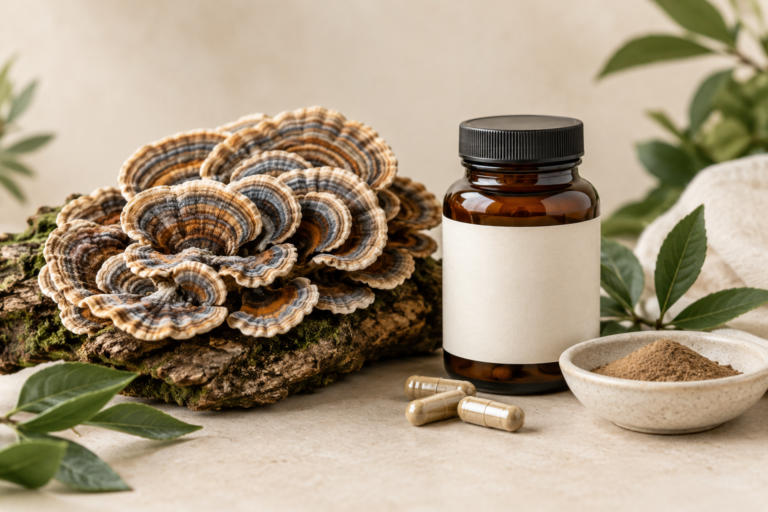
The fan-shaped caps have concentric bands of brown, tan, grey and sometimes blue, which is where the “turkey tail” name comes from. The mushroom is too tough to eat like a button mushroom, so it has traditionally been simmered into a tea or decoction in East Asian practice.
Most modern interest comes from two isolated compounds, PSK and PSP, and from research on beta-glucans more broadly. A supplement may support normal immune function as part of a balanced routine, but that is very different from the medical uses you may read about online.
Is a turkey tail supplement the same as PSK?
No. PSK (polysaccharide-K, sold as Krestin) is a proprietary, purified drug made from one specific strain of turkey tail mycelium, and it has been used alongside conventional cancer care in Japan since the mid-1970s. A dietary supplement is a different product, made a different way, and it is not tested or approved the same way.
What PSK and PSP actually are
According to the National Cancer Institute’s PDQ summary, PSK comes from a purified hot water extract of cultivated turkey tail mycelium, produced by the Kureha Corporation. PSP (polysaccharopeptide) is a related extract made in China, with a similar makeup but a different sugar composition. Both are protein-bound polysaccharides, and both are tightly standardised pharmaceutical materials.
Why that matters when you shop
Much of the human research on turkey tail used PSK or PSP, not a retail capsule. A 2022 Cochrane review of seven trials in people receiving colorectal cancer treatment found the evidence for PSK was mostly of low or very low certainty. Memorial Sloan Kettering also points out that the FDA has not approved coriolus extracts as a cancer treatment.
So when a supplement page quotes PSK survival data, treat it as background reading, not a promise about that bottle. An honest brand will tell you the same.
Fruiting body or mycelium on grain: which should you look for?
For most people, a fruiting body extract is the safer bet, because what you are paying for is the mushroom itself. Mycelium products can be excellent when grown in liquid culture and purified, but many retail “mycelium” powders are grown on grain and sold with that grain still in them.
The grain problem
When mycelium is grown on oats, rice or other grain, the whole block (fungus plus leftover grain) is often dried and milled. Grain is mostly starch, which is an alpha-glucan, not a beta-glucan. That starch still counts as “carbohydrate” or “polysaccharide” on many basic tests, so a grain-heavy powder can look impressive on paper while delivering far less of the mushroom compounds you wanted. The fix is a test that separates the two, which we cover below.
What “fruiting body” tells you
A fruiting body is the visible shelf of the mushroom. Extracts made from it contain the cell wall beta-glucans the research focuses on, without a grain substrate diluting them. That is why Endoca makes its turkey tail mushroom extract from fruiting bodies.
How do you verify what is really in the bottle?
Look for a beta-glucan figure measured with a specific enzymatic method, and confirmation that the raw material is genuinely Trametes versicolor. A big “polysaccharide” percentage on its own is not enough, because the gap between that number and true beta-glucan is where weak products hide.
Total polysaccharides vs beta-glucan
A “total polysaccharides” test counts many kinds of carbohydrate, and starch from grain can inflate the result. In 2016, Barry McCleary and Anna Draga published a method in the Journal of AOAC International that measures total glucan, then measures alpha-glucan (starch and glycogen) separately, and calculates beta-glucan as the difference. This approach, sold as the Megazyme mushroom and yeast beta-glucan kit, is now the reference most quality labs use.
What to ask the brand
- Which test method was used for the beta-glucan figure?
- Is the alpha-glucan (starch) figure also reported?
- Is the result from the current batch, and can you see the full report?
If a company cannot answer those questions, the polysaccharide claim on the label tells you very little.
Is it really turkey tail?
Mislabelling is possible. Several bracket fungi look like turkey tail at a glance, and identification errors are possible with wild harvested material. Reputable producers confirm species before extraction.
The best known look-alike is Stereum ostrea, often called false turkey tail. Mycologist Tom Volk of the University of Wisconsin-La Crosse explains the simplest check: true Trametes has tiny pores on the underside, while Stereum has no pores, just a smooth brown surface.
You cannot check the underside of a powder, so this is where documentation matters. Ask whether the raw material was identified by a qualified person or by testing, and buy from brands that grow or source their mushrooms under controlled conditions.
What does the research say about turkey tail and gut health?
The most interesting non-PSK human data concerns the gut. In a small randomised trial, PSP from turkey tail changed the gut microbiome in a way the authors described as prebiotic, meaning it fed beneficial bacteria.
The study, by Pallav and colleagues in Gut Microbes (2014), randomised 24 healthy volunteers to PSP, the antibiotic amoxicillin, or no treatment, and 22 completed it. PSP produced clear and consistent microbiome changes, while amoxicillin caused disruptions that were still present 42 days after the antibiotic stopped.
That is promising, but keep it in proportion. It was a small study, it used isolated PSP rather than a whole fruiting body extract, and it measured bacteria rather than symptoms or long-term outcomes. A turkey tail supplement may support a healthy gut environment, and larger trials are still needed.
How much turkey tail should you take?
There is no officially established dose for turkey tail. Follow the serving on your product label, start at the low end, and talk to your doctor if you plan to take large amounts.
For context, a phase I trial by Torkelson and colleagues (2012) gave women 3, 6 or 9 grams a day of freeze-dried turkey tail mycelial powder for six weeks and reported that it was well tolerated. A clinical monograph from the Ontario Integrative Cancer Centre lists 2 to 6 grams a day of dried extract, and 9 to 15 grams of mushroom when decocted as tea. These are research and clinical figures, not supplement directions.
Concentration matters more than raw weight. A gram of concentrated hot water extract is not the same as a gram of ground mushroom, which is why comparing milligrams between brands only works if both products tell you how they are made.
Is turkey tail safe, and who should check with a doctor first?
Turkey tail is generally well tolerated, and Memorial Sloan Kettering says it is generally safe in food and tea. Supplements are more concentrated, though, so some people should get medical advice first.
Reported side effects
- Digestive upset, such as nausea or loose stools (listed in the Ontario Integrative Cancer Centre monograph)
- Dark coloured stools and darkening of the fingernails, which MSK describes as rare
- In the Torkelson trial, most adverse events were mild
Talk to your doctor first if you
- Are pregnant or breastfeeding (MSK advises avoiding it until safety data are available)
- Are receiving chemotherapy, radiation or any cancer treatment
- Have an autoimmune condition, or have had an organ or bone marrow transplant
- Take blood thinners or antiplatelet drugs, or have a bleeding disorder
- Take immunosuppressant medication
- Have liver problems or plan long-term, high-dose use
Never use a supplement in place of treatment your doctor has recommended.
Quality checklist: what to look for on the label
Use the table below as a quick check before you buy any turkey tail product, from any brand.
| Label check | What a quality product shows | Red flag |
| Species | Trametes versicolor (or Coriolus versicolor) | No Latin name |
| Part used | Fruiting body, or mycelium with purification disclosed | “Mycelium” or “full spectrum” with grain not mentioned |
| Extraction | Hot water extract | Plain ground powder sold as an “extract” |
| Beta-glucan | Measured by an enzymatic beta-glucan method | Only “polysaccharides” listed |
| Starch | Alpha-glucan reported or low | Not reported, or grain listed in ingredients |
| Testing | Batch Certificate of Analysis you can download | No COA or a generic sample report |
| Claims | Structure/function wording | Claims to treat or cure disease, or PSK results quoted as the product’s own |
Third-party testing is the thread that ties all of this together. Our article on why independent lab testing matters explains the logic, and our step-by-step guide to reading batch lab reports shows you what to look for on a COA.
How does Endoca’s turkey tail extract fit?
Endoca’s Turkey Tail Mushroom Extract is made from organic Trametes versicolor fruiting bodies, extracted with hot water and concentrated into a powder, with 310 mg per vegan cellulose capsule. Every batch has a COA you can check at lab.endoca.com.
We do not print a beta-glucan percentage on the product page, so if that figure matters to you, check the label and the batch COA before you buy. That is the same standard we suggest you apply to any brand.
If you would rather take turkey tail alongside other mushrooms, the Organic Mushroom Immune Complex combines it with maitake, reishi, shiitake and chaga. You can see the full range in our functional mushroom collection.
Frequently asked questions
What is the best form of turkey tail supplement?
For most people, a hot water extract of turkey tail fruiting bodies in capsule form is the most practical choice. Hot water pulls out the polysaccharides that research focuses on, and capsules give you the same amount every day. Check that the label names Trametes versicolor, states the part used, and links to a batch Certificate of Analysis so you can confirm what you are getting.
Is turkey tail mycelium as good as fruiting body?
It depends on how the mycelium is grown. Mycelium cultured in liquid and purified can be a legitimate ingredient, and PSK itself comes from mycelium. Many retail mycelium powders, however, are grown on grain and sold with the grain included, which adds starch and dilutes beta-glucans. If a product uses mycelium, ask for its beta-glucan and starch results.
Can I take turkey tail every day?
Turkey tail has generally been well tolerated in studies lasting several weeks, and many people take it daily as part of their routine. Follow the serving on your product label and check with your doctor first if you are pregnant, breastfeeding, taking blood thinners or immunosuppressants, or receiving cancer treatment. Long-term safety data in healthy adults are still limited.
How long does turkey tail take to work?
There is no fixed timeline, because turkey tail is not a fast-acting product and effects are subtle. Research on the gut microbiome, such as the 2014 PSP trial, ran for about eight weeks. If you try a supplement, give it a consistent few weeks, keep notes on how you feel, and stop if you notice digestive upset or anything unusual.
Does turkey tail interact with medications?
Possibly. Clinical monographs advise caution with blood thinners and antiplatelet drugs, immunosuppressants, and cancer treatments, since turkey tail may influence immune activity. Memorial Sloan Kettering notes that herbal supplements can interact with medications and change how they work. If you take any prescription medicine, ask your doctor or pharmacist before adding turkey tail.