


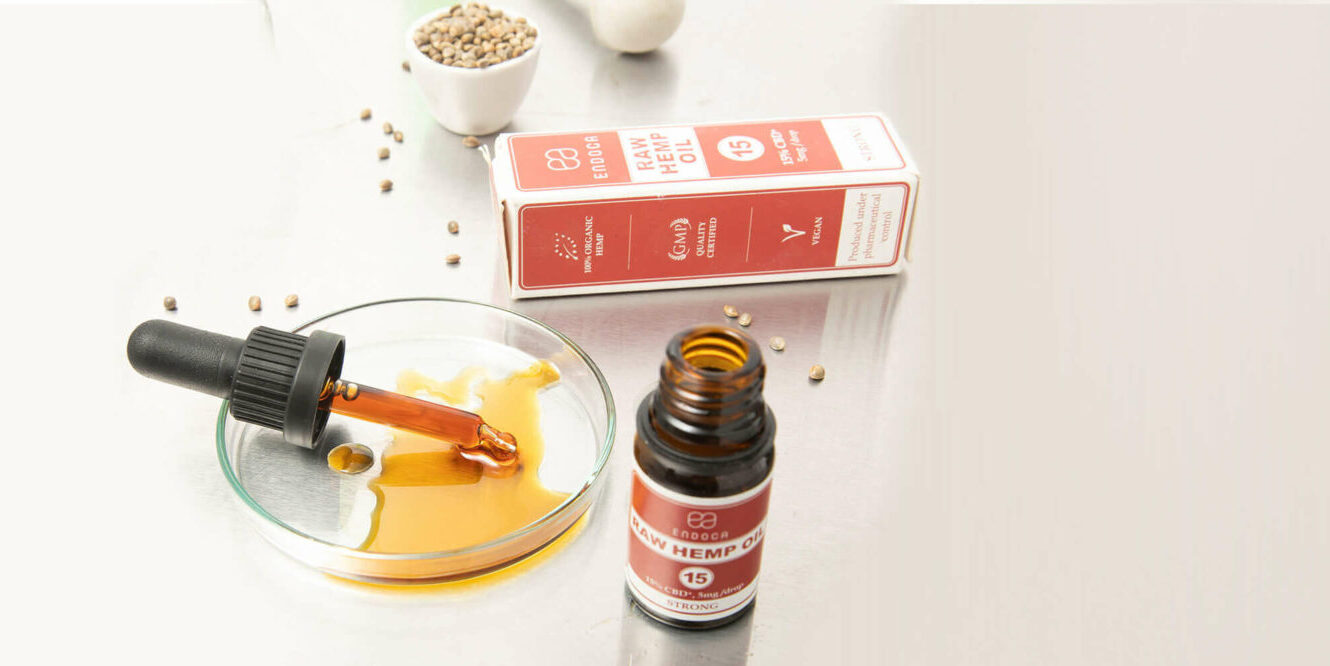




For most people CBD clears the body within two to five days. Half-life estimates range from about 1 to 11 hours for a single oral or sublingual serving, rising to 2 to 5 days after sustained daily use. How long you feel it is a different question entirely: effects typically last 4 to 6 hours from oil taken under the tongue.
Two questions people are usually asking at once
“How long does CBD stay in my system” almost always means one of two things. Either how long the effects last, which matters for timing your servings, or how long it remains detectable, which matters if you are tested at work. The answers are very different, so it is worth separating them.
Half-life, and what the research reports
Half-life is the time your body takes to clear half of a substance. It takes roughly four to five half-lives before a compound is essentially gone. A 2018 systematic review of human CBD pharmacokinetics pulled together the available figures, and the spread is wide:
| Route | Reported half-life |
| Oromucosal spray | 1.4 to 10.9 hours |
| Oral capsules | Around 3 hours |
| Smoked or inhaled | Around 31 hours |
| Intravenous | Around 24 hours |
| Chronic daily oral dosing | 2 to 5 days |
The important line is the last one. A single serving leaves fairly quickly. Take CBD every day and it accumulates in fatty tissue, which stretches clearance out considerably. That is also why the ranges published in different articles disagree so much: they are describing different people taking different amounts by different routes, and there is no single number that covers all of them.
How long the effects last
| Format | Onset | Duration |
| Oil under the tongue | 15 to 30 minutes | 4 to 6 hours |
| Capsules and edibles | 30 to 90 minutes | 6 to 8 hours |
| Inhaled | 2 to 10 minutes | 2 to 4 hours |
| Topical | 20 to 60 minutes | Localised, a few hours |
Capsules take longer to arrive because they pass through the digestive system and the liver before anything reaches your bloodstream. Oil held under the tongue absorbs partly through the mucous membrane, bypassing some of that, which is why it acts faster and fades sooner.
Why the format changes more than the timing
Half-life describes how quickly CBD leaves. Bioavailability describes how much of it got in to begin with, and the two together explain most of the disagreement you will find on this topic. Swallowed CBD passes through the liver before it reaches general circulation, and published estimates of oral bioavailability are low, frequently quoted at around 6%. Inhalation is considerably higher, in the region of 30%, which is why inhaled effects arrive within minutes and fade within hours. That is the practical reason a 25mg capsule and 25mg of inhaled CBD do not behave the same way, even though the label prints the same number on both.
What changes the numbers for you
How much and how often. A single 10mg serving behaves nothing like 50mg daily for six months, so check what your drops actually add up to. Frequency matters more than any single dose. Body composition. CBD is fat soluble and stores in fatty tissue, then releases slowly. That is what turns a matter of hours into a matter of days for regular users. Whether you took it with food. This is the underrated one. In a study of eight epilepsy patients, taking CBD with a high-fat meal raised peak blood levels roughly 14 times and total exposure around 4 times compared with taking it fasted. Same capsule, very different result. Your metabolism. CBD is processed by liver enzymes in the CYP450 family, which vary between people and are shared with a long list of medications. If you take prescription medicine, ask your doctor before adding CBD, particularly anything carrying a grapefruit warning.
Detection is a different question
Standard drug tests do not look for CBD. They look for THC-COOH, a metabolite of THC. So how long CBD stays in your system has very little bearing on a test result. What matters is the trace THC in full spectrum products. For occasional users, THC metabolites usually clear urine within a few days; for frequent heavy users the window can extend to several weeks. Broad spectrum products and CBD isolate remove the variable altogether.
Making the timing work for you
If you want steady levels, take CBD at the same times each day rather than only when you notice you want it. Consistency does more than a larger occasional serving. Take it with a meal containing some fat. Split the total across morning and evening if the effect fades before your next serving. And give any new routine at least a week before deciding whether to adjust, since the accumulation effect means the first day is rarely representative.
What giving it time actually means
Because CBD accumulates with repeated use, the first few days of a new routine are not a fair test of it. Levels are still climbing towards a steady state, which for most people takes several days of consistent daily servings. Judge a new product after a week or two at a consistent amount, taken at consistent times. If you change the strength, the format and the timing all at once, you will have no way of knowing which change did anything.
Frequently asked questions
How long does CBD stay in your system?
Usually two to five days for occasional use. Regular daily use at higher servings can extend that to a couple of weeks.
How long does it take for CBD oil to work?
Oil held under the tongue for 60 to 90 seconds usually takes effect within 15 to 30 minutes. Capsules and edibles take 30 to 90 minutes.
Does CBD build up in your body?
Yes. It is fat soluble and accumulates with daily use, which is one reason many people report a clearer effect after a week or two.
Does CBD stay in your system longer than THC?
No. THC metabolites are generally detectable far longer, and they are what tests are designed to find.
How long does CBD stay in your urine?
CBD itself is not what urine tests measure. THC metabolites are, and those range from a few days to several weeks depending on use.
Does CBD half-life differ between people?
Considerably. Dose, frequency, body composition, food and liver enzyme activity all shift it, which is why the published ranges are so wide.
Should I take CBD with food?
Yes, ideally with something containing fat. Absorption is substantially higher than on an empty stomach.