






No products in the cart.
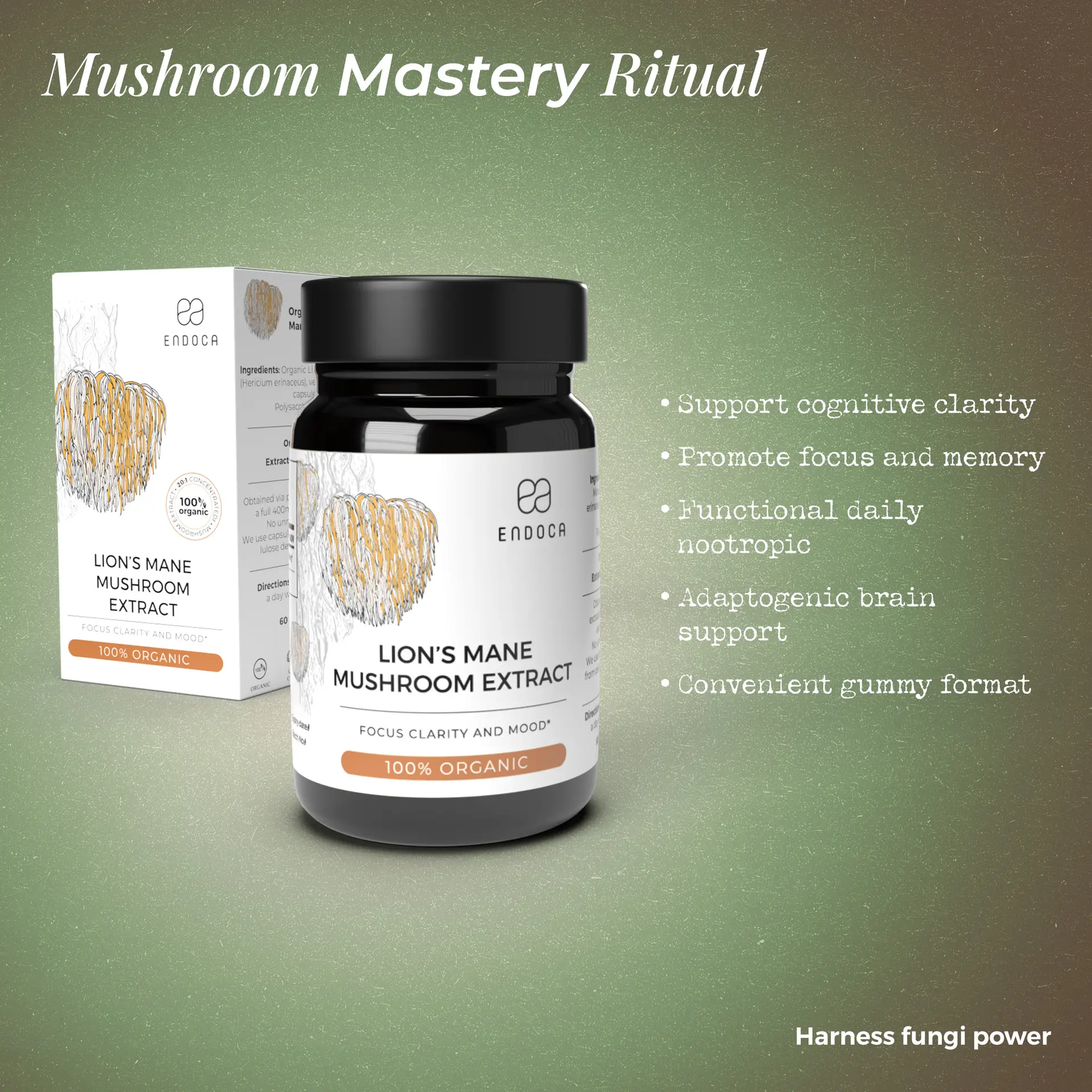
The lion’s mane benefits people look for are focus, mental clarity and nervous system support. Most of that interest traces back to two groups of compounds, hericenones and erinacines, which are studied for their effect on nerve growth factor. The research is genuine, and it is also small-scale and early.
This guide is for anyone deciding whether lion’s mane is worth adding to their routine. It covers what the mushroom is, what the evidence actually supports, how much people take, when to take it, who should avoid it, and how to tell a serious product from a weak one.
Lion’s mane benefits at a glance
Before the detail, here is an honest summary of what people take lion’s mane for and how strong the evidence behind each use currently is.
| What people take it for | What the research looks at | Strength of evidence |
|---|---|---|
| Focus and mental clarity | Small human trials of Hericium erinaceus extract measured against cognitive test scores | Early. Sample sizes are small and trials are short |
| Nerve and brain health | Hericenones and erinacines and their effect on nerve growth factor | Mostly laboratory and animal work, not confirmed in people |
| Mood and general wellbeing | A handful of small, short human studies | Very limited |
| Antioxidant support | Phenolic compounds measured in laboratory assays | Laboratory only |
| Immune support | Beta-glucans and other polysaccharides | Studied across functional mushrooms generally rather than lion’s mane specifically |
None of this means lion’s mane does nothing. It means the picture is still being assembled, and any source telling you the case is closed is overselling it.
What is lion’s mane?
Lion’s mane is a functional mushroom with a white, shaggy appearance that resembles a lion’s mane, which is where the name comes from. Its scientific name is Hericium erinaceus, and it grows on hardwood, often on beech and oak.
Unlike ordinary culinary mushrooms, it is valued for its naturally occurring compounds, including beta-glucans, hericenones and erinacines. Hericenones are found mainly in the fruiting body, the part of the mushroom you can see, while erinacines are found mainly in the mycelium, the root-like network beneath.
That split matters when you buy. A product made from fruiting body and a product made from mycelium do not contain the same compounds in the same proportions, so a label that does not tell you which it used is not telling you much.
Why is this mushroom so popular?
The rise in popularity comes mainly from its association with focus and mental clarity. Many people use lion’s mane as part of a morning routine to support productivity without relying on stimulants such as caffeine.
It has also benefited from being easy to fit into a day. It is available as capsules, powders, gummies and extracts, and because it works best with consistent use, most people take it daily as part of a long-term routine rather than reaching for it on demand.
Lions mane benefits
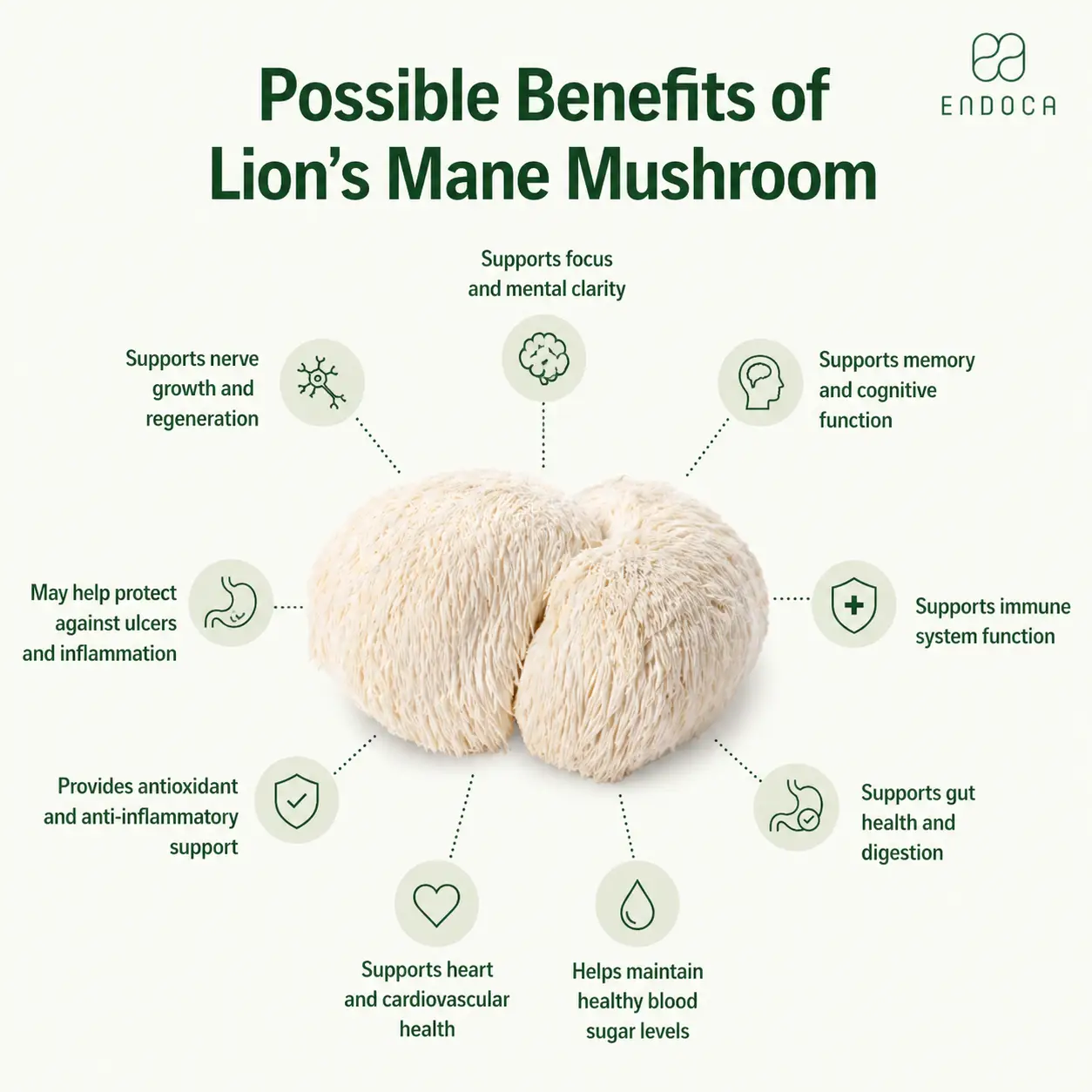
The benefits of lion’s mane are most often linked to cognitive support, nervous system health and general wellness. Here is what each of those means in practice.
1. Supports focus and mental clarity
This is the reason most people try it. Lion’s mane is commonly used by people who want support for concentration during studying, work and creative tasks. Small human trials have measured cognitive test scores in people taking Hericium erinaceus extract, and the results have been encouraging enough to justify larger studies without being conclusive on their own.
2. Supports brain and nerve health
Compounds such as hericenones and erinacines are researched for their potential role in nerve growth factor, or NGF, a protein involved in the growth and maintenance of nerve cells.
This is the part most often exaggerated online, so it is worth being precise. The NGF findings come largely from cell cultures and animal studies. They describe a plausible mechanism that researchers are actively investigating. They do not demonstrate that taking a lion’s mane capsule raises NGF in a human brain.
3. Provides antioxidant support
Like many functional mushrooms, lion’s mane contains phenolic compounds studied for their antioxidant activity, which is the body’s natural defense against oxidative stress. Most of this work has been done in the laboratory rather than in people.
4. Supports immune function
It contains polysaccharides, including beta-glucans, which are naturally occurring compounds often associated with normal immune system activity. Beta-glucans are the most studied compound class across functional mushrooms as a whole, from lion’s mane to turkey tail.
How does lion’s mane work?
Lion’s mane works through a combination of bioactive compounds rather than a single isolated ingredient. Whole mushroom extracts contain a wider matrix of nutrients and co-factors than any one purified molecule.
The mechanism researchers focus on is the hericenone and erinacine pathway and its relationship with nerve growth factor. Alongside that, the beta-glucan fraction is studied for its interaction with the immune system, and the phenolic fraction for antioxidant activity.
One practical point sits underneath all of this: the beta-glucans in mushrooms are locked inside chitin cell walls that humans do not digest well. Hot-water extraction breaks those walls down, which is why an extract and a raw ground powder are not equivalent products even at the same milligram weight.
Lion’s mane dosage: how much to take
There is no official recommended dose for lion’s mane. Commercial products typically fall somewhere between 500 mg and 3,000 mg per day, and human research has used amounts in a similar range. A small Japanese trial published in Phytotherapy Research in 2009, for example, used 3 grams a day of powdered lion’s mane over 16 weeks.
A few things are worth knowing before you compare labels:
- Powder and extract are not the same. A 1,000 mg extract can deliver considerably more of the studied compounds than 1,000 mg of raw powder. Compare extract ratios and stated beta-glucan content, not just total milligrams.
- Start at the lower end. Beginning at the bottom of a product’s stated range for a week or two lets you see how you respond before adjusting.
- Consistency beats quantity. The research is built on daily use over weeks, not on occasional large servings.
- Follow the product label. Concentrations vary enough between brands that a general figure is no substitute for the instructions on the bottle you actually own.
If you take prescription medication or have an existing health condition, speak to your doctor before starting lion’s mane or any supplement.
How long does it take to work?
Lion’s mane is not usually taken for an instant effect. Some people report improved focus or clarity within a few days, while others need several weeks of consistent use before they notice anything.
Responses vary with lifestyle, dose, product quality, sleep and individual biology. Most of the human research that exists ran for four to sixteen weeks, which is a reasonable guide to how long to give it a fair trial before deciding.
When is the best time to take it?
The best time to take lion’s mane is usually the morning or early afternoon. Because it is most often used for focus and mental performance, many people prefer taking it before work, studying or creative tasks.
It does not contain caffeine and is not a stimulant, so an evening dose is not a problem for most people. If your interest is winding down at the end of the day rather than sharpening up at the start, reishi is the mushroom more commonly used for that, and our guide to CBD and sleep covers another route people take. Always follow the usage instructions on the product label.
Side effects and who should avoid it
Lion’s mane is generally well tolerated, and reported side effects are uncommon and mild. The ones that do appear are worth knowing about.
- Digestive upset. Mild stomach discomfort is the most frequently reported effect, usually at higher servings or when starting too quickly.
- Allergic reactions. Lion’s mane is a mushroom. If you have a known mushroom allergy, avoid it. There are documented cases of skin reactions and breathing difficulty in sensitive individuals, and any allergic response is a reason to stop and seek medical attention.
Some people should be more cautious than others:
- Anyone with a known allergy to mushrooms or mold
- Anyone who is pregnant or breastfeeding, as there is not enough safety data to draw on
- Anyone taking prescription medication, particularly blood thinners or diabetes medication
- Anyone scheduled for surgery, who should mention all supplements to their surgical team
Speak to your doctor before adding lion’s mane to your routine, especially if you take prescription medication or manage an ongoing condition. This article is information, not medical advice.
Lion’s mane vs other nootropic mushrooms
Lion’s mane, cordyceps and reishi come up together constantly, but they are researched for different reasons and suit different parts of the day.
| Mushroom | Scientific name | Compounds studied | Commonly used for | Typical timing |
|---|---|---|---|---|
| Lion’s mane | Hericium erinaceus | Hericenones, erinacines, beta-glucans | Focus, mental clarity, nervous system support | Morning or early afternoon |
| Cordyceps | Cordyceps militaris | Cordycepin, adenosine | Physical stamina, energy, exercise routines | Morning or pre-workout |
| Reishi | Ganoderma lucidum | Triterpenes, beta-glucans | Calm, evening wind-down, general wellbeing | Evening |
They are frequently sold together in blends. That is fine when the label states how much of each species a serving contains, and much less useful when it lists a proprietary “mushroom complex” without amounts.
How to choose a high-quality lion’s mane supplement
Not all supplements are made the same. When choosing a product, look for clean ingredients, organic sourcing and a formula without unnecessary additives. A high-quality supplement should offer:
- Organic mushroom extract with the species named as Hericium erinaceus
- A clear statement of whether the fruiting body, the mycelium or both were used
- Clean-label ingredients with no artificial additives
- Plant-based capsules
- Clear usage instructions and a stated amount per serving
- Third-party testing for purity and contaminants
That last point is where most of the real difference sits. Mushrooms absorb what is in their growing substrate, so testing for heavy metals, pesticides and mycotoxins is not a luxury. Endoca screens raw material for more than 200 pesticides alongside heavy metals and mycotoxins using HPLC and NMR analysis, and publishes the results. You can read about our quality control process and check the lab test results for yourself.
If you are weighing a capsule against a mushroom drink, our comparison of mushroom coffee versus mushroom supplements goes through the trade-offs in detail.
Try Endoca lion’s mane
Endoca products are made for people who want clean, plant-based support for focus, clarity and daily wellness. Our organic mushroom extract comes in vegan capsules, which makes it straightforward to add to an existing routine.
If you would rather not take capsules, our functional mushroom gummies are an alternative format. You can also shop Endoca lion’s mane mushroom extract directly.
Final thoughts
Lion’s mane is one of the more interesting functional mushrooms for anyone focused on mental clarity and long-term wellness. The compounds are real, the mechanisms researchers are investigating are plausible, and the human evidence is still thin.
That combination argues for a specific approach: pick a product that names its species and its extraction, start at the lower end of the range, give it several weeks of consistent use, and judge it on your own experience rather than on a headline.
Frequently asked questions about lion’s mane
What are the main lion’s mane benefits?
People most often take lion’s mane for focus, mental clarity and nervous system support. Researchers study hericenones and erinacines for their relationship with nerve growth factor, and beta-glucans for immune activity. The human evidence behind these uses is small-scale and preliminary rather than settled.
How much lion’s mane should I take?
Commercial products generally fall between 500 mg and 3,000 mg per day, and human studies have used amounts in that range. Extracts and raw powders are not equivalent at the same weight, so compare stated beta-glucan content and follow the instructions on your specific product.
Can you take lion’s mane every day?
Daily use is the normal pattern, and it is how the mushroom has been used in the available research. Effects are associated with consistency over weeks rather than single servings. If you take prescription medication or have an ongoing health condition, check with your doctor first.
Does lion’s mane have side effects?
Reported side effects are uncommon and usually mild, most often digestive discomfort at higher servings. The important exception is allergy: lion’s mane is a mushroom, and anyone with a known mushroom allergy should avoid it. Stop and seek medical attention if you notice a skin or breathing reaction.
Is lion’s mane a nootropic?
It is commonly grouped with nootropics because of its association with focus and cognition, but it does not work like a stimulant and produces no immediate effect. It is better understood as a daily supplement studied for long-term nervous system support than as something you take before a deadline.
Sources and further reading
- Study on Hericium erinaceus extract and cognitive performance
- Review of lion’s mane and neuroprotective properties
- Research on glucans in lion’s mane mushroom
If you want to try lion’s mane, the sensible next step is to pick one product, commit to a consistent daily serving for four to six weeks, and see how you respond before changing anything else. Start with Endoca’s functional mushroom range and check the published lab results before you buy.





Comments are closed