






No products in the cart.
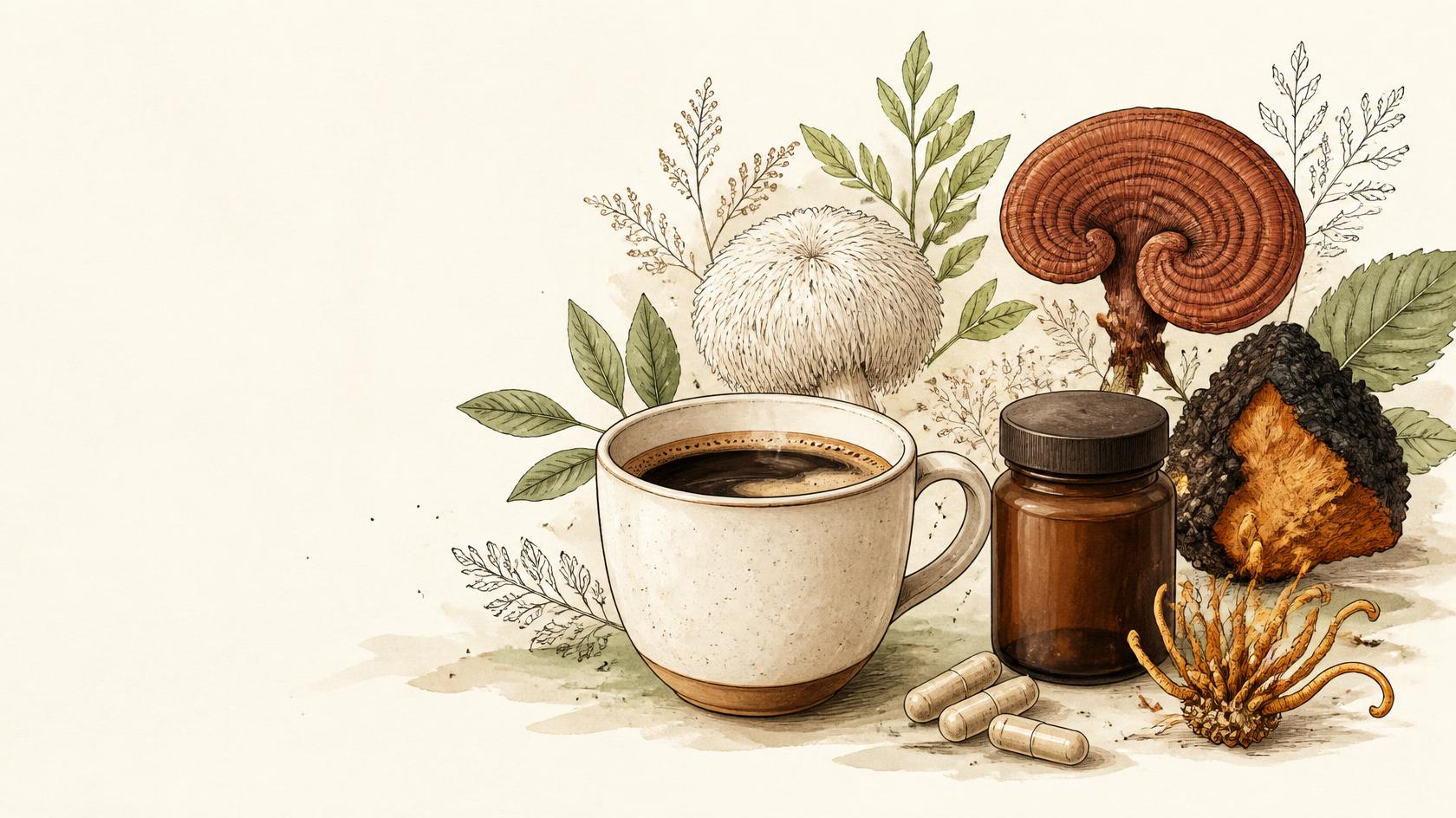
Mushroom coffee is the more convenient option, but a separate mushroom supplement gives you far more control over what you actually take. Coffee blends hide how much of each mushroom is in a cup. A dedicated supplement states the species, the extract type and the serving.
That is the short answer. The longer one matters if you care about beta-glucan content, caffeine, or whether heat destroys anything, so this guide works through both formats honestly: what each one is, what processing does to the compounds, and how to read either label properly.
What Is Mushroom Coffee?
Mushroom coffee is a coffee product containing powder or extract from one or more functional mushrooms. Common varieties include lion’s mane, reishi, chaga and cordyceps.
Some products are mainly coffee with a relatively small amount of mushroom powder. Others combine instant coffee with concentrated mushroom extracts. Two products both marketed as mushroom coffee can therefore have very different compositions.
The main advantage is convenience. Mushroom coffee slots into an existing morning routine without adding a step, and the flavor of the coffee makes the mushrooms more palatable than plain powder.
The main difficulty is knowing how much of each mushroom a serving contains. If the label lists only a proprietary “mushroom blend”, it will not tell you how much lion’s mane, reishi, chaga or cordyceps is in each cup.
What Is a Mushroom Supplement?
A mushroom supplement is taken separately from coffee and is commonly sold as capsules, powder, gummies or liquid extract.
Taking it separately usually makes it easier to identify the mushroom species and keep a consistent serving. You can explore Endoca’s selection of functional mushroom products and extracts to see how that is normally presented.
A clearly labeled supplement also makes it easier to work out:
- Whether the product contains one mushroom or a blend
- Whether it uses the fruiting body, the mycelium, or both
- Whether the ingredient is mushroom powder or an extract
- How much the recommended daily serving actually contains
- Whether the product has been tested for specific marker compounds
- Whether it has been tested for purity and unwanted contaminants
If you prefer a single species, Endoca offers products such as lion’s mane extract and cordyceps mushroom extract. Our guide to lion’s mane benefits covers what the research on that species currently supports.
Mushroom Coffee vs. Mushroom Supplements: What Is the Difference?
The difference is not simply drink versus capsule. It comes down to transparency, processing, caffeine and control over the daily serving.
| Mushroom coffee | Mushroom supplement | |
|---|---|---|
| Extract concentration | Usually low. Mushrooms share the serving with coffee and flavor components | Usually higher. The mushroom is the main ingredient |
| Dose transparency | Often unclear, especially with a proprietary blend | Normally stated per capsule or per measured serving |
| Caffeine | Usually present, and the amount depends on the coffee in the blend | None, unless deliberately added |
| Convenience | High. It replaces a drink you already make | High, but it is an extra step in the day |
| Taste | Coffee flavor masks the earthiness of the mushrooms | Capsules and gummies bypass taste entirely; loose powder does not |
| Cost per serving | Often lower per cup, but part of that cost is the coffee | Varies widely. Concentrated extracts cost more per serving and deliver more per milligram |
| Best for | People who want the ritual and are relaxed about exact amounts | People who want a defined serving, a chosen species, or no caffeine |
1. Mushroom Coffee Is a Blended Product
Mushroom coffee has to contain coffee, flavor components and mushroom ingredients. The mushrooms may therefore account for only a small part of the total serving.
When a manufacturer does not disclose the amount of each mushroom, comparing the product against a dedicated supplement becomes guesswork. In a mushroom supplement, the mushroom is the main ingredient, which generally makes a consistent daily serving easier to maintain.
2. Mushroom Coffee Often Contains Caffeine
Mushroom coffee is sometimes presented as an alternative to conventional coffee, but many products still contain caffeine. The exact amount depends on the type and quantity of coffee in the blend.
A separate mushroom supplement can be taken without coffee. That may suit you better if you are limiting caffeine or want to take your supplement at a different time of day.
3. Supplements Can Provide Clearer Serving Information
A capsule or a measured portion tells you how much you are taking. With mushroom coffee, intake varies with serving size, how much powder you use and how many cups you drink.
Format alone does not guarantee quality. Whether you choose mushroom coffee or a supplement, the product should have a transparent ingredient list and proper quality documentation behind it.
What Happens to Mushroom Compounds in Mushroom Coffee?
Functional mushrooms contain many different natural compounds. The most widely discussed are polysaccharides such as beta-glucans. Mushrooms also contain sterols, phenolic compounds, proteins, enzymes and species-specific molecules.
These compounds do not all react to heat in the same way. Some enzymes and other compounds are heat-sensitive and can be altered or reduced during processing. The effect depends on several factors:
- The mushroom species
- The individual compound
- The processing temperature
- The duration of heat exposure
- The extraction and drying methods
Mushroom coffee passes through several processing stages before it reaches the cup. The coffee beans are roasted, while the mushroom ingredient may be dried, ground, extracted or converted into an instant powder. The final product is then mixed with hot water.
The complete manufacturing process, not just the temperature of the water in your mug, is what determines the state of the finished product.
It would be inaccurate, though, to claim that all active mushroom compounds automatically disappear from mushroom coffee. Beta-glucans can remain present after heating, and hot-water extraction is itself a standard method for extracting polysaccharides from mushrooms. Research into the heat treatment of shiitake mushrooms indicates that temperature can alter their chemical profile without simply eliminating all beta-glucans.
A study of coffee prepared with Cordyceps militaris and lion’s mane also identified measurable bioactive substances in the finished beverage. That study does not show that mushroom coffee produces specific health benefits, but it does show why blanket claims about heat need qualifying.
Processing and heat may affect some of the natural compounds in mushrooms, but the extent depends on the compound and the manufacturing method. A separate, tested mushroom supplement gives you greater control over what you consume and in what quantity.
Is the Whole Mushroom Always Better Than an Extract?
“Whole mushroom” usually means a product made by drying and grinding the entire fruiting body. That can provide a broad range of naturally occurring components, but it does not automatically mean the product contains higher levels of the compounds you are interested in.
An extract is produced to make selected compounds more accessible or more concentrated. Hot-water extraction is standard for polysaccharides, while other methods suit other compound types. A properly manufactured full-spectrum extract can therefore be more targeted than ordinary mushroom powder.
Rather than asking only whether a product is whole mushroom or extract, ask:
- Which part of the mushroom is used?
- How has the mushroom been processed?
- Which compounds has the product been tested for?
- Is the daily serving clearly stated?
- Are proper quality reports available?
Advantages and Disadvantages of Mushroom Coffee
Potential Advantages
- Easy to fold into an existing coffee routine
- More palatable than plain mushroom powder
- Combines coffee and mushrooms in one product
Potential Disadvantages
- The quantity of each mushroom is often unclear
- It usually contains caffeine
- Intake varies with serving size and the number of cups you drink
- The mushroom ingredients may have been through several processing stages
- A proprietary blend is difficult to compare against a tested extract
Advantages and Disadvantages of Mushroom Supplements
Potential Advantages
- A clearer amount per serving
- Can be taken without coffee or caffeine
- Lets you choose a particular mushroom species
- Available as tested or standardized extracts
- Makes a consistent daily amount easier to maintain
Potential Disadvantages
- Quality varies significantly between manufacturers
- Terms such as “natural”, “whole” and “full-spectrum” are not evidence on their own
- The label still has to be read carefully
How to Choose a Mushroom Product
When comparing mushroom coffee and mushroom supplements, do not rely on the product name. Read the ingredient declaration, the manufacturing information and the supporting documentation.
Look for the Full Mushroom Name
The label should state both the common and Latin names, for example lion’s mane and Hericium erinaceus. That makes it possible to verify which species the product actually contains. The same applies to any other species in the blend, from cordyceps to turkey tail.
Check the Amount per Serving
Choose a product that states the quantity of each mushroom wherever possible. The total weight of a blend tells you nothing about how that weight is distributed between its ingredients.
Examine the Raw Material and Extraction Method
Look for information about fruiting body, mycelium, powder and extraction process. If a manufacturer promotes a standardized level of a particular compound, that figure should be backed by analysis you can see.
Prioritize Transparency and Testing
Quality is also about purity and consistency. Mushrooms take up what is in their growing substrate, so screening for heavy metals, pesticides and mycotoxins is essential rather than optional. Read about Endoca’s approach to quality control and see the third-party lab test results for each batch.
Mushroom Coffee or Mushroom Supplements: Which Should You Choose?
Mushroom coffee may suit you if you mainly want a convenient drink and enjoy the combination of coffee and mushrooms. In that case the flavor and the daily ritual are a genuine part of the product’s value.
A separate mushroom supplement is likely to suit you better if you want a clearly defined serving, want to avoid caffeine, or prefer a particular species and extract type.
The point is not that mushroom coffee contains no active compounds. It is that a separate, well-documented supplement generally offers more transparency and more control, without the extra variable of how you brewed your coffee that morning.
You can explore Endoca’s full range of functional mushroom extracts, or try functional mushroom gummies if you want an alternative to capsules and mushroom drinks.
Frequently Asked Questions About Mushroom Coffee
Is Mushroom Coffee the Same as a Mushroom Supplement?
No. Mushroom coffee is a coffee blend containing mushroom powder or extract, so the mushrooms share the serving with coffee and flavor components. A mushroom supplement is taken separately, with the mushroom as the main ingredient, which usually makes the species, the extract type and the serving size much easier to identify.
Does Mushroom Coffee Have Any Benefits?
The clearest benefit is practical: it makes functional mushrooms easy to take daily, and the coffee flavor masks the earthy taste. Whether it delivers meaningful amounts of the studied compounds depends entirely on how much mushroom extract is in each serving, which many labels do not disclose.
Do Beta-Glucans Disappear in Mushroom Coffee?
Not necessarily. Processing can alter the structure or the measured properties of beta-glucans, but they do not automatically vanish during normal preparation. Hot water is itself a standard method for extracting mushroom polysaccharides. The bigger unknown is usually how much mushroom extract the blend contained to begin with.
Why Choose Capsules Instead of Mushroom Coffee?
Capsules give you a more consistent serving and can be taken without coffee or caffeine, at whatever time of day suits you. The capsule format is not a guarantee of quality on its own. The raw material, the extraction method, the testing and the product declaration all still matter.
Can Everyone Take Functional Mushrooms?
No. Mushroom supplements are not suitable for everyone, and anyone with a mushroom allergy should avoid them. Follow the product instructions and speak to a doctor or pharmacist if you are pregnant or breastfeeding, have a medical condition, are preparing for surgery, or take prescription medication.
Conclusion
Mushroom coffee is a convenient way to combine coffee with functional mushrooms, but the category does not make it easy to judge the quantity, quality or processing of the mushroom ingredients.
Some natural compounds are altered by heat and repeated processing. Others, including beta-glucans, do not simply disappear. If you want control over the species, the extract type and the daily serving, a clearly labeled and tested mushroom supplement is the more targeted choice.
Look for transparent ingredients, real analysis and documented quality control rather than broad wellness promises. If you would like an alternative to mushroom coffee, start with Endoca’s functional mushroom gummies and check the published lab results before you buy.




Comments are closed