
- Shop
- About Us
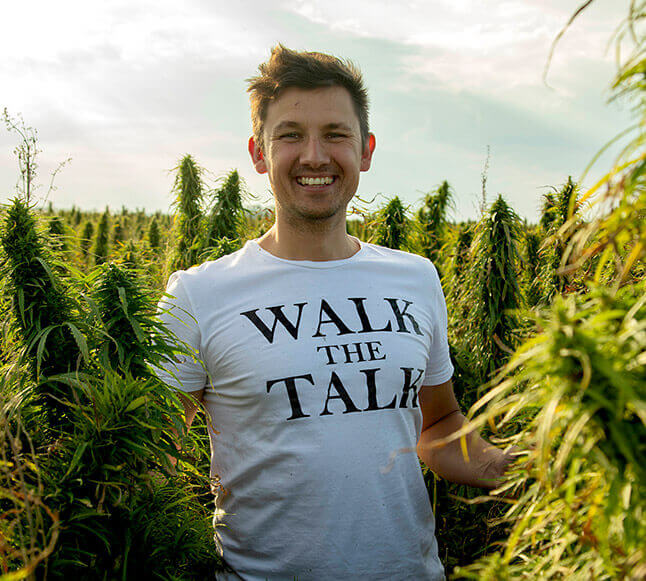
Our Story
From humble beginnings to a global mission – we grow, harvest, and craft hemp with care for people and planet.
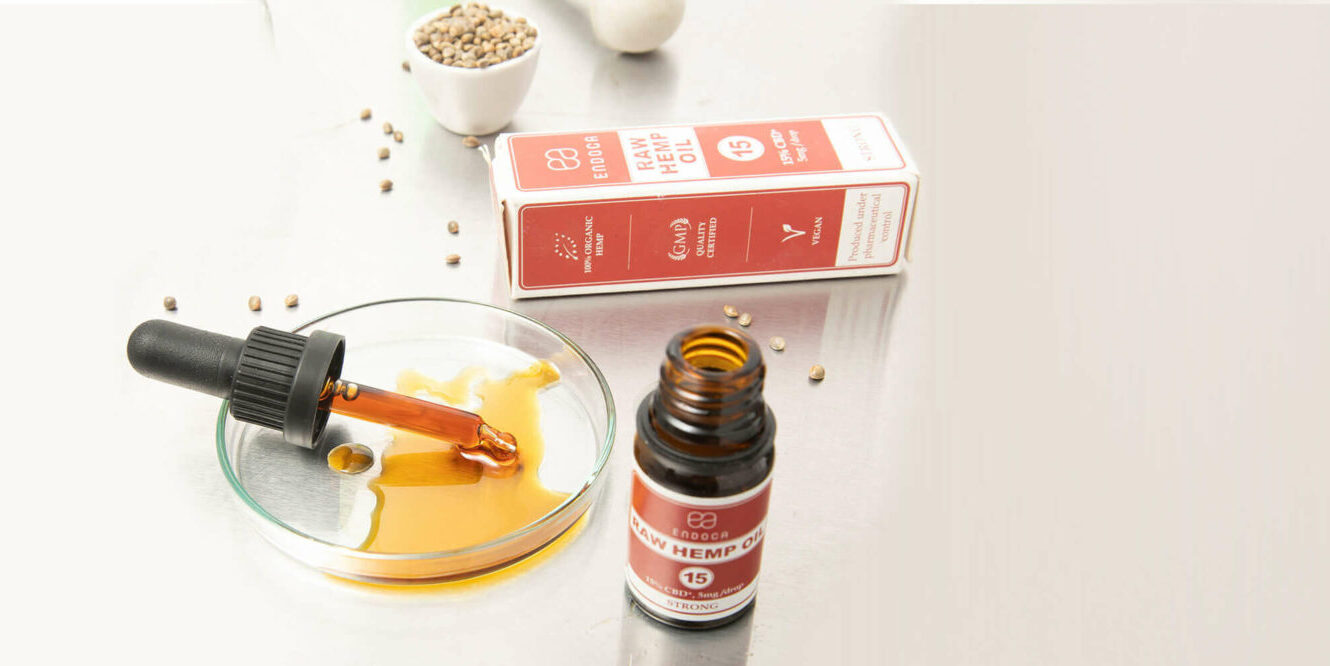
What Is CBD?
CBD is nature’s way to restore balance, calm, and overall well-being – naturally and without the high.
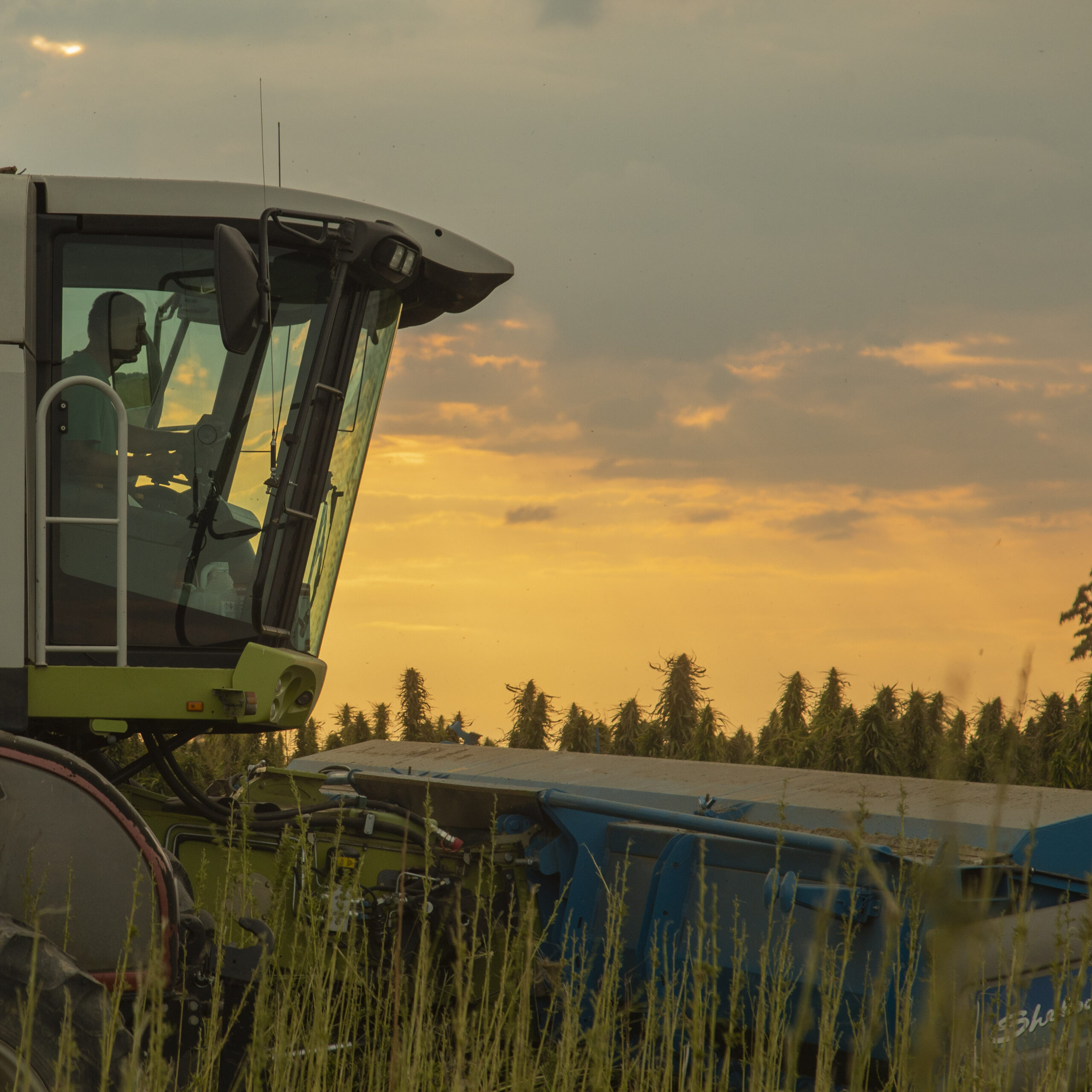
The Process
From seed to shelf, we grow organically, extract cleanly, and follow strict quality standards for purity.
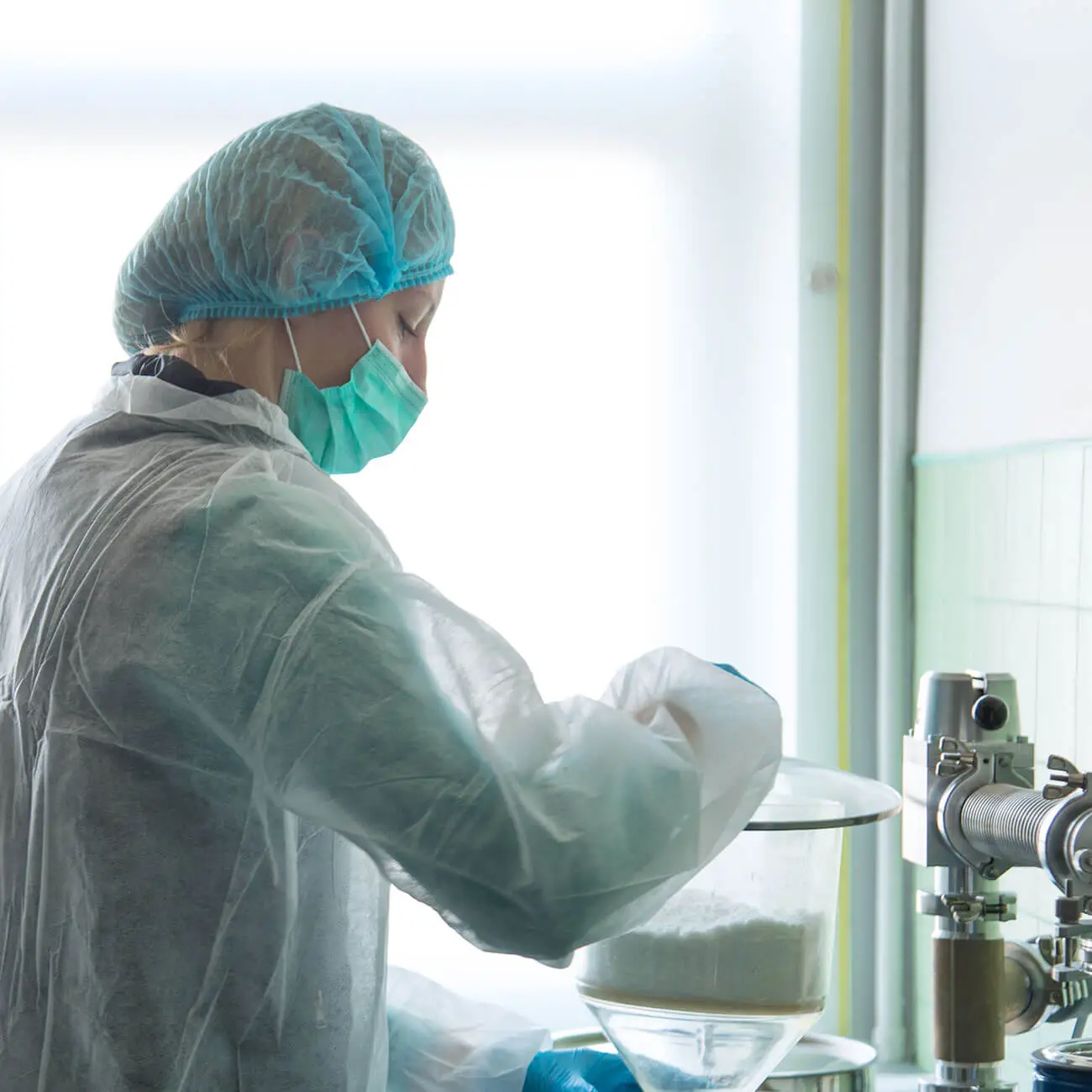
Lab Testing
Every batch is third-party tested to ensure purity, safety, and the exact amount of CBD every time.
Our Values
Sustainability, transparency, and wellness guide every decision – for you and for the planet.
At a glance
The disagreement worth knowing about: distillate is a process, not a profile
Both materials start the same way. Hemp is extracted, usually with CO2 or ethanol, then winterised in cold ethanol to drop out waxes and lipids. The extract still carries its acid forms at that point, so it is heated, which drives decarboxylation and converts CBDa to CBD and THCa to THC.
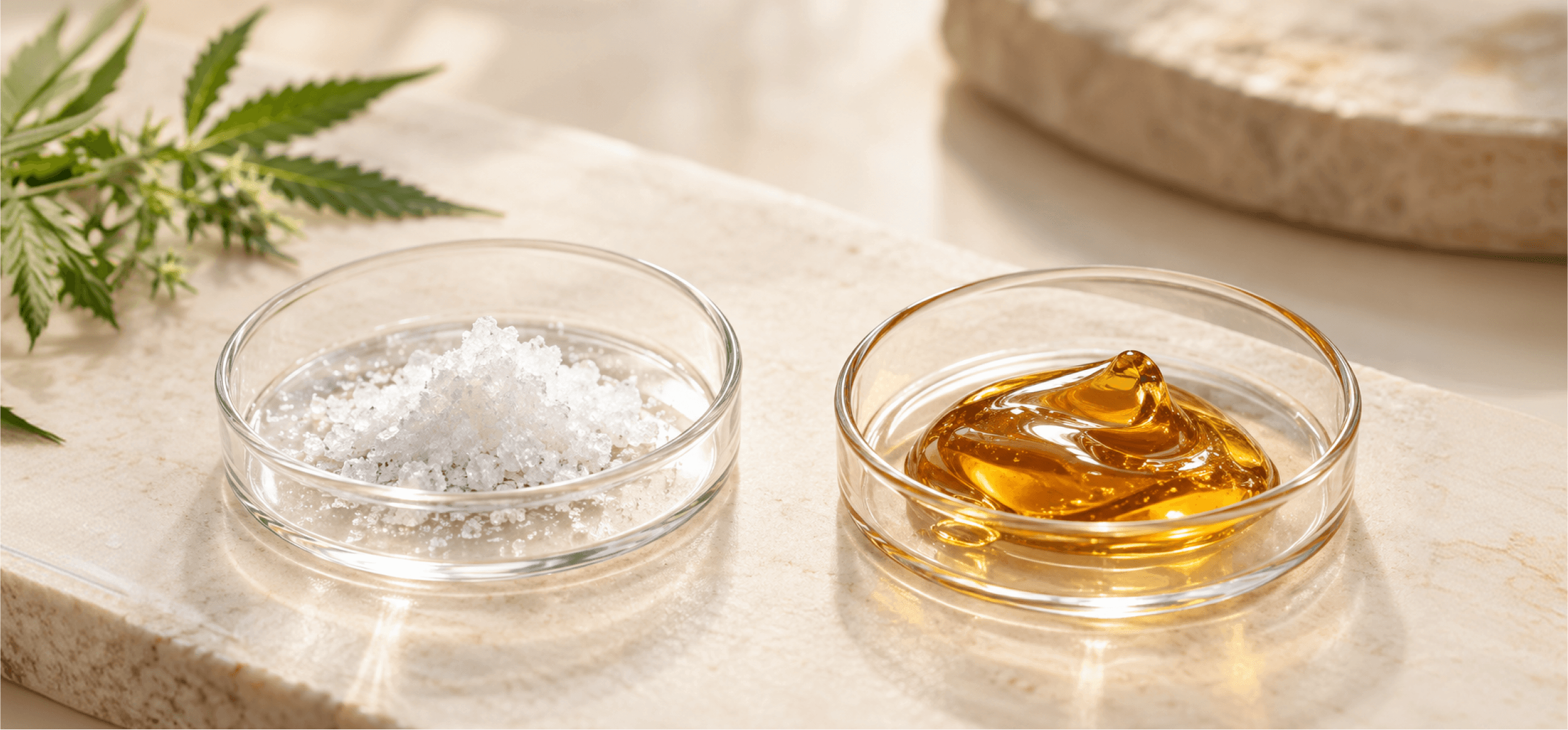
Distillation is the next step. Under vacuum, in short path or wiped film equipment, fractions come off in order of boiling point. Terpenes are lightest and leave first, which is why distillate is low in terpenes unless some are added back. The main fraction is a thick amber material usually reported between 70 and 90 percent total cannabinoids.
Isolate carries on past that point: chromatography to separate CBD from everything that elutes near it, including THC, then crystallisation from solvent. The word distillate therefore tells you little: it names the equipment and the separation principle, not what ended up in the jar. Broad spectrum distillate makes it worse, because it means a distillate put through a further THC removal step, a claim about process rather than a defined composition.
Where the 99 percent figure matters, and where it does not
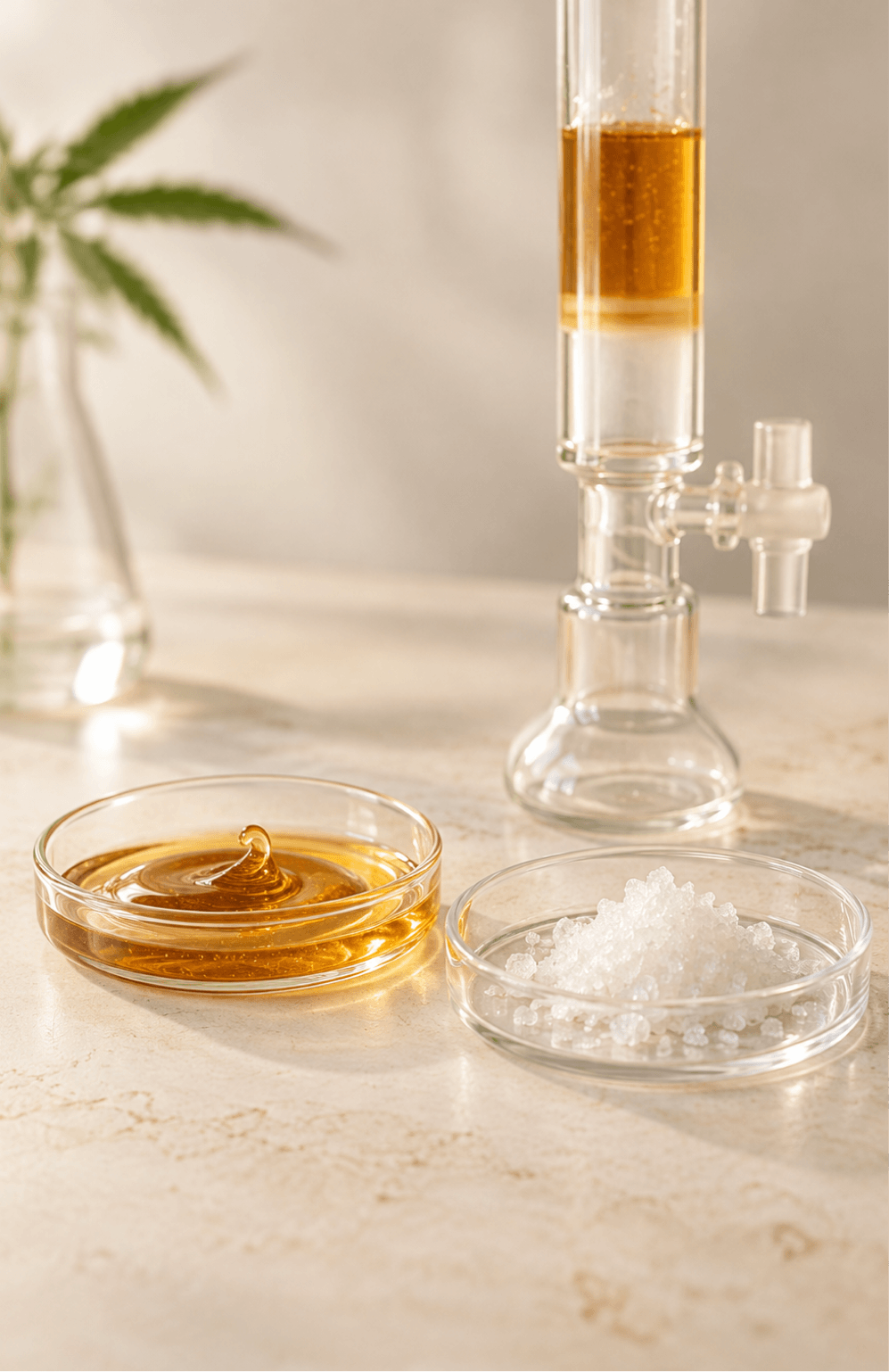
Purity is the one claim here that is genuinely checkable. A 99 percent isolate is a single analyte measured against a reference standard, and a laboratory either confirms it or does not. The equivalent figure on a distillate, 80 percent for instance, is a total cannabinoid number: the sum of a set, saying nothing about which members are present or in what proportion. Those are different kinds of claim, routinely compared as if they were one.
Labels here are also unreliable. In a 2022 analysis of 80 commercial hemp derived CBD products by LC-MS/MS, 37 held CBD concentrations more than 10 percent away from the label claim, 12 below 90 percent of the stated amount and 25 above 110 percent.
Purity stops being useful when it is treated as a proxy for effect. No human study has measured whether a more purified CBD performs differently from a less purified one. One thing both share, and neither markets: decarboxylation happens before distillation and crystallisation, so both carry very little CBDa. If CBDa is what you want, the product is a cold processed raw extract.
What the research shows, and does not
The limitation covers both columns: nobody has run the study. Purity has trial data only because the pharmaceutical route used a purified molecule, not because anyone tested purity against an extract. Distillate has no human data, and the breadth it is sold for rests on a hypothesis a 2024 review calls unproven.
What people get wrong
Choosing between them
You rarely buy either directly. They are ingredients: the choice reaches you as the formulation behind a finished oil, capsule or topical. What matters is control. An isolate based product has one cannabinoid at a known amount, no THC and no hemp taste, which helps if THC is a problem or if you are working out what is doing what.
A distillate based product gives you minor cannabinoids alongside the CBD, at proportions the term does not pin down. If that is what you want, ask for the batch cannabinoid table rather than accepting the category name.
Legal status and safety
CBD extracts are novel foods in the UK under Regulation (EU) 2015/2283 as retained in UK law, and isolate based and distillate based products are treated the same way. The Food Standards Agency keeps a public list of CBD products that may legally be sold while authorisation applications are assessed; a product not on that list, or marked as removed, must be withdrawn.
No health claim for CBD is authorised under Regulation (EC) 1924/2006. Nobody, including us, may state or imply that an isolate or a distillate treats, prevents or improves anything, however pure the material. Every figure here is a measurement or a published finding.
The FSA advises that healthy adults take no more than 10 mg of CBD a day, a figure from a joint position of the Advisory Committee on Novel Foods and Processes and the Committee on Toxicity. CBD is not recommended for under 18s, anyone on medication or people pregnant or breastfeeding, unless under medical direction.
THC is a controlled drug under the Misuse of Drugs Act 1971, and consumer CBD products rely on the exempt product criteria in the Misuse of Drugs Regulations 2001, allowing no more than 1 mg of a controlled drug per container. The FSA also gives a safe upper intake of 70 micrograms of delta-9 THC a day. A distillate retaining THC must be formulated against those limits; an isolate starts from material where THC was removed.
How Endoca tests for this
Our hemp is grown on our own farm and extracted by us, as it has been since 2010. CBD Isolate 1000mg, at 99 percent cannabidiol, starts from that crop rather than a purchased drum, and its certificate reports the single analyte against a reference standard, THC below the laboratory’s reporting limit.
On the extract side, every batch certificate reports CBD and CBDa separately alongside THC and THCa, the only way to tell how far decarboxylation went and to check a product against the 1 mg per container limit. What a certificate cannot grade is breadth, so we report what we measured and stop there.
Frequently asked questions
No. Per milligram of CBD, isolate is the more concentrated material at 99 percent or higher against roughly 70 to 90 percent total cannabinoids for distillate. The difference is what else is present, and no human study has measured whether that matters.
Very little. Distillation is preceded by decarboxylation and run hot, so the acid forms have largely converted to their neutral partners by the time the fraction is collected. If CBDa is what you want, a cold processed raw extract is the product.
It means the laboratory quantified cannabidiol against a reference standard and found at least 99 percent of the sample by mass. That is a composition result for one named compound, and it is not comparable to a distillate’s total cannabinoid figure.
Both, depending on the product. Isolate is used where no THC and no hemp flavour are wanted, such as a flavoured oil or a cosmetic base, and distillate where a broader cannabinoid profile is wanted. The batch certificate is the way to tell.
References
Devinsky O, Cross JH, Laux L, et al. Trial of Cannabidiol for Drug-Resistant Seizures in the Dravet Syndrome. N Engl J Med 2017;376(21):2011-2020.
Devinsky O, Nabbout R, Miller I, et al. Long-term cannabidiol treatment in patients with Dravet syndrome: An open-label extension trial. Epilepsia 2019;60(2):294-302.
Lazarjani MP, Young O, Kebede L, Seyfoddin A. Processing and extraction methods of medicinal cannabis: a narrative review. J Cannabis Res 2021;3(1):32.
Wang M, Wang YH, Avula B, et al. Decarboxylation Study of Acidic Cannabinoids: A Novel Approach Using Ultra-High-Performance Supercritical Fluid Chromatography/Photodiode Array-Mass Spectrometry. Cannabis Cannabinoid Res 2016;1(1):262-271.
Johnson E, Kilgore M, Babalonis S. Label accuracy of unregulated cannabidiol (CBD) products: measured concentration vs. label claim. J Cannabis Res 2022;4(1):28.
Millar SA, Stone NL, Yates AS, O’Sullivan SE. A Systematic Review on the Pharmacokinetics of Cannabidiol in Humans. Front Pharmacol 2018;9:1365.
Simei JLQ, Souza JDR, Lisboa JR, et al. Does the Entourage Effect in Cannabinoids Exist? A Narrative Scoping Review. Cannabis Cannabinoid Res 2024;9(5):1202-1216.
De Petrocellis L, Ligresti A, Moriello AS, et al. Effects of cannabinoids and cannabinoid-enriched Cannabis extracts on TRP channels and endocannabinoid metabolic enzymes. Br J Pharmacol 2011;163(7):1479-1494.
Food Standards Agency. Cannabidiol (CBD) guidance, including the public list of CBD products and the 10 mg a day advice for healthy adults. Updated 28 August 2026.
Last reviewed 6 October 2026.
These statements have not been evaluated by the Food and Drug Administration. This product is not intended to diagnose, treat, cure, or prevent any disease.