No products in the cart.

- Shop
- About Us
Our Story
From humble beginnings to a global mission – we grow, harvest, and craft hemp with care for people and planet.
What Is CBD?
CBD is nature’s way to restore balance, calm, and overall well-being – naturally and without the high.
The Process
From seed to shelf, we grow organically, extract cleanly, and follow strict quality standards for purity.
Lab Testing
Every batch is third-party tested to ensure purity, safety, and the exact amount of CBD every time.
Our Values
Sustainability, transparency, and wellness guide every decision – for you and for the planet.
At a glance
What these two actually are
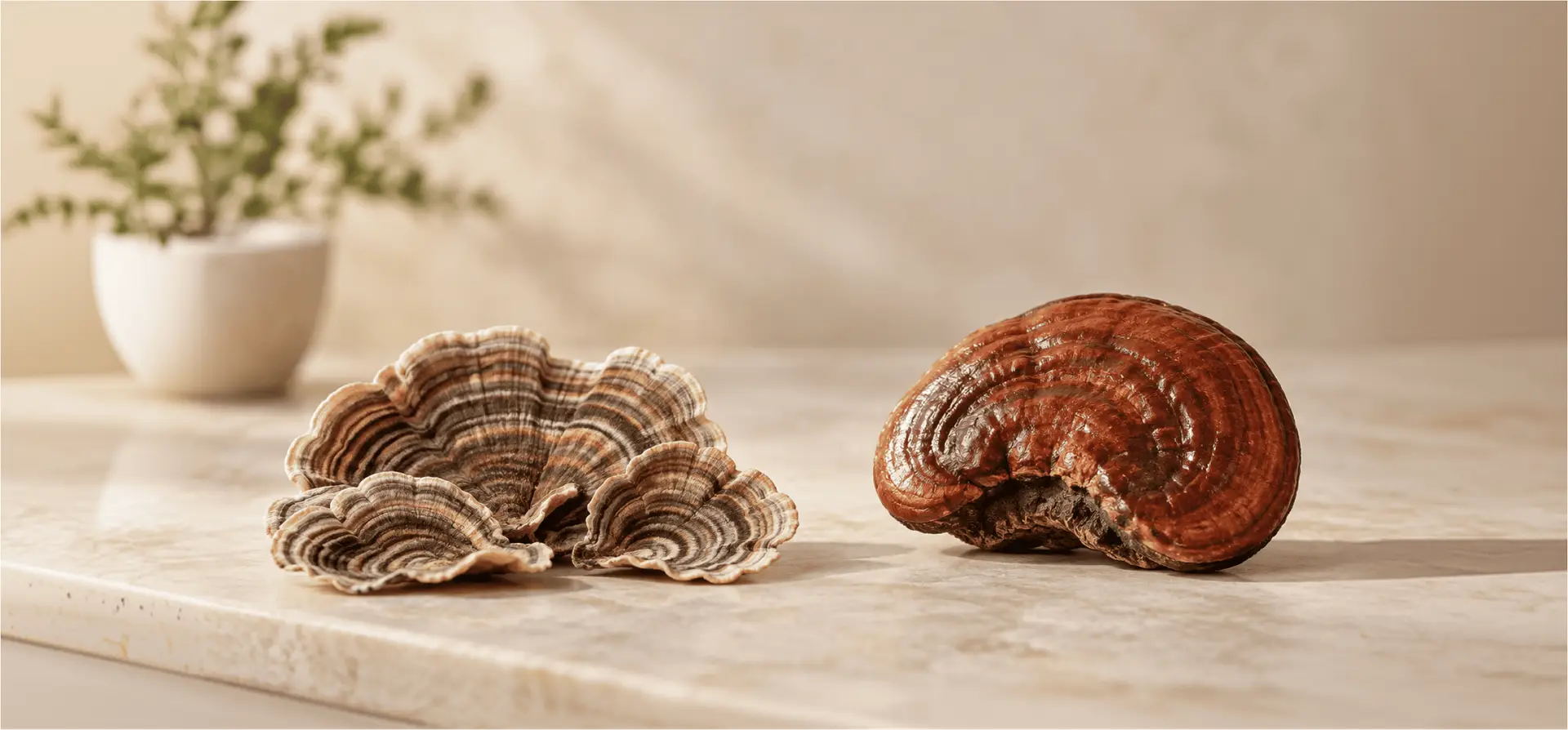
They are two bracket fungi that share a shelf and nothing else. Turkey tail is thin, flexible and banded, with no stem at all. Reishi is a woody shelf with a varnished upper surface. The species names matter because the chemistry attached to each is different, and because species identity on a processed powder cannot be judged by eye. DNA barcoding of the internal transcribed spacer region settles it, and it is hardest to apply to mycelium, where milling and drying remove every feature a taxonomist would use.
Part used is the variable this category hides. Fruiting body and mycelium grown on grain are not interchangeable raw materials. Grain carries starch, starch is an alpha-glucan, and alpha-glucan is counted in any figure labeled total polysaccharide. Endoca’s turkey tail and reishi both enter the range as fruiting body extracts.
A certificate of analysis can measure glucan fractions, heavy metals, pesticides and microbial load on a finished batch. What it cannot tell you is that a polysaccharide fraction behaves in a person the way a licensed oncology preparation did in a randomized trial. No brand’s COA claims otherwise.
Beta-glucans, and why the number on the label may not mean what you think
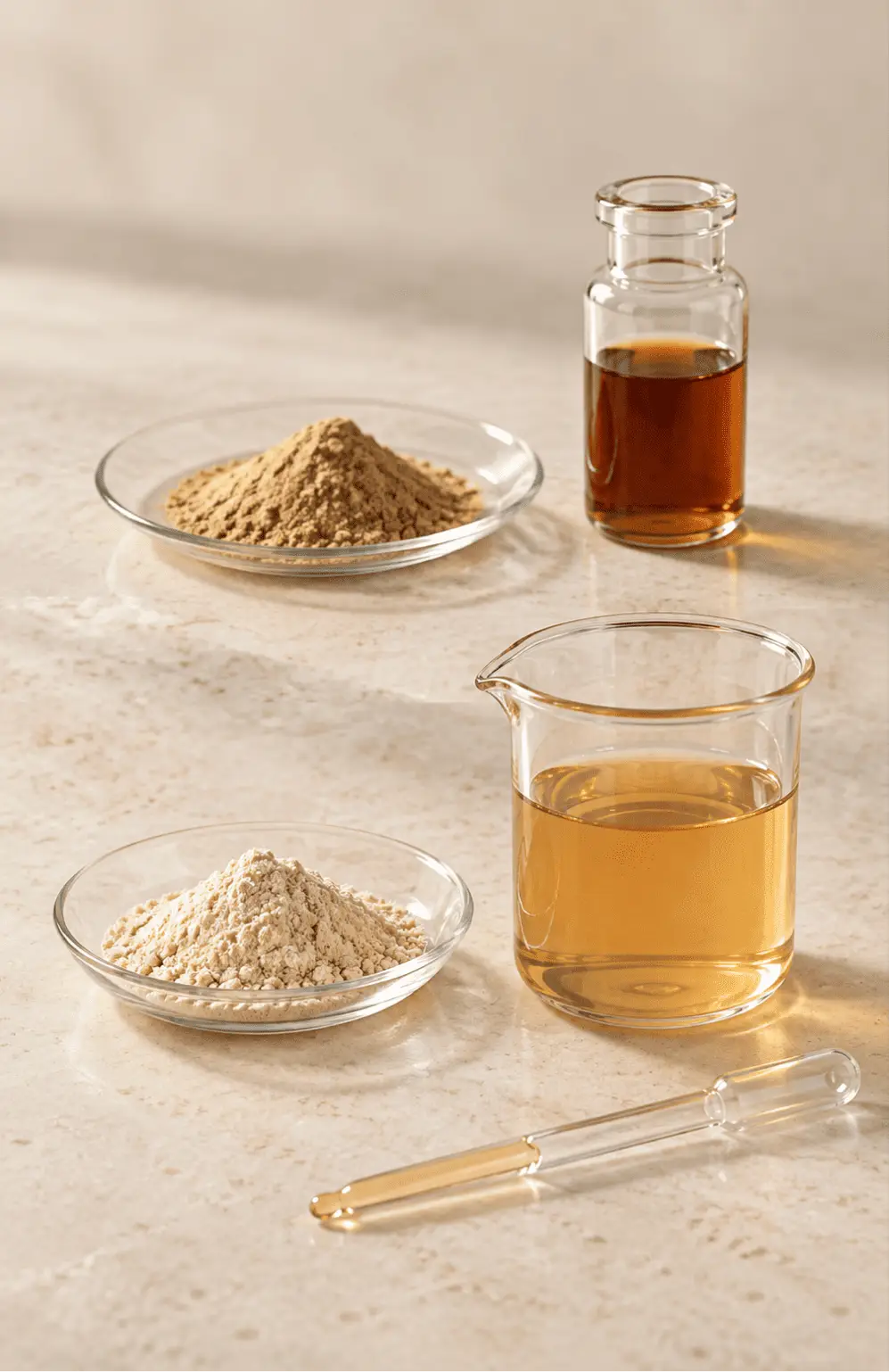
Beta-glucan is almost never measured directly. The accepted approach hydrolyzes total glucan with sulfuric acid and measures the glucose released, measures alpha-glucan separately by digesting starch and glycogen with glucoamylase, then reports beta-glucan as the difference. A product carrying starch from a grain substrate inflates total glucan, and the beta-glucan figure depends entirely on whether anyone subtracted it.
Reishi is a specific problem case. In the method work behind this approach, Ganoderma lucidum and Poria cocos gave significantly higher beta-glucan values with sulfuric acid than with hydrochloric acid, while most other samples read about the same either way. A second method, the Congo red assay, responds to the intact triple helix rather than to released glucose and reports different values again. Reviews of mushroom glucans are explicit that true comparisons can only be made within one method.
Solvent choice then splits the two apart. Turkey tail’s studied fractions are water soluble, so hot water extraction is the relevant step. Reishi carries two useful compound classes with opposite solubility: beta-glucans need hot water, ganoderic acids need alcohol. A reishi product extracted one way is missing half its own chemistry.
What the human evidence shows
Turkey tail
A meta-analysis of three randomized trials in 1,094 resected colorectal cancer patients found PSK with chemotherapy gave an overall survival risk ratio of 0.71.
A network meta-analysis of 23 trials and 10,684 gastrointestinal cancer patients found PSK raised 1 to 5 year survival without more side effects.
A phase 1 trial in 9 women after breast cancer radiotherapy found 9 grams a day tolerable, with trends only in lymphocyte counts.
No trial has compared a retail turkey tail extract against PSK at a matched dose.
Reishi
A Cochrane review found five randomized cancer trials; tumor response with chemotherapy gave a risk ratio of 1.50, confidence interval 0.90 to 2.51.
In that review CD3, CD4 and CD8 percentages rose by 3.91, 3.05 and 2.02 points, on generally unsatisfactory methodology.
A second Cochrane review found no HbA1c effect across 130 participants, weighted mean difference minus 0.10 percent, 95 percent CI minus 1.05 to 0.85, and none in cholesterol, LDL or body mass index across 107.
No reishi trial has recorded long-term cancer survival, so that question is open.
Read the columns as two kinds of evidence, not two scores. Turkey tail’s survival data belong to PSK, a standardized preparation given under medical supervision with chemotherapy. Reishi’s trials tested reishi itself, and two of the cleanest outcomes in them were null.
What people get wrong
01Turkey tail extract is backed by cancer survival trials.
PSK is. PSK is a specific preparation used in Japanese and Chinese oncology alongside chemotherapy. Whether PSK, PSP and other extracts have comparable effects is unclear.
02Reishi is the more researched of the two.
Not in humans. Reishi has five randomized cancer trials of generally unsatisfactory quality and no long-term survival data. Turkey tail's PSK record covers more than 10,000 randomized patients.
03A higher polysaccharide percentage means a stronger product.
Total polysaccharide counts starch and glycogen as well as beta-glucan. Beta-glucan is reported as total glucan minus alpha-glucan, so a grain-grown product can post a high figure with little fungal glucan.
Choosing between them
Choose on what you can verify, because that is all either label gives you. Check the Latin name, check that the part used is stated as fruiting body, and check whether the glucan figure names its method. If a turkey tail product cites colorectal or gastric cancer survival data, those results belong to PSK under medical supervision and do not transfer. If reishi interests you for its triterpenoids, a water-only extract will not carry them. Anyone on chemotherapy, on tamoxifen or with liver disease should raise either mushroom with their oncologist first.
Still weighing up the options? See Chaga vs turkey tail or Lion’s mane vs reishi. For more background, read our guide on mushroom supplements for immune support. Endoca products related to this comparison: Turkey Tail Mushroom Extract and Immune support range.
Legal status and safety
Legal status in the United States
Both are sold as dietary supplements under the Dietary Supplement Health and Education Act, which permits structure and function statements but no claim to treat, cure or prevent disease. PSK is not approved by the Food and Drug Administration as a cancer treatment here, and no turkey tail or reishi product may be marketed as one.
A brand may describe what a batch contains, how it was extracted and what was measured. It may not import the conclusion of an oncology trial run on a licensed preparation into a claim about a capsule.
Safety
Reishi carries a real hepatic signal. A fatal case of fulminant hepatitis was reported in a patient taking Ganoderma lucidum in powder form, and the same report described an earlier case. Both patients had taken traditionally boiled lingzhi without incident before switching to powder for one to two months.
There is also an interaction question. In female rats, a Trametes versicolor polysaccharide peptide extract raised the time to peak tamoxifen concentration by 228 percent. That is a rodent finding, but it belongs in front of anyone on endocrine therapy. Across trials both species were generally well tolerated. Pregnancy and breastfeeding have not been studied for either.
How Endoca tests for this
Every batch of the Organic Mushroom Immune Complex and the Red Reishi Mushroom Extract is third-party tested, and the certificate of analysis is published through the lab portal. A COA covers identity, heavy metals, pesticide residues and microbial load on a finished fruiting body extract. It cannot cover clinical effect, and no batch result is evidence for an outcome measured in a trial of a different preparation. Endoca has worked from its own farm, own land and own extraction since 2010.
Frequently asked questions
Turkey tail, with a large caveat. Its survival data come from PSK, a specific preparation given with chemotherapy in Japanese and Chinese oncology, across more than 10,000 randomized patients. Reishi has five randomized cancer trials of generally unsatisfactory quality and no long-term survival data.
No. PSK is a standardized protein-bound polysaccharide preparation used under medical supervision with chemotherapy. Over-the-counter turkey tail products are often not standardized, and whether PSK, PSP and other Trametes versicolor extracts have comparable effects has not been established in any trial.
Because the method changes the answer. Beta-glucan is calculated as total glucan minus alpha-glucan, and Ganoderma lucidum reads significantly higher with sulfuric acid than with hydrochloric acid. The Congo red assay reports different values again, so figures are comparable only within one method.
No. Five trials were eligible and three supplied usable data, all in type 2 diabetes at 1.4 to 3 grams a day for 12 to 16 weeks. HbA1c did not move across 130 participants, nor did total cholesterol, LDL cholesterol or body mass index across 107.
Yes, they are often combined and no interaction is known. No trial has tested the combination.
Turkey tail’s evidence comes mainly from PSK, a specific extract, so it does not carry over automatically to retail powders. Reishi’s trials are small and generally of poor quality.
References
01
Sakamoto J, Morita S, Oba K, et al. Efficacy of adjuvant immunochemotherapy with polysaccharide K for patients with curatively resected colorectal cancer: a meta-analysis of centrally randomized controlled clinical trials. Cancer Immunol Immunother. 2006;55(4):404-411.
02
Ma Y, Wu X, Yu J, et al. Can polysaccharide K improve therapeutic efficacy and safety in gastrointestinal cancer? A systematic review and network meta-analysis. Oncotarget. 2017;8(51):89108-89118.
03
Torkelson CJ, Sweet E, Martzen MR, et al. Phase 1 clinical trial of Trametes versicolor in women with breast cancer. ISRN Oncol. 2012;2012:251632.
04
Jin X, Ruiz Beguerie J, Sze DM, Chan GC. Ganoderma lucidum (Reishi mushroom) for cancer treatment. Cochrane Database Syst Rev. 2016;4(4):CD007731.
05
Klupp NL, Chang D, Hawke F, et al. Ganoderma lucidum mushroom for the treatment of cardiovascular risk factors. Cochrane Database Syst Rev. 2015;2015(2):CD007259.
06
McCleary BV, Draga A. Measurement of beta-glucan in mushrooms and mycelial products. J AOAC Int. 2016;99(2):364-373.
07
Vetter J. The mushroom glucans: molecules of high biological and medicinal importance. Foods. 2023;12(5):1009.
08
Raja HA, Baker TR, Little JG, Oberlies NH. DNA barcoding for identification of consumer-relevant mushrooms: a partial solution for product certification? Food Chem. 2017;214:383-392.
09
Wanmuang H, Leopairut J, Kositchaiwat C, et al. Fatal fulminant hepatitis associated with Ganoderma lucidum (Lingzhi) mushroom powder. J Med Assoc Thai. 2007;90(1):179-181.
10
Razmovski-Naumovski V, Kimble B, Laurenti D, et al. Polysaccharide peptide extract from Coriolus versicolor increased Tmax of tamoxifen and maintained biochemical serum parameters, with no change in the metabolism of tamoxifen in the rat. Front Pharmacol. 2022;13:857864.
11
Narayanan S, de Mores AR, Cohen L, et al. Medicinal mushroom supplements in cancer: a systematic review of clinical studies. Curr Oncol Rep. 2023;25(6):569-587.
Last reviewed 1 October 2026.
These statements have not been evaluated by the Food and Drug Administration. This product is not intended to diagnose, treat, cure, or prevent any disease.