




No products in the cart.
Quick answer: The mushrooms most studied for immune support are turkey tail, shiitake, maitake, reishi and chaga. Human evidence is real but small, and strongest for turkey tail and shiitake. The best supplement is the one with a named species, the part used, a hot water extract, measured beta-glucans (not just “polysaccharides”) and a batch lab report you can read.
If you have browsed ashelf of functional mushroom extracts, you have seen the same five names again and again. They all promise something for your immune system, and the labels rarely tell you how they differ. That makes choosing hard.
This guide takes each mushroom in turn, says plainly what the research does and does not show, and gives you a short list of label checks. We sell mushroom extracts, so we have a stake here. We have tried to write the guide we would want to read ourselves, including the parts that do not flatter the category.
Which mushrooms are most often used for immune support?
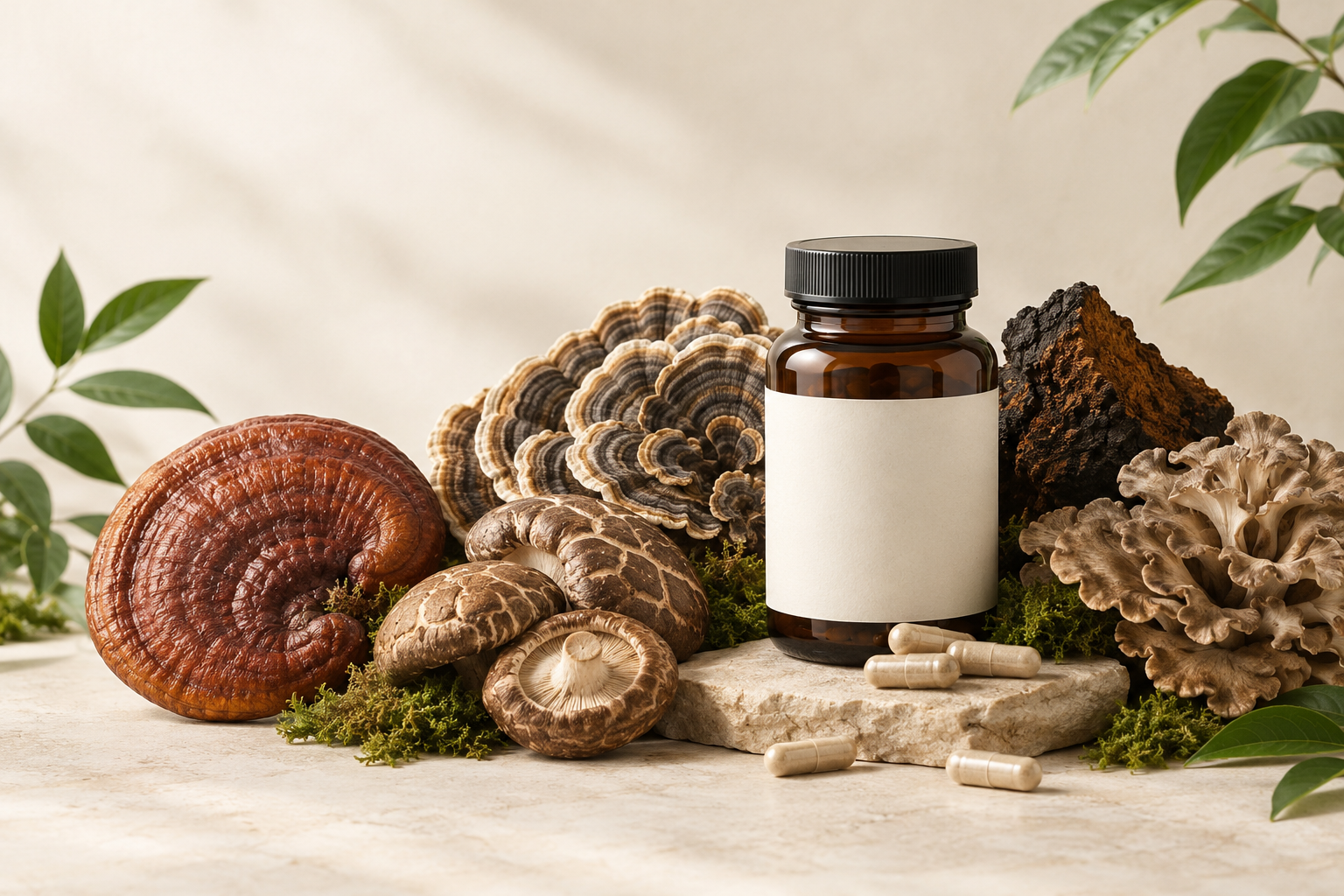
Five mushrooms do most of the work in this category: turkey tail, shiitake, maitake, reishi and chaga. Each has a long history of traditional use, and each contains beta-glucans, but the amount and quality of human research varies a lot between them.
Turkey tail (Trametes versicolor)
Turkey tail has the deepest research file, with one big caveat. Much of it involves PSK and PSP, two concentrated extracts of turkey tail. PSK was developed in Japan as a cancer drug, and Memorial Sloan Kettering notes it has been studied alongside conventional treatment. That is not the same thing as a supplement capsule, and you should not read those results as a promise.
What is relevant for healthy adults is smaller. In a randomized trial of 24 healthy volunteers, PSP from turkey tail shifted gut bacteria in a way consistent with a prebiotic. Since much of your immune tissue sits in the gut, that is a reasonable reason it is traditionally used for immune support. Ourturkey tail extract is made from fruiting bodies, at 310 mg per capsule.
Shiitake (Lentinula edodes)
Shiitake has one of the cleaner human studies in the whole category. In a four-week trial, 52 healthy adults aged 21 to 41 ate 5 or 10 grams of dried shiitake a day. Their gamma delta T cells and NK-T cells multiplied more readily in lab tests, salivary IgA (an antibody in the gut lining) went up, and C-reactive protein, a marker of inflammation, went down.
Two honest notes. The study used whole mushrooms as food, not an extract, and it had no placebo group. It is encouraging, not conclusive.
Maitake (Grifola frondosa)
Maitake research is mostly lab and animal work, plus small human studies in people with cancer. Memorial Sloan Kettering lists immunomodulating effects in limited trials but no large studies in healthy people. Maitake is a sensible part of a blend, but there is less direct evidence for it on its own than for turkey tail or shiitake.
Reishi (Ganoderma lucidum)
Reishi is often sold as a calming, evening mushroom, and its immune data in humans is small and mixed. It contains beta-glucans and triterpenes, the bitter compounds that alcohol extracts well. It also has the most notable safety file of the five, covered below.
Chaga (Inonotus obliquus)
Chaga is popular, but Memorial Sloan Kettering states that its safety and efficacy have not been evaluated in clinical studies. The promising findings are from cells and animals. If you take chaga, take it for traditional reasons and with clear eyes, and read the oxalate note in the safety section.
What are beta-glucans and why do they matter?
Beta-glucans are long chains of glucose found in mushroom cell walls, and they are the compounds most mushroom immune research focuses on. If a supplement does not tell you how much it contains, you cannot compare it fairly with another.
Your immune cells have receptors that recognize these chains. The best known, Dectin-1, sits on macrophages, dendritic cells and neutrophils and is highly specific for the 1,3-linked beta-glucans found in fungi. That is the basic reason mushrooms are studied for immune function at all.
Here is the catch most labels skip. A test for “total polysaccharides” counts every long sugar chain, including starch. Starch is an alpha-glucan with no special immune role. A method published in the Journal of AOAC International in 2016 measures total glucan and alpha-glucan separately, and reports beta-glucan as the difference. That is the number worth asking for.
Should you choose a single mushroom or a blend?
Choose a single mushroom if you have a clear reason for one species, and a blend if you want broad, everyday coverage. Neither is better by default.
| Single-mushroom extract | Multi-mushroom blend | |
| Best for | A specific species you have read about | General daily immune support |
| Dose per mushroom | Higher, all in one species | Lower, shared across species |
| Easy to compare with research | Yes, easier | Harder, research rarely tests blends |
| Number of bottles | One per mushroom | Usually one |
| What to check | Species, part used, beta-glucans | Amount of each mushroom, not just the total |
The weak spot of many blends is a “proprietary blend” line that hides how much of each mushroom you get. If a label lists five mushrooms in 300 mg, some may be present in small amounts. That is not always a problem, but you deserve to know.
What should you check on a mushroom supplement label?
Check the species, the part of the mushroom, the extraction method, the beta-glucan figure and whether a batch lab report exists. Those five facts tell you more than any front-of-pack claim.
- Latin name. “Reishi” alone is vague. Look for Ganoderma lucidum, Trametes versicolor and so on.
- Fruiting body or mycelium. Fruiting bodies are the mushroom you can see. Mycelium is the root-like network, and in the US it is often grown on grain that ends up in the final powder.
- Extract, not just powder. Hot water extraction pulls out water-soluble polysaccharides, including beta-glucans.
- Beta-glucans, measured. A beta-glucan percentage beats a “polysaccharides” percentage, because the second can include starch from the grain.
- Starch or alpha-glucan. A low figure suggests little grain filler.
- A batch lab report. Look for heavy metals, microbes and pesticide results tied to your lot number. Our guide onwhy third-party lab testing matters explains how to read one.
- The amount per capsule and per serving. Compare like with like.
If the brand cannot tell you most of these, that is useful information in itself. Remember that the FDA does not approve dietary supplements before they are sold, so these checks fall to you.
Do vitamin D, vitamin C and zinc pair well with mushrooms?
Yes, they are a sensible pairing, because these three nutrients have the clearest role in normal immune function. Mushrooms are the optional extra; these are the basics.
The NIH Office of Dietary Supplements summarizes the evidence fairly. Regular vitamin C may slightly shorten colds, especially in people under heavy physical stress. Vitamin D may slightly lower the risk of respiratory infections, mainly in people whose levels are low. Zinc lozenges started early may shorten a cold, but evidence in well-fed people is less clear.
Upper limits matter. For adults, ODS lists 2,000 mg a day for vitamin C, 100 mcg (4,000 IU) for vitamin D and 40 mg for zinc. Long-term high zinc can lower copper levels and, ironically, weaken immune function. If you want to cover these basics, ournatural vitamins range includes organic vitamin C, D and zinc. Food and sunlight come first, and a blood test can tell you if you actually need vitamin D.
Are mushroom supplements safe, and who should check with a doctor first?
For most healthy adults, mushroom extracts are well tolerated. A few specific risks are worth knowing, and some people should speak to a doctor before starting.
Known side effects and rare reactions
- Reishi: Memorial Sloan Kettering lists nausea, dry mouth and insomnia as possible side effects. The NIH LiverTox database records rare cases of liver injury, mostly with reishi powders, that resolved after stopping. It rates reishi a possible but rare cause.
- Chaga: Chaga is very high in oxalate. Published case reports describe serious kidney damage in people taking chaga powder daily for months.
- Turkey tail: Side effects are usually mild, such as dark stools.
- Maitake: Memorial Sloan Kettering notes a report of raised eosinophils (a type of white blood cell) without symptoms.
Possible drug interactions
- Blood thinners such as warfarin: reishi, chaga and maitake may add to bleeding risk.
- Diabetes medicines: maitake and chaga may lower blood sugar further.
- Immunosuppressants: reishi could work against them.
Talk to your doctor first if you
- Take any of the medicines above
- Have kidney disease, kidney stones or a history of high oxalate
- Have liver disease
- Are pregnant or breastfeeding
- Are having cancer treatment or have an autoimmune condition
- Have surgery coming up
Stop and get advice if you notice yellowing skin, dark urine, unusual bruising or swelling.
How do Endoca’s immune mushroom products fit in?
All Endoca functional mushroom extracts are organic and made by hot water extraction, then concentrated and dried into a powder in vegan cellulose capsules. Every batch has a Certificate of Analysis atlab.endoca.com.
If you want one bottle, ourOrganic Mushroom Immune Complex combines organic maitake, reishi, shiitake, turkey tail and chaga at 300 mg per daily serving, with 30 vegan capsules per bottle. If you prefer a single species, we also makeshiitake extract at 350 mg per capsule, maitake at 380 mg, red reishi at 280 mg, chaga at 370 mg and turkey tail at 310 mg.
We do not list a beta-glucan percentage on every product page, so if that number matters to you, check the label or the batch COA. For a closer look at the process, readhow each of our seven mushroom extracts is made.
How long should you take a mushroom supplement before judging it?
Give it at least four to eight weeks of daily use. The shiitake trial measured changes after four weeks, and immune effects are not something you feel overnight.
Keep it simple. Take it at the same time each day, with food if your stomach is sensitive, and keep a short note of how you feel. If you notice nothing after two months, it is fair to stop. Mushrooms support normal immune function alongside sleep, food, movement and the basics above. They do not replace them.
Frequently asked questions
What is the best mushroom for immune support?
Turkey tail and shiitake have the most useful human research for healthy adults. Turkey tail extract acted as a prebiotic in a small trial, and eating shiitake daily for four weeks improved several immune markers. Reishi, maitake and chaga are widely used, but their immune evidence in healthy people is smaller or mostly from lab and animal studies. A blend covers several species at lower doses.
Is a mushroom blend better than a single mushroom?
Not automatically. A blend gives you several species in one capsule, which suits general daily use. A single extract gives you a higher dose of one species, which is easier to match against research. Whichever you choose, check that the label shows the species, the part used and, ideally, the amount of each mushroom rather than one combined total.
Why does the fruiting body vs mycelium matter?
The fruiting body is the mushroom itself. Mycelium is the root network, and in the US it is often grown on grain that cannot be fully separated out. Lab testing has found these products can be high in starch and lower in beta-glucans. A fruiting body extract with a measured beta-glucan figure is the more transparent choice.
Can I take mushroom supplements with vitamin D, C and zinc?
Yes, for most people this is a reasonable pairing. Vitamin D, vitamin C and zinc have well-documented roles in normal immune function, and mushrooms add beta-glucans. Stay within adult upper limits: 4,000 IU of vitamin D, 2,000 mg of vitamin C and 40 mg of zinc a day. Check with your doctor if you take other medicines.
Who should avoid mushroom supplements?
Talk to a doctor first if you take blood thinners, diabetes medicines or immunosuppressants, or if you have kidney or liver disease, a history of kidney stones, an autoimmune condition or upcoming surgery. People who are pregnant or breastfeeding should also check first. Chaga is high in oxalate, and reishi has rare reports of liver injury.



Comments are closed