No products in the cart.

- Shop
- About Us
Our Story
From humble beginnings to a global mission – we grow, harvest, and craft hemp with care for people and planet.
What Is CBD?
CBD is nature’s way to restore balance, calm, and overall well-being – naturally and without the high.
The Process
From seed to shelf, we grow organically, extract cleanly, and follow strict quality standards for purity.
Lab Testing
Every batch is third-party tested to ensure purity, safety, and the exact amount of CBD every time.
Our Values
Sustainability, transparency, and wellness guide every decision – for you and for the planet.
At a glance
What these two actually are
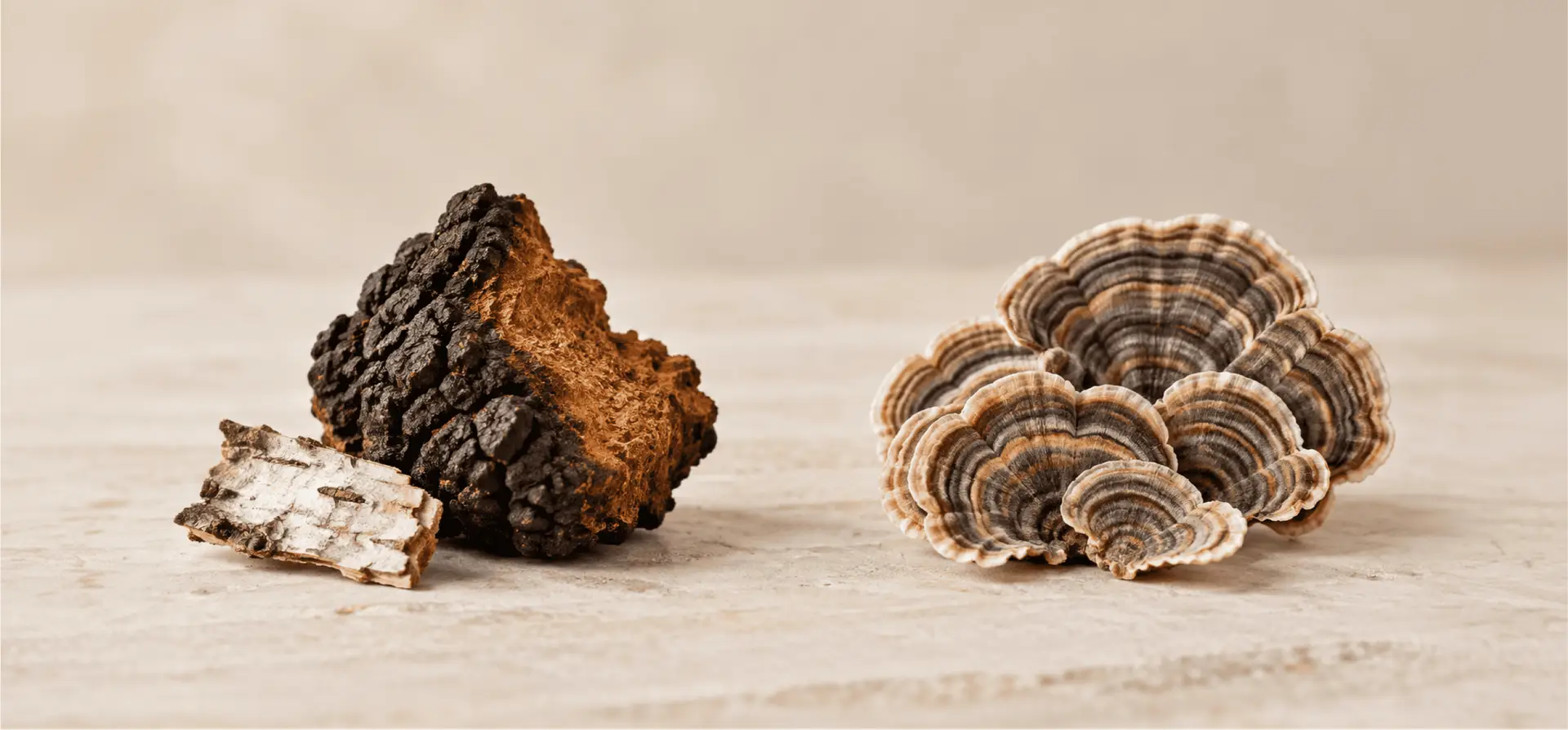
Turkey tail is a fruiting body and chaga is not, which is the first real difference. Trametes versicolor, called Coriolus versicolor through most of the older literature, grows as thin banded fans on dead hardwood, and the fan is the reproductive structure. Inonotus obliquus makes its fruiting body only briefly, under the bark of a dying birch, so the black lump harvested as chaga is a sterile conk: fungal hyphae grown through the wood of the host tree.
The second difference is which material was studied. Turkey tail’s clinical record is not a turkey tail extract in the retail sense. It is PSK, a protein-bound polysaccharide and a proprietary preparation from one manufacturer, approved in Japan and given at around 3 g a day with chemotherapy since the mid-1970s. PSP is a related but chemically distinct preparation from a different strain in China.
Chaga has no equivalent. There is no licensed chaga preparation, no defined strain behind a clinical programme, and no randomized trial. What chaga does have is oxalate, at concentrations behind three published case reports of kidney injury.
Beta-glucans, and why the number on the label may not mean what you think
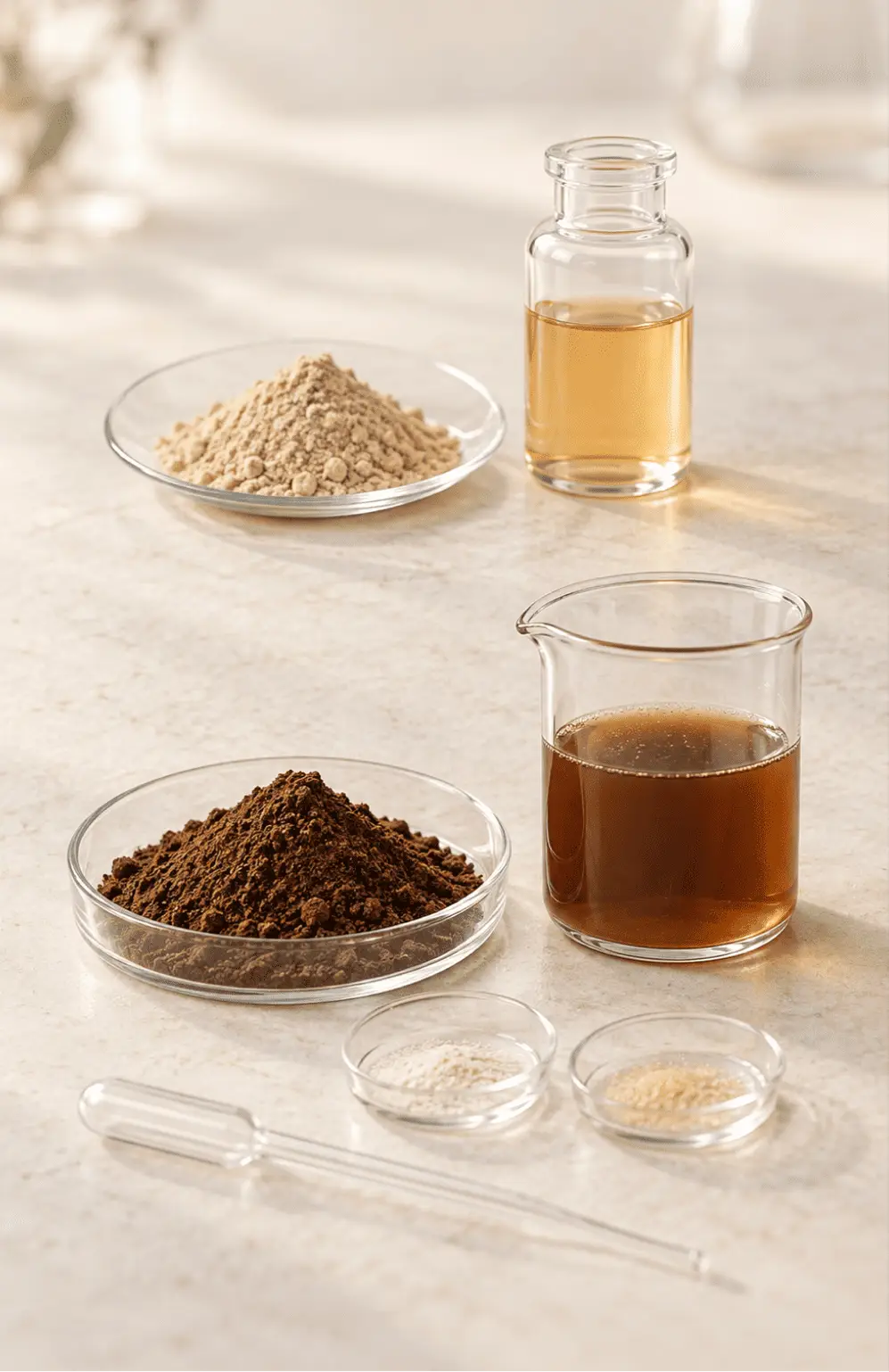
The polysaccharide warning lands hard on this pair. Beta-glucan is defined by subtraction: total glucan measured, alpha-glucan measured, beta-glucan reported as the difference, because starch registers as alpha-glucan. Liquid-fermented biomass of Trametes versicolor and two other species returned total glucan of 76.15 to 80.45 percent of dry weight, at an alpha to beta ratio of 3.22 to 7.26.
The authors say so plainly: those biomasses differ from fruiting bodies and from mycelium chiefly in their higher total and alpha-glucan content and their lower beta-glucan content. An 80 percent glucan headline is therefore compatible with a modest beta-glucan figure, and the only useful question is which glucan was measured.
On the chaga side the variable is solvent. Two chaga samples taken through subcritical water at 200 degrees Celsius yielded total glucan of 20.4 and 20.9 g per 100 g, with up to 20 times more beta-glucan than the alternatives tested; the same material in 96 percent ethanol under microwave or ultrasound gave 0.62 to 1.13 g per 100 g. For turkey tail the water route is the point, because PSK and PSP are water extracted protein-bound polysaccharides.
What the human evidence shows
Chaga
Chaga has no randomized controlled trial behind it, so no efficacy estimate exists for any indication.
Its published human literature is three nephropathy case reports, following chaga powder taken for between 3 months and 5 years.
Turkey tail
Across 3 of 7 randomized trials, covering 1,094 of 1,569 colorectal cancer patients, 5-year survival was higher with adjunctive PSK, risk ratio 1.08, 95 percent CI 1.01 to 1.15, number needed to benefit 16, low certainty.
Across 8 randomized trials and 8,009 patients after gastric cancer resection, PSK with chemotherapy gave a survival hazard ratio of 0.88, 95 percent CI 0.79 to 0.98.
PSK was generally given with chemotherapy after curative resection, in one study before surgery, and the reviewers noted the regimens do not reflect current preferred practice.
The only trial of a non-PSK oral Trametes versicolor preparation was a phase 1 dose escalation at 3 to 9 g daily, completed by 9 women.
Turkey tail’s evidence belongs to PSK, a licensed preparation given with chemotherapy around cancer surgery, in trials rated low to very low certainty. It does not transfer to a shelf capsule, whose whole human record is a 9-person dose escalation. Chaga has none.
What people get wrong
01Turkey tail is a proven cancer treatment.
The trials tested PSK, a licensed Japanese preparation given with chemotherapy after surgery, and Cochrane rated the survival finding low certainty and the adverse event findings very low.
02A turkey tail capsule is PSK.
PSK is one manufacturer's proprietary protein-bound polysaccharide from a defined strain. PSP is a different preparation from a different strain. A capsule labeled turkey tail is neither.
03Chaga is the stronger immune mushroom of the two.
Nothing in humans allows that ranking. Chaga has no randomized trial and three case reports of oxalate nephropathy. Turkey tail has trials, of a preparation most products are not.
Choosing between them
If the turkey tail evidence is what draws you, read it precisely. It belongs to PSK, given at around 3 g a day with chemotherapy around cancer surgery, and Cochrane rates it low certainty even there. A shelf product is not that preparation, so the expectation from a capsule is unknown. Chaga offers no trial and three kidney injury case reports, so the question is not which works better but which carries a known risk. Anyone with kidney stones should avoid chaga, and anyone in cancer treatment should ask their oncology team.
Still weighing up the options? See Turkey tail vs reishi, Reishi vs chaga or Maitake vs shiitake. For more background, read our guide on choosing a turkey tail supplement. Endoca products related to this comparison: Turkey Tail Mushroom Extract and Chaga products.
Legal status and safety
Legal status in the United States
Chaga and turkey tail are both sold as dietary supplements. Under the Dietary Supplement Health and Education Act a structure/function statement is permitted with the disclaimer below and notification to FDA within 30 days. A disease claim is not. PSK is approved in Japan and not by FDA, so a turkey tail supplement sold here cannot be presented as a cancer treatment, and both FDA and FTC have acted against sellers who did. The move to a total THC standard on 11 December 2026 under Public Law 119-37 reaches the hemp range only, since these capsules contain no cannabinoids.
Safety
The oxalate signal belongs to chaga and should not be buried. Chaga powder has been measured at 14 g of oxalate per 100 g. The three nephropathy reports, all three requiring hemodialysis and with renal function recovering in only one, involve a 49-year-old man who went from 3 g to 9 g a day across 5 years, a 72-year-old woman on 4 to 5 teaspoons a day for 6 months, and a 69-year-old man on 10 to 15 g a day with 500 mg of vitamin C, whose nephrotic syndrome with calcium oxalate crystals on biopsy needed high-dose steroids before kidney function recovered.
Chaga is a poor choice with stones or reduced kidney function, worse alongside high dose vitamin C. Turkey tail’s safety data are narrower than reassuring: a phase 1 trial recorded 9 adverse events in 9 women taking up to 9 g daily.
How Endoca tests for this
Endoca lists a certificate of analysis for each mushroom extract, and the quality programme covers pesticide, heavy metal and mycotoxin screening to GMP standards with third party verification. Neither certificate reports a beta-glucan percentage, so it cannot say how much of a declared polysaccharide is beta rather than alpha, and neither reports oxalate. Those two numbers are what this comparison turns on. Endoca works from its own farm, own land and own extraction, since 2010.
Frequently asked questions
No. PSK, also called krestin, is a protein-bound polysaccharide made from a defined strain by one manufacturer and approved in Japan as a cancer adjunct. PSP is a separate preparation from a different strain in China. A retail turkey tail extract is neither.
A Cochrane review found 7 randomized trials in 1,569 colorectal cancer patients, 6 in Japan and 1 in China, using PSK with chemotherapy generally after curative resection and in one study before surgery. Five-year survival was higher in 3 of those studies, covering 1,094 participants, risk ratio 1.08, at low certainty.
No. No randomized controlled trial of any chaga preparation has been published for any outcome. The human record is three case reports of oxalate nephropathy, all three requiring hemodialysis, with renal function recovering in only one, after powder taken for 3 months to 5 years.
Because glucan includes alpha-glucan, which is largely starch. Liquid-fermented Trametes versicolor biomass measured 76 to 80 percent total glucan with an alpha to beta ratio of 3.22 to 7.26, and its authors reported lower beta-glucan in that biomass than in fruiting bodies.
They are often combined and no interaction is known. Chaga’s oxalate content is the main caution, especially for people with kidney problems.
Turkey tail has far more human research, mainly on the prescription extract PSK used alongside cancer treatment in Japan. Chaga has very little human data.
References
01
Pilkington K, Wieland LS, Teng L, Jin XY, Storey D, Liu JP. Coriolus (Trametes) versicolor mushroom to reduce adverse effects from chemotherapy or radiotherapy in people with colorectal cancer. Cochrane Database Syst Rev. 2022;11:CD012053.
02
Oba K, Teramukai S, Kobayashi M, Matsui T, Kodera Y, Sakamoto J. Efficacy of adjuvant immunochemotherapy with polysaccharide K for patients with curative resections of gastric cancer. Cancer Immunol Immunother. 2007;56(6):905-911.
03
Sakamoto J, Morita S, Oba K, Matsui T, Kobayashi M, Nakazato H, Ohashi Y. Efficacy of adjuvant immunochemotherapy with polysaccharide K for patients with curatively resected colorectal cancer: a meta-analysis of centrally randomized controlled clinical trials. Cancer Immunol Immunother. 2006;55(4):404-411.
04
Torkelson CJ, Sweet E, Martzen MR, Sasagawa M, Wenner CA, Gay J, Putiri A, Standish LJ. Phase 1 clinical trial of Trametes versicolor in women with breast cancer. ISRN Oncol. 2012;2012:251632.
05
Araujo-Rodrigues H, Amorim M, Sousa C, Salsinha AS, Marcal S, de Freitas V, Relvas JB, Tavaria FK, Pintado ME. Chemical composition of Trametes versicolor, Hericium erinaceus, and Pleurotus ostreatus mushroom biomass: deciphering their rich alpha-glucan composition and nutritional value. J Food Compost Anal. 2025;143.
06
McCleary BV, Draga A. Measurement of beta-glucan in mushrooms and mycelial products. J AOAC Int. 2016;99(2):364-373.
07
Lazic V, Lazic V, Klaus A, Kozarski M, Doroski A, Tosti T, Simic S, Vunduk J. The effect of green extraction technologies on the chemical composition of medicinal chaga mushroom extracts. J Fungi (Basel). 2024;10(3):225.
08
Lee S, Lee HY, Park Y, Ko EJ, Ban TH, Chung BH, Lee HS, Yang CW. Development of end stage renal disease after long-term ingestion of chaga mushroom: case report and review of literature. J Korean Med Sci. 2020;35(19):e122.
09
Kikuchi Y, Seta K, Ogawa Y, Takayama T, Nagata M, Taguchi T, Yahata K. Chaga mushroom-induced oxalate nephropathy. Clin Nephrol. 2014;81(6):440-444.
10
Kwon O, Kim Y, Paek JH, Park WY, Han S, Sin H, Jin K. Chaga mushroom-induced oxalate nephropathy that clinically manifested as nephrotic syndrome: a case report. Medicine (Baltimore). 2022;101(10):e28997.
11
National Cancer Institute. Medicinal mushrooms (PDQ), health professional version. Accessed 1 October 2026.
Last reviewed 1 October 2026.
These statements have not been evaluated by the Food and Drug Administration. This product is not intended to diagnose, treat, cure, or prevent any disease.