No products in the cart.

- Shop
- About Us
Our Story
From humble beginnings to a global mission – we grow, harvest, and craft hemp with care for people and planet.
What Is CBD?
CBD is nature’s way to restore balance, calm, and overall well-being – naturally and without the high.
The Process
From seed to shelf, we grow organically, extract cleanly, and follow strict quality standards for purity.

Lab Testing
Every batch is third-party tested to ensure purity, safety, and the exact amount of CBD every time.
Our Values
Sustainability, transparency, and wellness guide every decision – for you and for the planet.
At a glance
What these two actually are
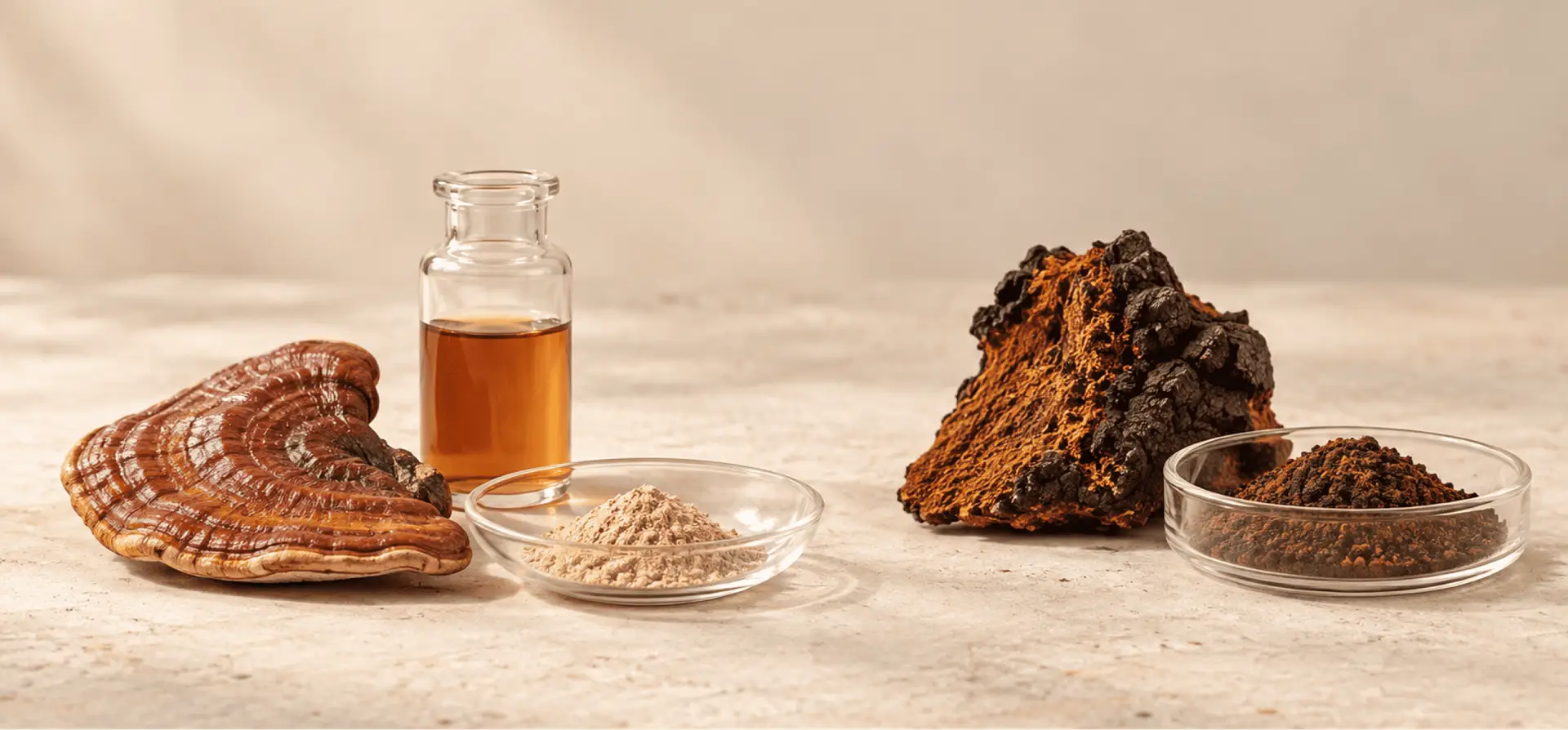
Reishi is a fruiting body. The bracket on the log is the reproductive structure of Ganoderma lucidum, the material Chinese texts have called lingzhi for about two millennia. Chaga is not that. Inonotus obliquus forms its true fruiting body only briefly, under the bark of a dying birch, and what gets harvested is the sterile conk: a hard black mass of fungal hyphae grown through the wood it colonized.
The distinction changes what is in the jar. A reishi fruiting body is largely fungal cell wall, which is why beta-glucan assays return high figures from it. A chaga conk carries a large melanin pigment fraction, birch-derived triterpenes, phenolics including chlorogenic acid, and oxalate at concentrations that have caused kidney failure in published cases.
It also changes what a certificate can honestly measure. For reishi the useful numbers are beta-glucan, as total glucan minus alpha-glucan, and a triterpene figure. For chaga they are glucan, phenolics and oxalate. Fruiting body against mycelium grown on grain is the standard quality question here; for chaga the prior question is whether the material is conk at all.
Beta-glucans, and why the number on the label may not mean what you think
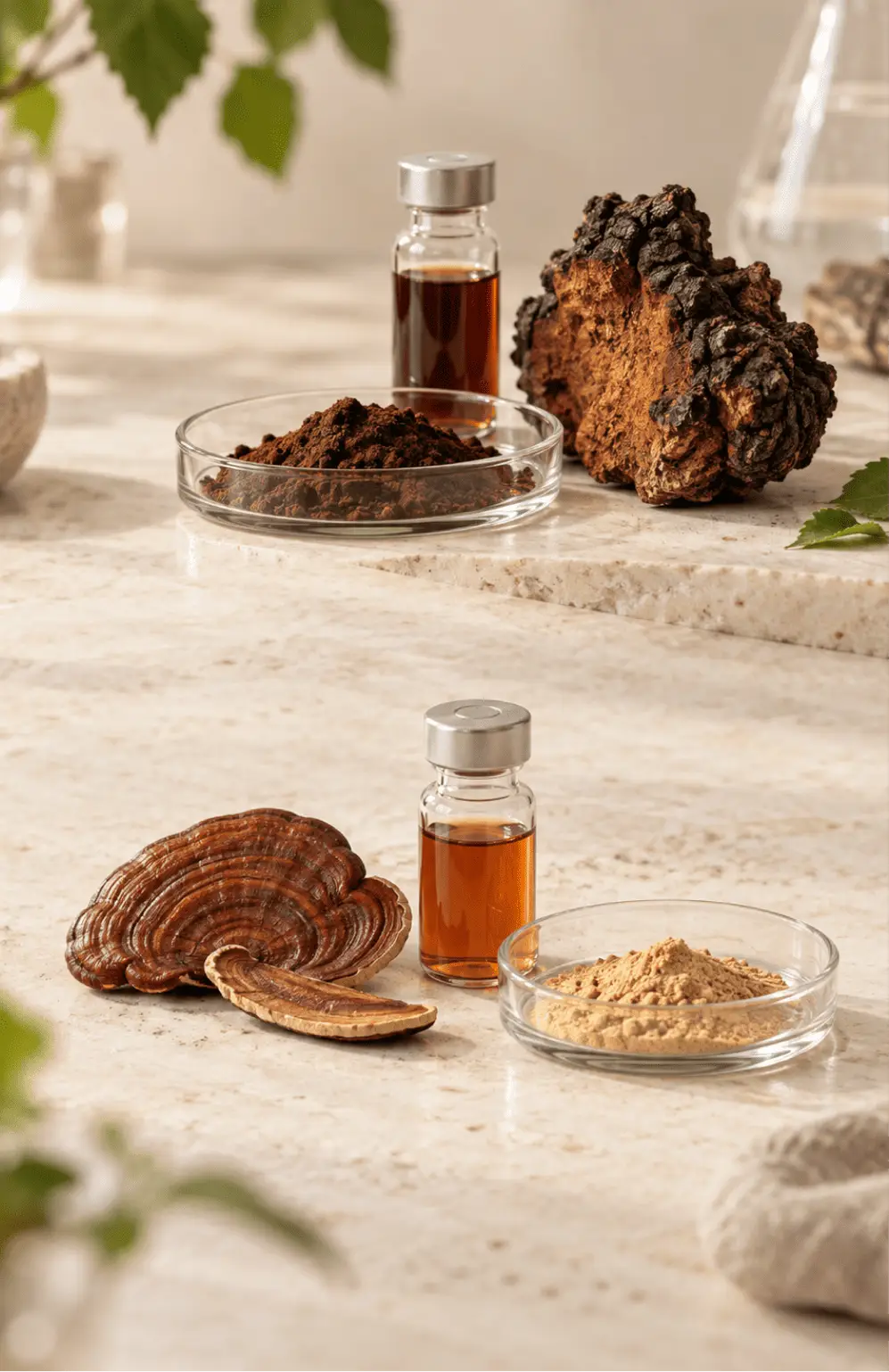
Beta-glucan is the measure that means something, and it is reached by subtraction. The accepted enzymatic method determines total glucan, determines alpha-glucan separately, and reports beta-glucan as the difference. The reason is starch: a crude polysaccharide figure counts alpha-glucan too, so a product grown on rice or oats carries grain starch into its headline number.
Strain and substrate move the real figure too. Ganoderma lucidum fruiting bodies cultivated on sawdust and chips from five tree species measured 47.5 to 55.9 percent beta-glucan of dry weight by that method, lowest on pine and highest on aspen. That is an 8 point spread inside one species, measured in one laboratory.
Chaga reaches the same conclusion through solvent. Subcritical water at 200 degrees Celsius returned total glucan of 20.4 and 20.9 g per 100 g from two chaga samples, up to 20 times the beta-glucan of the other techniques tested, while microwave or ultrasound extraction in 96 percent ethanol returned 0.62 to 1.13 g per 100 g. Reishi needs both solvents: hot water takes the beta-glucans, alcohol takes the ganoderic acids. One extraction gets one fraction.
What the human evidence shows
Reishi
A Cochrane review of 5 randomized trials reported tumor response more likely when G. lucidum was added to chemotherapy or radiotherapy, relative risk 1.50, 95 percent CI 0.90 to 2.51.
No trial in that review recorded long-term survival, and the authors rated the primary studies methodologically unsatisfactory.
A second Cochrane review found no reduction in HbA1c across 130 participants at 1.4 to 3 g daily, weighted mean difference minus 0.10 percent, 95 percent CI minus 1.05 to 0.85, and none in cholesterol, LDL cholesterol or body mass index across 107.
Chaga
No randomized controlled trial of chaga in humans has been published, for any outcome, in any population.
The human chaga literature is case reports of harm: three describe oxalate nephropathy after months to years of chaga powder, all three requiring hemodialysis, with renal function recovering in only one.
An inotodiol-rich chaga extract increased Y-maze alternation in transgenic mice, a rodent result with no human counterpart.
The asymmetry is the finding. Reishi’s one positive pooled estimate has a confidence interval crossing no effect, and its glucose and lipid outcomes came back flat. Chaga has no randomized human literature at all; its only human data are three kidney injury case reports.
What people get wrong
01Chaga is a mushroom.
It is a sterile conk: hardened fungal tissue fused with birch wood on a living tree, not the true fruiting body, which forms only briefly under the bark.
02A high polysaccharide percentage means a strong extract.
Not on its own. Polysaccharide figures include alpha-glucan, which is largely starch from grain substrate, and the beta-glucan subtraction is where inflated numbers collapse.
03Chaga is harmless because it has been eaten for centuries.
Three published case reports describe oxalate nephropathy after chaga powder, all three requiring hemodialysis, with renal function recovering in only one. One analyzed powder contained 0.14 g of oxalate per gram.
Choosing between them
Reishi is the better studied of the two, and the honest version is that its trials are small, concentrated in one region and rated poor quality by two Cochrane reviews, with no long-term survival data. For reishi’s whole chemistry rather than half, check the extract used both hot water and alcohol. Chaga offers no human trial to weigh and three kidney injury cases to weigh against it. Anyone with kidney stones, reduced kidney function or a diet already high in oxalate should leave chaga alone and raise it with a clinician.
Still weighing up the options? See Chaga vs turkey tail, Turkey tail vs reishi or Maitake vs shiitake. For more background, read our guide on chaga tea vs capsules. Endoca products related to this comparison: Chaga Mushroom Extract and Red Reishi Mushroom Extract.
Legal status and safety
Legal status in the United States
Reishi and chaga are lawful dietary ingredients sold as dietary supplements under the Dietary Supplement Health and Education Act. That permits structure/function statements, requires the disclaimer below, and requires notification to FDA within 30 days of first marketing one. It does not permit a disease claim. FDA has approved no mushroom preparation to treat any condition, and both FDA and FTC have acted against sellers claiming mushroom products treat cancer.
The federal hemp rules changed separately. Public Law 119-37 excludes finished products containing more than 0.4 mg of total THC per container, from 11 December 2026. That governs Endoca’s hemp range, not a mushroom capsule.
Safety
Chaga needs a warning, not a caveat. Three published cases describe oxalate nephropathy, all three requiring hemodialysis, with renal function recovering in only one: 3 g daily for 4 years then 9 g for a year, ending in end stage renal disease; 4 to 5 teaspoons daily for 6 months; and 10 to 15 g daily with 500 mg of vitamin C for 3 months, presenting as nephrotic syndrome with calcium oxalate crystals on biopsy and needing high-dose steroids before kidney function recovered.
Avoid chaga with any history of kidney stones or impaired kidney function. In the cardiovascular Cochrane review reishi carried an adverse event risk ratio of 1.67, 95 percent CI 0.86 to 3.24, not statistically significant, with nausea, diarrhea and constipation reported and none serious; the cancer review recorded nausea and insomnia.
How Endoca tests for this
Endoca publishes a certificate of analysis for each mushroom extract and runs pesticide, heavy metal and mycotoxin screening under GMP standards with third party verification. What the certificate does not carry is a beta-glucan percentage, a triterpene figure or an oxalate result, and nor does the label. If those numbers matter, and for chaga the oxalate one should, ask for them rather than assume. Endoca works from its own farm, own land and own extraction, since 2010.
Frequently asked questions
Not in the strict sense. What is sold as chaga is the sterile conk of Inonotus obliquus, a hard black mass of fungal hyphae grown through birch wood. The species does form a true fruiting body, briefly under the bark, but not what supplements contain.
Reishi, by a wide margin from a low base. Two Cochrane reviews pooled 5 randomized trials in cancer patients and 5 in cardiovascular risk, rating the primary studies poor. No randomized trial of chaga in humans has been published for any outcome.
Because its two compound classes dissolve differently. Beta-glucans are water soluble and come out in hot water. The ganoderic acid triterpenoids are lipophilic and partition into alcohol. A hot water extract is low in triterpenoids; an alcohol tincture is low in beta-glucans.
Three published case reports describe oxalate nephropathy after chaga powder, all three requiring hemodialysis, with renal function recovering in only one, and one analyzed powder measured 0.14 g of oxalate per gram. Case reports cannot show how often this happens, but they are the only human chaga data.
They are often combined and no interaction is known. Chaga is high in oxalate, so anyone with kidney problems should speak to a doctor first.
Reishi has more human studies, though their quality is generally poor. Chaga has almost none, so neither can be called better on the evidence.
References
01
Cortina-Escribano M, Pihlava JM, Miina J, Veteli P, Linnakoski R, Vanhanen H. Effect of strain, wood substrate and cold treatment on the yield and beta-glucan content of Ganoderma lucidum fruiting bodies. Molecules. 2020;25(20):4732.
02
McCleary BV, Draga A. Measurement of beta-glucan in mushrooms and mycelial products. J AOAC Int. 2016;99(2):364-373.
03
Jin X, Ruiz Beguerie J, Sze DM, Chan GC. Ganoderma lucidum (Reishi mushroom) for cancer treatment. Cochrane Database Syst Rev. 2016;(4):CD007731.
04
Klupp NL, Chang D, Hawke F, Kiat H, Cao H, Grant SJ, Bensoussan A. Ganoderma lucidum mushroom for the treatment of cardiovascular risk factors. Cochrane Database Syst Rev. 2015;(2):CD007259.
05
Lazic V, Lazic V, Klaus A, Kozarski M, Doroski A, Tosti T, Simic S, Vunduk J. The effect of green extraction technologies on the chemical composition of medicinal chaga mushroom extracts. J Fungi (Basel). 2024;10(3):225.
06
Lee S, Lee HY, Park Y, Ko EJ, Ban TH, Chung BH, Lee HS, Yang CW. Development of end stage renal disease after long-term ingestion of chaga mushroom: case report and review of literature. J Korean Med Sci. 2020;35(19):e122.
07
Kikuchi Y, Seta K, Ogawa Y, Takayama T, Nagata M, Taguchi T, Yahata K. Chaga mushroom-induced oxalate nephropathy. Clin Nephrol. 2014;81(6):440-444.
08
Kwon O, Kim Y, Paek JH, Park WY, Han S, Sin H, Jin K. Chaga mushroom-induced oxalate nephropathy that clinically manifested as nephrotic syndrome: a case report. Medicine (Baltimore). 2022;101(10):e28997.
09
Ban S, Do TT, Pyo JW, Moon M, Park JT. INO10, a chaga mushroom extract, alleviates Alzheimer’s disease-related pathology and cognitive deficits in 3xTg-AD mice. Int J Mol Sci. 2025;26(10):4729.
10
Fordjour E, Manful CF, Javed R, Galagedara LW, Cuss CW, Cheema M, Thomas R. Chaga mushroom: a super-fungus with countless facets and untapped potential. Front Pharmacol. 2023;14:1273786.
Last reviewed 1 October 2026.
These statements have not been evaluated by the Food and Drug Administration. This product is not intended to diagnose, treat, cure, or prevent any disease.