





No products in the cart.
BD suppositories are small, solid capsules of CBD in a fat base that are inserted rectally or vaginally, where body heat melts them and the CBD is absorbed through the surrounding tissue. They are used by people who want CBD delivered somewhere other than the digestive tract.
This guide covers how the route works, what the research does and does not currently show, and exactly how to use one. It is written plainly, because this is a product people search for and then find very little clear information about.
What are CBD suppositories?
A CBD suppository is a bullet-shaped capsule, usually made from a fat or oil base such as coconut oil or cocoa butter, with hemp extract blended through it. It is solid at room temperature and melts at body temperature, which is what makes the format work.
Cannabidiol, or CBD, is a non-intoxicating compound found in the hemp plant. Taken this way it behaves the same as it does in any other format, and a CBD suppository will not make you feel high. If the compound is new to you, start with the basics on what CBD is.
Two things make this category unusual. First, almost no major CBD brand makes them, so reliable information is thin on the ground. Second, it is one of the few CBD formats where the route of administration, rather than the extract, is the whole point.
How CBD suppositories work, and why absorption differs
When you swallow CBD in an oil or capsule, it travels through your digestive system and then through your liver before it reaches general circulation. The liver metabolizes a substantial portion of it on that first pass, which is why oral CBD has relatively low bioavailability. This is called first-pass metabolism, and it is the reason the same amount of CBD produces different results depending on how you take it.
A suppository takes a different path. Placed rectally, it dissolves in the body’s warmth and fluids and the CBD is released gradually and absorbed through the many blood vessels in the rectal mucosa. The lower rectum drains partly into veins that return to general circulation without passing through the liver first, so in principle this route avoids some of that first-pass loss. It also bypasses the stomach entirely, which is the practical appeal for people who find oral oils hard on a sensitive stomach.
Now the honest part, which most articles on this topic skip. Published human research on how much CBD is actually absorbed rectally is limited. The theoretical case for higher bioavailability is sound and it is well established for other drugs given this way, but the specific numbers that get quoted for CBD are not well supported by human trials. Absorption also varies with how far up the suppository sits, individual physiology, and what else is going on in the bowel at the time.
Vaginal absorption is a separate question again, and it has been studied even less. Anyone telling you a precise bioavailability figure for either route is going beyond the evidence.
So the fair summary is this: the route plausibly avoids some first-pass metabolism, it definitely avoids the stomach, and the size of any bioavailability advantage is not yet well established.
Vaginal versus rectal use
The same basic format is sold for both routes, and the differences are worth understanding before you choose.
| Rectal | Vaginal | |
|---|---|---|
| Tissue | Rectal mucosa, dense blood supply | Vaginal mucosa, also well supplied with blood vessels |
| First-pass metabolism | Partly avoided, depending on placement | Avoided |
| Who it is for | Anyone | People with a vagina |
| Research base | Limited for CBD, better established for other drugs | Very limited for CBD |
| Main practical issue | Timing around bowel movements | Leakage of the melted base, so a liner is advisable |
One point specific to the vaginal route: oil-based products can degrade latex. If you use latex condoms or a latex diaphragm, do not rely on them in the hours after using an oil-based vaginal suppository.

How to use a CBD suppository
There is nothing complicated here, and no reason to feel awkward about it. Suppositories are an ordinary pharmaceutical format that has been in routine use for well over a century.
- Store them somewhere cool. These melt. Keep the pack away from heat and direct sunlight, and if a suppository has gone soft, put it in the refrigerator for a few minutes before you unwrap it. A firm suppository is far easier to insert than a soft one.
- Wash your hands thoroughly before and after. Trim long fingernails if that is relevant.
- Time it sensibly. For rectal use, go to the toilet first if you need to, and try to choose a moment when you will not need to go again for an hour or so. Many people find bedtime the easiest slot for exactly this reason.
- Unwrap it and, if you want, apply a little lubricant. A water-based lubricating gel on the tip makes insertion more comfortable. This is optional but most people find it helps.
- Get into position. Lying on your side with your upper knee drawn toward your chest is the standard and easiest position. Standing with one foot raised also works.
- Insert it, narrow end first, far enough that it stays in place comfortably. Roughly one finger length is the usual guidance for rectal use. Do not force it.
- Stay lying down for 15 to 30 minutes. This is the step people skip, and it matters. Standing up immediately increases the chance the suppository shifts or the melted base leaks out before much has been absorbed.
- Use a panty liner. The fat base melts, and some of it will come back out over the following hours. This is normal, it is not a sign the product failed, and a liner saves you the laundry.
Do not cut a suppository in half to reduce the amount unless the manufacturer says you can, and never use one that has melted and re-set out of shape, because the CBD will no longer be evenly distributed through it.
How much CBD is in each suppository
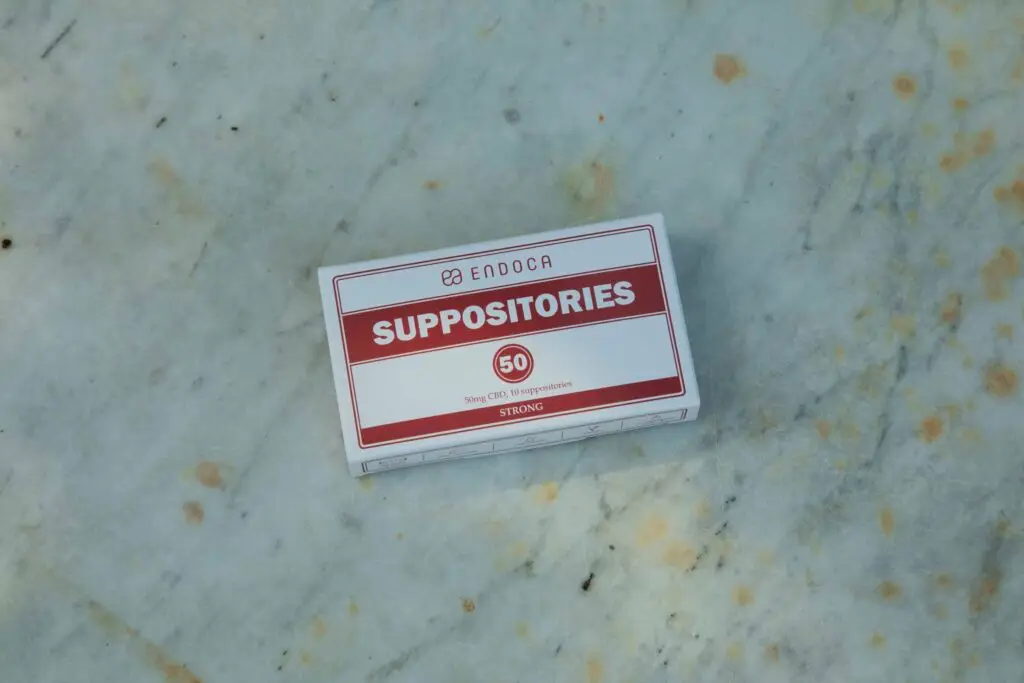
Endoca’s suppositories come as a pack of 10 containing 500mg of CBD in total, which works out at 50mg per suppository. That is a substantial amount by CBD standards, and it reflects the fact that this is a once-in-a-while format rather than something most people use several times a day.
The base is organic coconut oil, and the active is hemp extract containing naturally occurring cannabinoids and terpenes from Endoca’s own farms. There are no artificial colors and no preservatives. The suppository range includes a standard version and a vaginal version, both at 500mg per pack of 10, plus two formulations that combine the hemp extract with additional botanical ingredients.
Endoca grows the hemp, extracts with supercritical CO2 and manufactures under GMP conditions, and every batch is screened for more than 200 pesticides along with heavy metals and mycotoxins. Given where this product goes, that matters more than usual, and the results are published so you can read the lab report for your batch before you use it. The extraction process is documented here.
What to expect
The first thing to expect is that the format is undramatic. Insertion takes a few seconds, and once the suppository melts you will mostly stop noticing it.
Beyond that, be realistic. Individual responses to CBD vary a great deal across every format, and this one is no exception. Effectiveness varies with individual physiology and with the amount used, so some experimentation is usually needed. Give any new format several separate occasions before you form a view.
Some leakage of the melted coconut oil base over the following hours is normal and expected. Mild local sensation on insertion is also common, particularly the first time. What is not normal is pain, burning, bleeding or ongoing irritation, and if you experience any of those you should stop using the product and speak to a doctor.
People generally choose this format for one of two reasons: they want a route that avoids the digestive system, or they want the CBD delivered close to a specific area rather than distributed through the whole body. If neither of those applies to you, an oral format such as CBD oil is simpler and cheaper.
Are CBD suppositories safe?
CBD itself has a well-documented safety profile, and the suppository format uses ordinary food-grade ingredients. The specific considerations with this route are practical rather than exotic.
- Speak to a doctor first, particularly if you are pregnant or breastfeeding, if you have any gynecological or bowel condition, or if you have recently had surgery in the area. This is not boilerplate. A doctor who knows your history is the right person to ask.
- Check your medications. CBD can interact with some prescription drugs through the same liver enzymes that metabolize them. Ask your doctor or pharmacist if you take anything regularly.
- Do not use them if the tissue is irritated, broken or inflamed.
- Latex and oil do not mix. Oil-based products can weaken latex condoms and diaphragms.
- Check the lab report for cannabinoid content and contaminant screening. This is a route with no digestive barrier, so ingredient quality and third-party testing matter more here than in almost any other format.
CBD suppositories are a wellness product, not a medicine. They are not intended to diagnose, treat, cure or prevent any condition, and no CBD product should be used in place of medical care.
Frequently asked questions about CBD suppositories
How long does a CBD suppository take to dissolve?
The coconut oil base begins melting almost immediately at body temperature and is usually fully dissolved within about 15 to 20 minutes. This is why staying lying down for the first half hour makes a practical difference to how much stays in place.
Do CBD suppositories make you high?
No. CBD is non-intoxicating regardless of how you take it, and full spectrum hemp extract contains only trace THC. The route of administration does not change the character of the compound, only how much of it reaches your bloodstream.
Can you use a rectal CBD suppository vaginally?
Use each product for the route it was formulated and labeled for. The bases and any additional botanical ingredients are chosen with a specific tissue in mind, and vaginal tissue has a different pH and a different microbial balance than the rectum.
When is the best time to use a CBD suppository?
Most people use them at bedtime. You are already lying down, you are unlikely to need the toilet immediately, and any leakage of the melted base happens overnight onto a liner rather than during your day.
How often can you use CBD suppositories?
There is no established frequency, and at 50mg per suppository most people use them occasionally rather than daily. Start with one, leave time to see how you respond, and speak to your doctor about frequency if you are considering regular use.
If this format makes sense for you, start with a single pack, use it at bedtime and follow the steps above rather than improvising. You can see the full range, with the published batch lab report for each one, in Endoca’s CBD suppository collection.




Comments are closed