
- Shop
- About Us
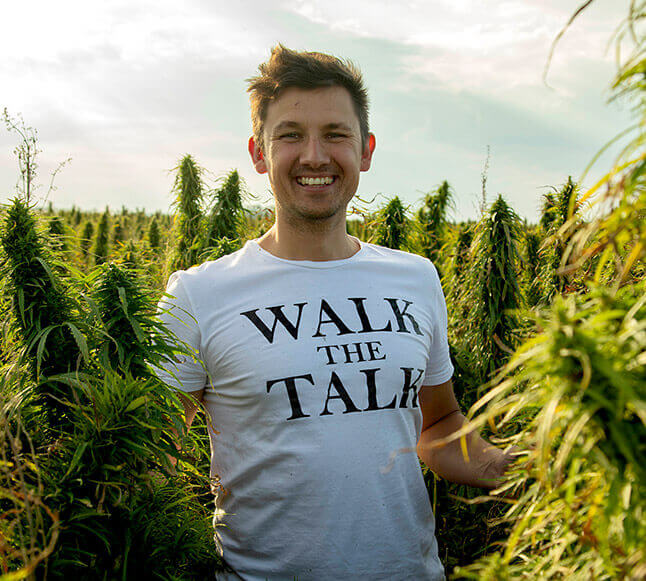
Our Story
From humble beginnings to a global mission – we grow, harvest, and craft hemp with care for people and planet.

What Is CBD?
CBD is nature’s way to restore balance, calm, and overall well-being – naturally and without the high.

The Process
From seed to shelf, we grow organically, extract cleanly, and follow strict quality standards for purity.

Lab Testing
Every batch is third-party tested to ensure purity, safety, and the exact amount of CBD every time.
Our Values
Sustainability, transparency, and wellness guide every decision – for you and for the planet.

At a glance
Two directions at one receptor

Most compounds do one thing at a receptor. THCV does two, depending on concentration.
A 2005 study in the British Journal of Pharmacology characterised THCV as a competitive antagonist at CB1 and CB2, with an affinity of 75.4 nanomolar at mouse brain CB1, and found it antagonised THC in isolated tissue.
A 2008 review noted that in living animals THCV behaves as a CB1 antagonist at low doses and as a CB1 agonist at higher ones. A 2020 study reported weak CB1 partial agonism outright, along with a full cannabis-like behavioural profile in mice at 3 to 10 mg per kilogram: catalepsy, reduced body temperature, reduced pain response and reduced movement.
The accurate description is that THCV blocks CB1 at low doses and crosses over to activating it at higher ones, and is separately a CB2 partial agonist and a positive modulator at 5-HT1A.
This matters because THCV is marketed heavily as a non-intoxicating appetite suppressant. The non-intoxicating part is dose-conditional, and product doses have been rising.
CBD shows no such behaviour. It does not activate CB1 at any achievable concentration.
The human evidence
There is also a small pilot in ten men examining THCV’s interaction with THC. THCV reduced THC’s heart rate increase and appeared to protect delayed verbal recall, but it also increased memory intrusions, and the study failed to produce THC-induced impairment in the first place, which makes the protective finding difficult to interpret. Its authors urged caution.
THCV’s reputation as an appetite suppressant derives from its CB1 antagonist pharmacology and from rodent work showing reduced food intake. Blocking CB1 does reduce appetite; that is well established as a mechanism.
There is relevant context. Rimonabant, a pharmaceutical CB1 antagonist developed for weight loss, was withdrawn from the European market because of psychiatric adverse effects. The mechanism THCV is marketed on is the same one that failed on safety grounds in a properly tested medicine.
That is not a claim that THCV is dangerous. It is a reason not to treat the appetite story as established.
Legal status and safety
No health claim for THCV, CBD or any cannabinoid is authorised under Regulation (EC) No 1924/2006, and Article 10(3) excludes general wellbeing language. Regulation (EU) No 1169/2011 prohibits attributing disease-related properties to food.
Appetite and weight claims carry additional constraints. Article 12 of Regulation 1924/2006 prohibits claims referring to the rate or amount of weight loss, and Article 13(1) claims about satiety and weight management have specific authorised wordings that do not extend to cannabinoids.
THCV falls within the EU Novel Food Catalogue entry covering cannabinoid-containing extracts, and is not authorised.
Its dose-dependent CB1 agonism raises an additional question in member states that apply narcotics rules to psychotropic cannabinoids. Because the varin pathway is uncommon in ordinary hemp, much commercial THCV is produced synthetically, which the Novel Food Catalogue entry explicitly covers.
EFSA’s February 2026 provisional safe level applies to CBD isolate of at least 98 percent purity and does not cover THCV.
How Endoca tests for this
We do not sell THCV. A compound whose intoxicating potential depends on dose, with no published human pharmacokinetics to define that dose, is not one we are willing to put a number on a label for.
Frequently asked questions
At low doses it blocks the receptor responsible for intoxication. At higher doses it activates it. The crossover point in humans is unknown.
Not demonstrated in people.
It occurs in varin-type cultivars, which are uncommon. Much commercial THCV is synthesised.
The one trial that tested combined arms found no significant effect on any endpoint.
References
Jadoon KA et al. Diabetes Care 2016;39:1777-1786.
Thomas A et al. Br J Pharmacol 2005;146:917-926.
Pertwee RG. Br J Pharmacol 2008;153:199-215.
Zagzoog A et al. Sci Rep 2020;10:20405.
Englund A et al. J Psychopharmacol 2016;30:140-151.
Cascio MG et al. Br J Pharmacol 2015;172:1305-1318.
Last reviewed 1 September 2026.
Educational information about published research and European regulation. Not a health claim.