No products in the cart.

- Shop
- About Us
Our Story
From humble beginnings to a global mission – we grow, harvest, and craft hemp with care for people and planet.
What Is CBD?
CBD is nature’s way to restore balance, calm, and overall well-being – naturally and without the high.
The Process
From seed to shelf, we grow organically, extract cleanly, and follow strict quality standards for purity.
Lab Testing
Every batch is third-party tested to ensure purity, safety, and the exact amount of CBD every time.
Our Values
Sustainability, transparency, and wellness guide every decision – for you and for the planet.
At a glance
The disagreement worth knowing about: the mother cannabinoid is barely in anything
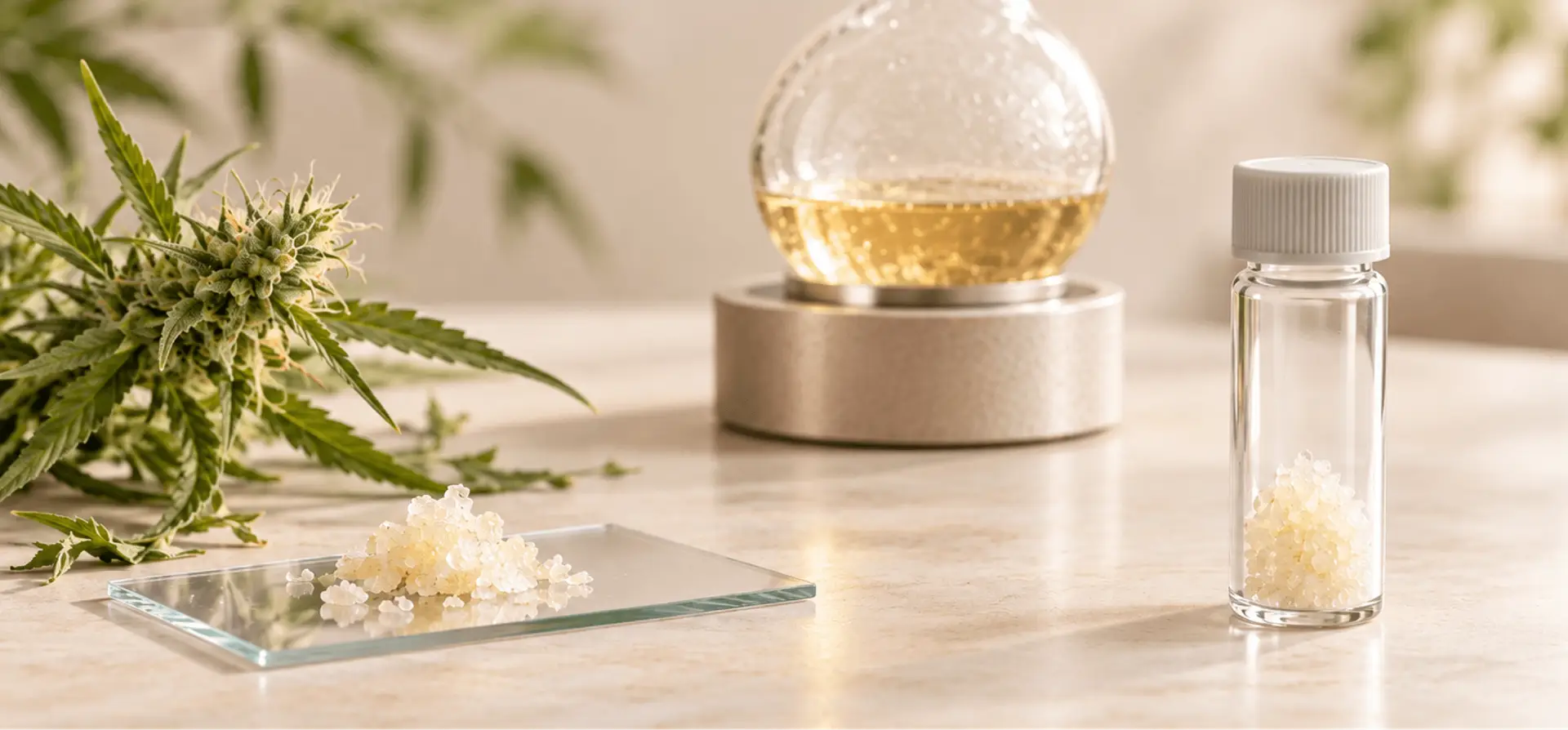
CBGa is routinely called the mother cannabinoid, and as biochemistry that is accurate. The plant assembles it from a geranyl unit and olivetolic acid, and it is the substrate that THCA synthase, CBDA synthase and CBCA synthase all compete for. Every major cannabinoid in a mature plant passed through it.
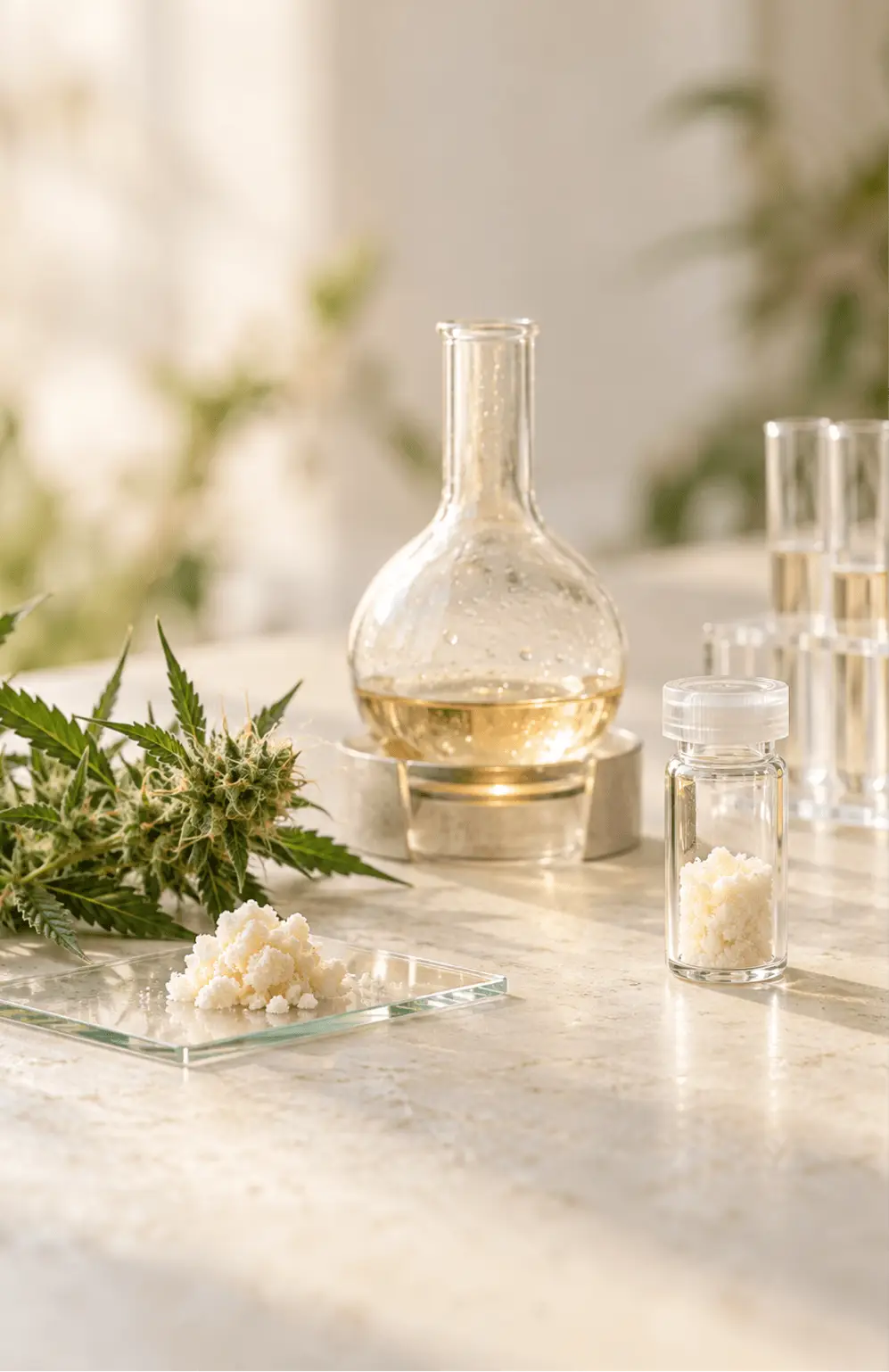
Being the starting point is a statement about the plant, not about the bottle on your shelf. In a mature CBD rich hemp plant, CBDA synthase has consumed most of the available CBGa, so what remains at harvest is a small fraction of what was made. Then a second loss: whatever survives decarboxylates to CBG during drying, storage or heated processing. The precursor is squeezed from both ends, so CBGa appears on certificates in small amounts even on products marketed around it.
Decarboxylation also behaves awkwardly here. In the 2016 Mississippi kinetics study, rate constants for THCa were about twice those of CBGa, and CBGa decarboxylation was not straightforward, with an unexplained loss of reactants or products. You cannot calculate a CBG figure from a CBGa figure with any confidence.
Where CBG is genuinely potent
CBG’s most striking potency figure is not at a cannabinoid receptor. In a 2010 study using [35S]GTPgammaS binding with mouse brain membranes, CBG behaved as an alpha-2 adrenoceptor agonist with an EC50 of 0.2 nanomolar. The same work had it antagonizing 5-HT1A agonist 8-OH-DPAT with an apparent KB of 51.9 nanomolar, acting as a competitive CB1 antagonist at 10 micromolar, and inhibiting evoked mouse vas deferens contractions with an EC50 of 72.8 nanomolar.
The authors flagged a puzzle most summaries drop. CBG showed agonism more potently in the binding assay than in isolated tissue, a gap of more than 300-fold they said should be explained. A sub-nanomolar figure from a membrane preparation describes a receptor, not a dose.
In a 2024 double blind, placebo controlled crossover field trial, 34 healthy adults took 20 mg of hemp derived CBG or placebo a week apart, then the Trier Social Stress Test and a verbal memory test. The result was lower anxiety and stress ratings than placebo, no subjective drug effects and no impairment. It is one single dose study in healthy volunteers, with no clinical population.
What the research shows, and does not
CBGa
CBGa bound the SARS-CoV-2 spike protein with micromolar affinity and prevented pseudovirus entry into human epithelial cells (J Nat Prod 2022).
Acidic cannabinoids including CBGa inhibited diacylglycerol lipase alpha in a radiolabeled substrate assay (Br J Pharmacol 2011).
No controlled human trial of isolated CBGa has been published, for any outcome.
No human pharmacokinetic data exist for CBGa, and in mice the brain to plasma ratio for cannabinoid acids was 0.04 or lower.
CBG
In 34 healthy adults, 20 mg of hemp derived CBG recorded lower self reported anxiety and stress than placebo in a double blind crossover trial (Sci Rep 2024).
CBG was an alpha-2 adrenoceptor agonist at EC50 0.2 nanomolar and a 5-HT1A antagonist at apparent KB 51.9 nanomolar in mouse brain membranes.
A pilot crossover study found a high fat meal significantly raised Cmax, exposure and terminal half life after a 25 mg oral CBG dose.
No trial has tested CBG against an active comparator or in a clinical population.
The asymmetry is the story. CBG has one small randomized trial, one pilot pharmacokinetic study and a reasonably characterized receptor profile from animal tissue. CBGa has in vitro work, no human trial and no pharmacokinetics. Writing about CBGa as a compound you take runs ahead of the evidence.
What people get wrong
01CBGa matters most because everything is made from it.
A fact about biosynthesis. By harvest the synthase enzymes have consumed most of it, and the rest decarboxylates to CBG, leaving a minor constituent of any extract.
02CBG is non-intoxicating, so it does nothing.
At 20 mg in a placebo controlled crossover trial it produced no subjective drug effects and no measured impairment, yet anxiety ratings separated from placebo.
03An EC50 of 0.2 nanomolar means a tiny dose is enough.
That figure comes from a mouse brain membrane binding assay; the same study measured 72.8 nanomolar in isolated tissue. It describes a receptor, not a dose.
04A raw product gives you the CBGa benefits.
No controlled human trial of CBGa has been published, so there is no measured outcome to pass on. A raw product retains more CBGa, a composition fact.
Choosing between them
The compound that has at least been studied in people is CBG, and the human record is one 34 person single dose trial, so hold it loosely. If you want CBGa, you are choosing a cold processed raw extract and should expect a small certificate number, because the plant used most of it and heat converted the rest.
One practical point is specific to CBG. In the pilot pharmacokinetic study, dietary fat affected CBG blood levels more than the delivery vehicle did, so taking it with food is the best supported variable.
Still weighing up the options? See CBGa vs CBDa, CBG vs CBD or CBDA vs THCA. Endoca products related to this comparison: Raw CBD + CBDa oil.
Legal status and safety
Legal status in the United States
Neither CBG nor CBGa is scheduled in its own right. The 2018 Farm Bill defined hemp by a delta-9 THC concentration of not more than 0.3 percent on a dry weight basis. Section 781 of Public Law 119-37 rewrote it, and from 11 December 2026 hemp means not more than 0.3 percent total THC by dry weight, including tetrahydrocannabinolic acid, with finished hemp derived cannabinoid products capped at 0.4 milligrams of total THC and similarly acting cannabinoids per container.
A CBG rich extract is still a hemp extract and total THC is calculated on the whole product, so a raw CBG product carrying THCa faces the same recalculation. FDA has not authorized CBG or CBGa as a dietary supplement ingredient or a food additive.
Safety
The human safety data for CBG is one trial of 34 adults at a single 20 mg dose, reporting no subjective drug effects and no motor or cognitive impairment. That is reassuring at that dose and sample size, and not a safety dataset. No repeat dose study, no study in people on other medicines and none at higher doses has been published.
For CBGa there is no human safety information of any kind, so the honest position is to say so rather than borrow cannabidiol’s safety profile. The interaction data for cannabidiol do not cover these two compounds, which is worth raising with a prescriber.
How Endoca tests for this
Our hemp is grown on our own farm and extracted by us, as it has been since 2010. Every batch certificate reports CBG and CBGa as separate lines alongside CBD, CBDa, THC and THCa, the only way to see how much of each is present rather than implied by a product name.
It measures how much is in the batch, not what either compound does, and in RAW CBD+CBDa Oil 150mg both appear as minor constituents because the plant converted most of the CBGa before harvest. We report the measured number, not a target.
Frequently asked questions
It is the compound CBG comes from, which is not the same thing. CBGa is the acid the plant builds and its synthase enzymes consume, and CBG is what remains after decarboxylation. Only CBG has been given to people in a published trial.
In the one controlled trial, 20 mg produced no subjective drug effects and no measured impairment. The study also recorded lower anxiety and stress ratings than placebo. That is a single dose finding in 34 healthy adults and nothing more.
Because the plant uses it. CBGa is the substrate for the enzymes that make CBDa, THCa and CBCa, so most is converted before harvest, and whatever survives decarboxylates to CBG. Small certificate numbers for CBGa are the norm, not a defect.
The pharmacokinetic evidence points that way. In a pilot crossover study of a single 25 mg oral dose, a high fat meal significantly raised peak plasma concentration, total exposure and terminal half life, and mattered more than the delivery vehicle did.
There are no human trials of CBGA. Research is limited to lab and animal work, so specific benefits have not been shown in people.
No. CBGA is a non-intoxicating acid. Heat converts it to CBG, which is not intoxicating either.
References
01
Cascio MG, Gauson LA, Stevenson LA, Ross RA, Pertwee RG. Evidence that the plant cannabinoid cannabigerol is a highly potent alpha2-adrenoceptor agonist and moderately potent 5HT1A receptor antagonist. Br J Pharmacol 2010;159(1):129-141.
02
Cuttler C, Stueber A, Cooper ZD, Russo E. Acute effects of cannabigerol on anxiety, stress, and mood: a double-blind, placebo-controlled, crossover, field trial. Sci Rep 2024;14(1):16163.
03
Story G, Lee J, Cohen G, Rani A, Doherty J, Sela DA. Impact of Dietary Fat and Oral Delivery System on Cannabigerol Pharmacokinetics in Adults. Cannabis Cannabinoid Res 2024;9(6):1543-1555.
04
De Petrocellis L, Ligresti A, Moriello AS, et al. Effects of cannabinoids and cannabinoid-enriched Cannabis extracts on TRP channels and endocannabinoid metabolic enzymes. Br J Pharmacol 2011;163(7):1479-1494.
05
van Breemen RB, Muchiri RN, Bates TA, et al. Cannabinoids Block Cellular Entry of SARS-CoV-2 and the Emerging Variants. J Nat Prod 2022;85(1):176-184.
06
Wang M, Wang YH, Avula B, et al. Decarboxylation Study of Acidic Cannabinoids: A Novel Approach Using Ultra-High-Performance Supercritical Fluid Chromatography/Photodiode Array-Mass Spectrometry. Cannabis Cannabinoid Res 2016;1(1):262-271.
07
Anderson LL, Low IK, Banister SD, McGregor IS, Arnold JC. Pharmacokinetics of Phytocannabinoid Acids and Anticonvulsant Effect of Cannabidiolic Acid in a Mouse Model of Dravet Syndrome. J Nat Prod 2019;82(11):3047-3055.
08
Smeriglio A, Giofre SV, Galati EM, et al. Inhibition of aldose reductase activity by Cannabis sativa chemotypes extracts with high content of cannabidiol or cannabigerol. Fitoterapia 2018;127:101-108.
09
Congressional Research Service. Changes to the Statutory Definition of Hemp and Implications for Agricultural Policy. CRS In Focus IF13136, 28 September 2026.
Last reviewed 6 October 2026.
These statements have not been evaluated by the Food and Drug Administration. This product is not intended to diagnose, treat, cure, or prevent any disease.