No products in the cart.

- Shop

- About Us

Our Story
From humble beginnings to a global mission – we grow, harvest, and craft hemp with care for people and planet.
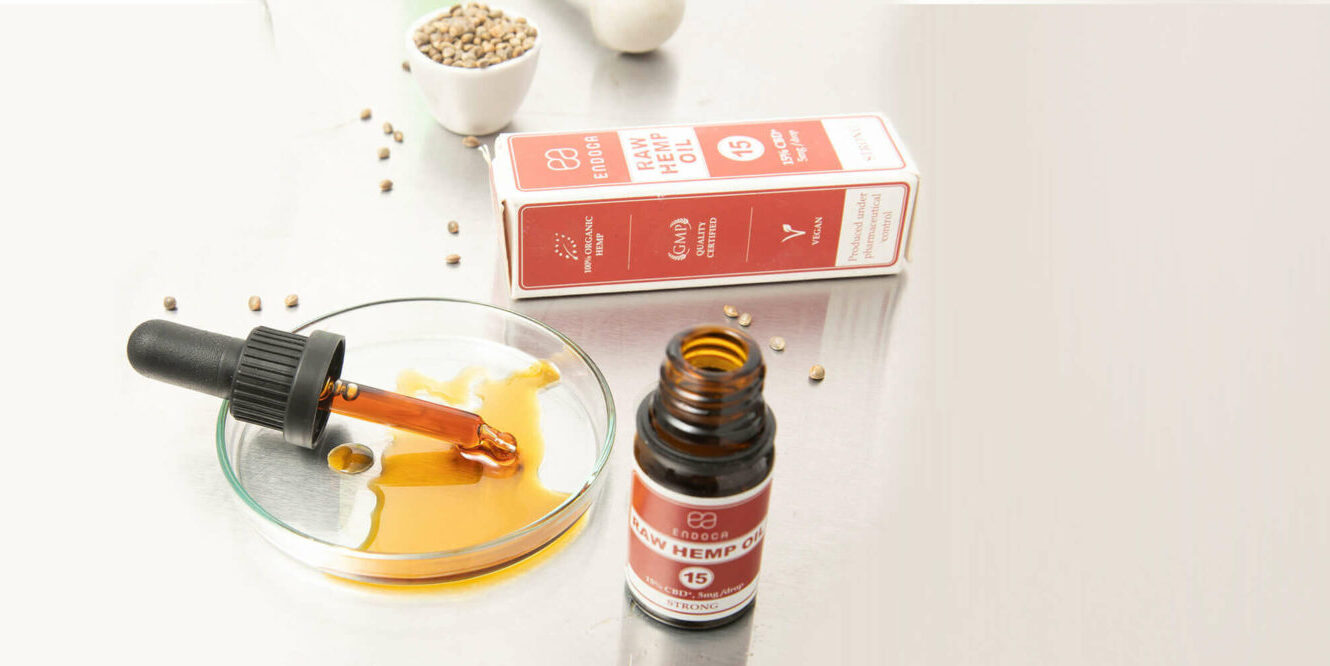
What Is CBD?
CBD is nature’s way to restore balance, calm, and overall well-being – naturally and without the high.

The Process
From seed to shelf, we grow organically, extract cleanly, and follow strict quality standards for purity.

Lab Testing
Every batch is third-party tested to ensure purity, safety, and the exact amount of CBD every time.

Our Values
Sustainability, transparency, and wellness guide every decision – for you and for the planet.
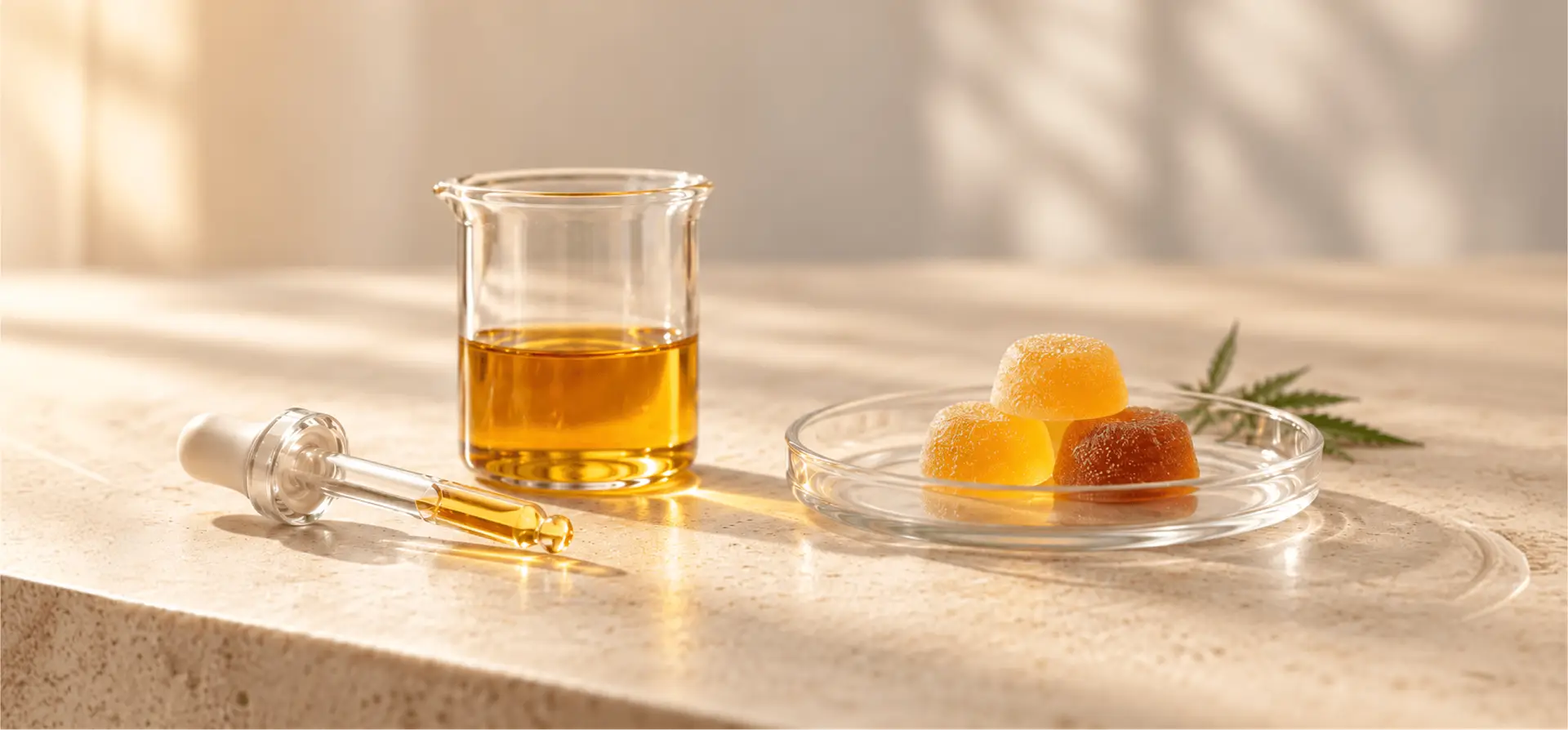
At a glance
What actually differs
Both formats are swallowed, and that is the first thing most comparisons get wrong. A participant-blinded randomized crossover in 8 healthy men gave the same hemp oil as sublingual drops and inside gelatin capsules. Peak plasma CBD was 24.0 ng/mL from the drops and 28.0 ng/mL from the capsules, both at 4 hours, with no difference in exposure across 6 hours. The authors reported comparable plasma profiles, and that shared 4-hour peak points to gut absorption, not the oral mucosa. A gummy is chewed and swallowed, so it travels exactly the same path through gut and liver.
That path runs through the liver first. Phase I metabolism of CBD is handled by CYP2C19 and CYP3A4 and phase II by UGT1A7, UGT1A9 and UGT2B7, and the inactive metabolite 7-COOH-CBD circulates at roughly 40 times the exposure of CBD itself. Food changes how much survives. A high-fat, high-calorie meal raised peak concentration 5-fold and total exposure 4-fold at 750 and 1,500 mg doses. In 8 adults with refractory epilepsy taking CBD capsules, a high-fat meal of 840 to 860 calories raised peak concentration 14-fold against fasting.
Where the difference actually shows up
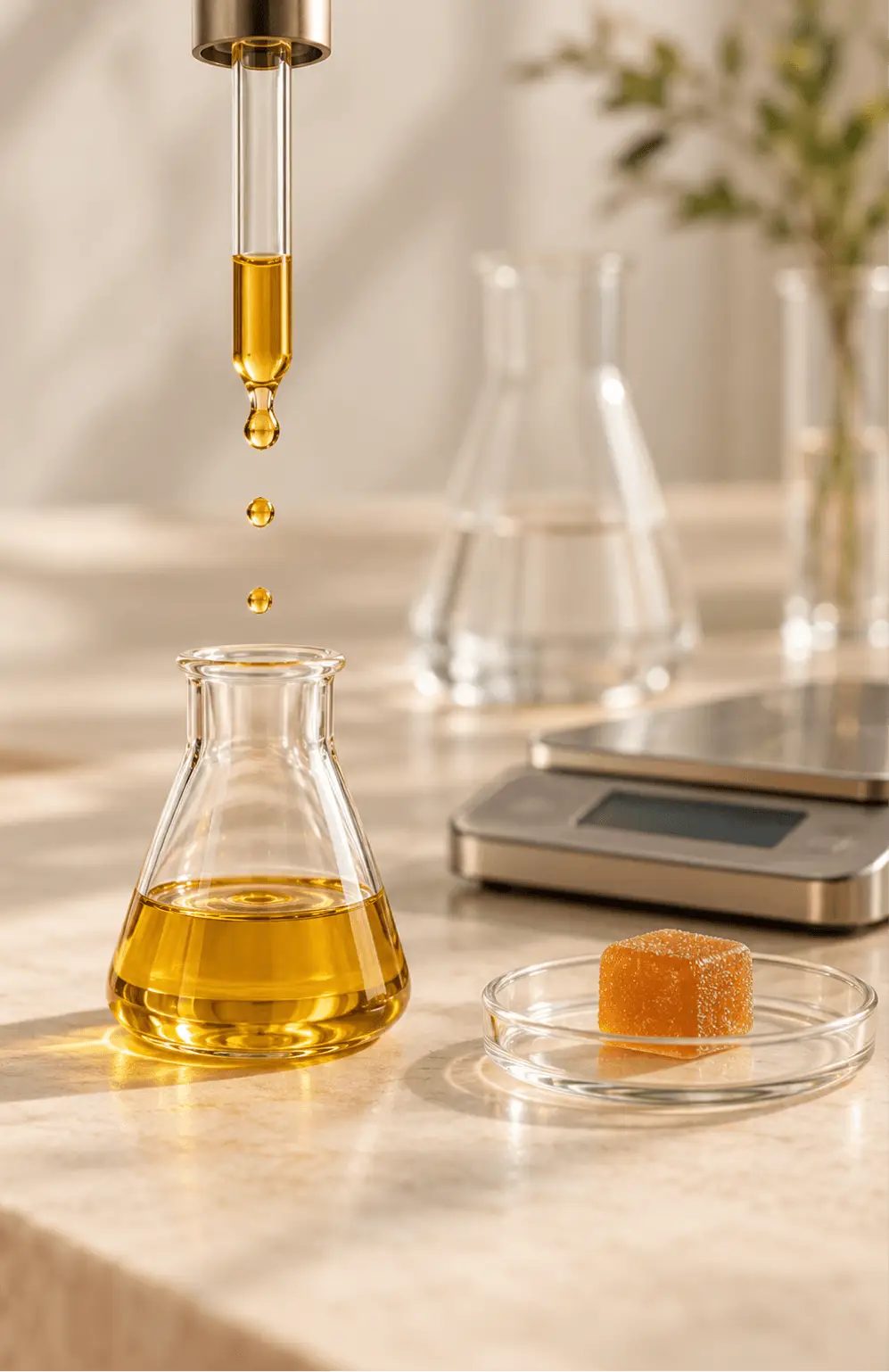
Dose control is the real split. Endoca’s 15 percent raw oil declares 5 mg of CBD+CBDa per drop, so a dose can be raised or lowered 5 mg at a time. A gummy cannot be split meaningfully. It is also harder to read: the Mountain High gummy declares 300 mg of full spectrum hemp extract per gummy, which is extract weight rather than cannabinoid weight, while the Chill and Restore jars declare 1,200 mg per jar rather than per piece.
Then there is what is actually in the piece. An LC-MS/MS analysis of 56 CBD gummy products sold by national brands found a mean of 21.38 mg of CBD per gummy across a range of 5.70 to 59.99 mg, 70 percent of products more than 10 percent away from their labeled dose, and variation from gummy to gummy inside a single bottle. None were Endoca products, but they describe the category a gummy buyer is choosing inside. If you want to titrate, use drops. If you want to stop thinking about it, a gummy is one unit and that is the point.
What human data exists for each format
CBD oil
Hemp oil drops containing 69 mg CBD per mL produced a peak plasma CBD of 24.0 ng/mL at 4 hours in 8 healthy males.
Five oral CBD preparations at 30 mg each in 15 adults gave peaks of 1.29 to 5.57 ng/mL and times to peak of 0.70 to 3.39 hours.
No study has measured the absolute oral bioavailability of CBD from an oil, or from any route other than smoking.
CBD gummies
No human pharmacokinetic study of a CBD gummy has been published, so every onset figure quoted for gummies is borrowed from another format.
LC-MS/MS testing of 56 CBD gummy products found a mean of 21.38 mg CBD per gummy across a range of 5.70 to 59.99 mg.
In those same 56 products, 70 percent were more than 10 percent off their labeled dose and 39 percent contained delta-9-THC.
The oil column has thin but real human pharmacokinetic data. The gummy column has none at all. What the gummy literature does have is analytical work on what is in the jar, and that work is not reassuring. Neither format has a measured bioavailability, a measured onset of effect or a measured duration.
What people get wrong
01Gummies are weaker than oil.
Nothing in the human literature ranks them. No trial has compared a gummy with an oil, and the absolute bioavailability of neither has been measured, so a potency ranking has nothing to rest on.
02Holding oil under your tongue gets more into your blood.
A randomized crossover found the same oil as sublingual drops and in swallowed capsules gave the same peak, the same 4-hour timing and the same exposure, which points to gut absorption rather than the mouth.
03A gummy labeled 300 mg gives you 300 mg of CBD.
On the Mountain High gummy that figure is full spectrum hemp extract per gummy, not CBD. Extract weight and cannabinoid weight are different quantities, and the certificate of analysis carries the second one.
Choosing between them
Choose the oil if you want to control the number. Five milligrams per drop means you can work upward slowly, hold a dose for a week and change it without buying a different product. Choose gummies if the dropper is the reason you keep forgetting, or if the taste of hemp is what stops you. Both are swallowed, both face the same first pass, and taking either with a fatty meal will do more for absorption than switching between them. If trace THC matters to you, the broad spectrum gummies are the THC free option in the range.
Still weighing up the options? See CBD capsules vs gummies or CBD oil vs capsules. For more background, read our guide on how to take CBD drops. Endoca products related to this comparison: CBD gummies and CBD oil.
Legal status and safety
Legal status in the United States
Hemp and hemp-derived CBD stopped being controlled substances under the 2018 Farm Bill, which set the line at 0.3 percent delta-9 THC on a dry weight basis. Public Law 119-37 replaces that test from 11 December 2026 with a total THC standard, caps finished products at 0.4 mg of total THC per container and excludes cannabinoids synthesized outside the plant. A per-container cap lands hardest on multi-piece formats: in the 56-gummy analysis, 16 percent of products held more than 0.4 mg of delta-9-THC in a single gummy. FDA has not concluded that CBD can be lawfully marketed in a dietary supplement.
Safety
In the phase 1 single and multiple ascending dose trial of purified CBD, diarrhea, nausea, headache and somnolence were the most common adverse events, all mild or moderate, at doses far above anything in a consumer product. CBD is metabolized by CYP2C19 and CYP3A4, so it can interact with prescribed medicines, and that is a conversation for a prescriber rather than a product page. The food effect cuts both ways: a gummy eaten after dinner is not the same dose as the same gummy on an empty stomach.
How Endoca tests for this
Our hemp is grown on our own land and extracted with our own supercritical CO2 equipment, and we have published batch reports since 2010. Cannabinoid content is measured by HPLC and confirmed by NMR, and each batch is screened for more than 200 pesticides as well as heavy metals and mycotoxins at third party laboratories, with reports at lab.endoca.com. What a certificate of analysis cannot do is measure bioavailability, onset or duration. It tells you what is in the drop and in the gummy, which is the thing the 56-product analysis found missing elsewhere.
Frequently asked questions
Nobody knows, because no trial has compared them. Both are swallowed and both go through the same first-pass metabolism, so there is no pharmacological reason to expect a large gap. The measurable difference is dose control: oil moves in 5 mg steps per drop, a gummy is one fixed unit.
There is no published human pharmacokinetic study of a CBD gummy, so no figure for a gummy exists. In human studies of swallowed CBD, plasma concentrations peak between roughly 0.7 and 5 hours depending on dose and food. Onset of a felt effect has not been measured for either format.
With food, and ideally with fat. A high-fat, high-calorie meal raised peak CBD concentration 5-fold and total exposure 4-fold in the registration pharmacokinetics for purified CBD, and a study in epilepsy patients found a 14-fold rise in peak concentration with a high-fat meal.
That depends on the product, not the format. Endoca’s full spectrum oils and Mountain High gummies carry trace THC declared below 0.2 percent, while the Restore and Energy gummies are broad spectrum and sold as THC free. Check the batch certificate rather than the format.
Neither format has been shown to be better for sleep. Oil gives you finer control over the dose and a faster onset; gummies give a fixed dose and slower onset. Choose the one you will take consistently.
Swallowed CBD, as in a gummy, takes longer to start and tends to last longer than oil held under the tongue, because it goes through digestion first. Individual results vary.
References
01
Johnson DA, Funnell MP, Heaney LM, Cable TG, Wheeler PC, Bailey SJ, Clifford T, James LJ. Cannabidiol Oil Ingested as Sublingual Drops or Within Gelatin Capsules Shows Similar Pharmacokinetic Profiles in Healthy Males. Cannabis Cannabinoid Res 2024;9:e1423-e1432.
02
Williams NNB, Ewell TR, Abbotts KSS, Harms KJ, Woelfel KA, Dooley GP, Weir TL, Bell C. Comparison of Five Oral Cannabidiol Preparations in Adult Humans. Pharmaceuticals 2021;14:35.
03
Johnson ED, Kilgore MW, Stafford M, Randolph M, Glover M, Babalonis S. Cannabidiol Gummy Products: LC-MS/MS Assessment of Cannabinoid Concentrations. Cannabis Cannabinoid Res 2025;10:710-718.
04
Millar SA, Stone NL, Yates AS, O’Sullivan SE. A Systematic Review on the Pharmacokinetics of Cannabidiol in Humans. Front Pharmacol 2018;9:1365.
05
Birnbaum AK, Karanam A, Marino SE, Barkley CM, Remmel RP, Roslawski M, Gramling-Aden M, Leppik IE. Food effect on pharmacokinetics of cannabidiol oral capsules in adult patients with refractory epilepsy. Epilepsia 2019;60:1586-1592.
06
Taylor L, Gidal B, Blakey G, Tayo B, Morrison G. A Phase I, Randomized, Double-Blind, Placebo-Controlled, Single Ascending Dose, Multiple Dose, and Food Effect Trial of Highly Purified Cannabidiol in Healthy Subjects. CNS Drugs 2018;32:1053-1067.
07
FDA. EPIDIOLEX prescribing information, 2025.
08
Congressional Research Service. Changes to the Statutory Definition of Hemp and Issues for Congress. IF13136, updated 17 August 2026.
Last reviewed 1 October 2026.
These statements have not been evaluated by the Food and Drug Administration. This product is not intended to diagnose, treat, cure, or prevent any disease.