No products in the cart.

- Shop
- About Us

Our Story
From humble beginnings to a global mission – we grow, harvest, and craft hemp with care for people and planet.
What Is CBD?
CBD is nature’s way to restore balance, calm, and overall well-being – naturally and without the high.
The Process
From seed to shelf, we grow organically, extract cleanly, and follow strict quality standards for purity.
Lab Testing
Every batch is third-party tested to ensure purity, safety, and the exact amount of CBD every time.
Our Values
Sustainability, transparency, and wellness guide every decision – for you and for the planet.
At a glance
What these two actually are
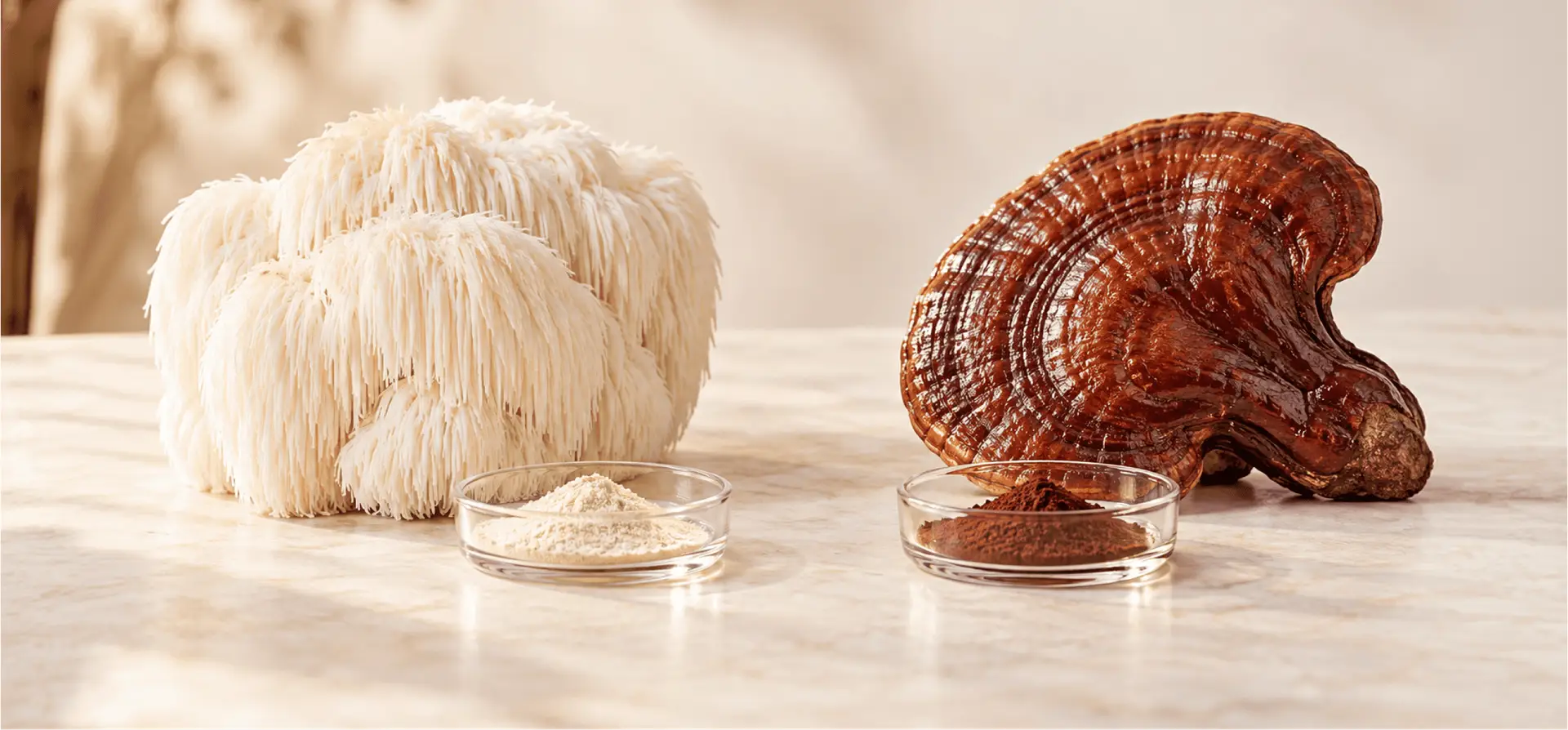
Lion’s mane is taxonomically settled. Hericium erinaceus is a wood-rotting tooth fungus with long white spines, grown on hardwood sawdust and eaten as a vegetable. Reishi is not settled. Nearly every label reads Ganoderma lucidum, the type species designated from an 1881 collection, but Du and colleagues re-examined the Ganoderma sichuanense holotype in 2023 and concluded that Chinese cultivated lingzhi is that species, with Ganoderma lingzhi a later synonym of it.
Part used divides them more sharply than species does. Hericenones C to H were isolated from lion’s mane fruiting bodies and erinacines A to I from its mycelia, so a fruiting body powder and a mycelium powder are not two grades of one product. In reishi the division runs between cell wall beta-glucans and the triterpenoid ganoderic acids.
All of it is measurable. Beta-glucan can be reported separately from starch, hericenones and erinacine A resolve with ergosterol in a single validated run, and 17 Ganoderma triterpenes can be quantified against one reference standard. The assays are published and in routine use. Printing the results is what almost nobody does.
Beta-glucans, and why the number on the label may not mean what you think
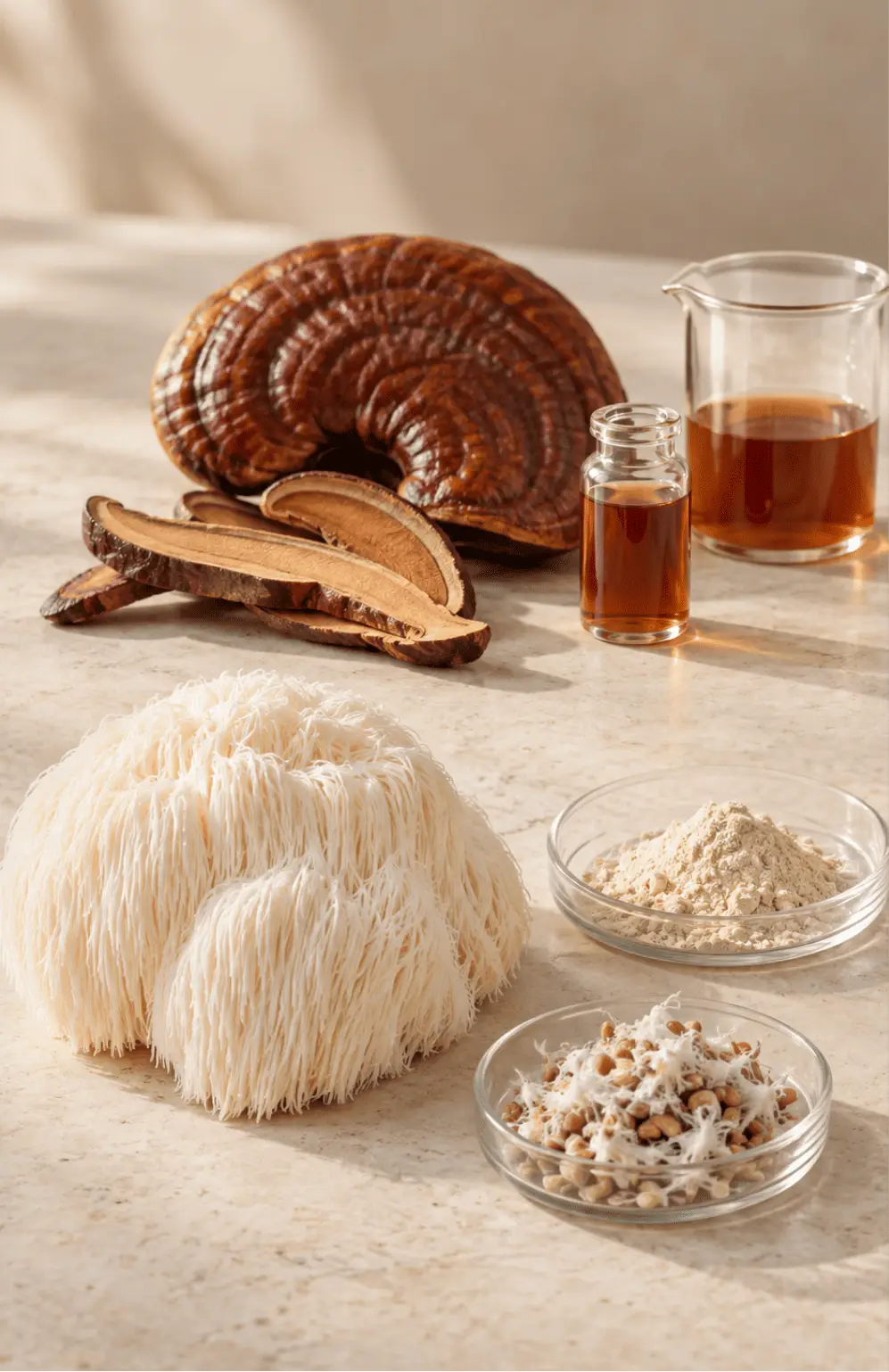
Polysaccharide content is not beta-glucan content, and the difference is grain. Mycelium is usually grown on sterilized cereal grain and never separated from it. McCleary and Draga measured the result: in mycelial products the bulk of the grain starch remains intact and is by far the major glucan in the finished product. A crude polysaccharide figure counts that starch as fungal. A beta-glucan figure subtracts it.
The method is the reason it can. Total glucan is released by acid hydrolysis, alpha-glucan is measured separately, and beta-glucan is reported as the difference between them. For scale, a 39-species screen put turkey tail at 60.79 g beta-glucan per 100 g dry matter against 0.41 g alpha-glucan, and maitake at 25.99 g against 5.04 g.
Even a beta-glucan figure carries its method. Enzyme-only assays returned much lower values than the sulfuric acid procedure, and Ganoderma read significantly higher with sulfuric acid than with hydrochloric acid, so two reishi percentages are not comparable unless both name the assay. Our own lion’s mane gummy extract is standardized to 50 percent polysaccharides, not beta-glucan, and we would rather say so.
What the human evidence shows
Lion's mane
In 30 Japanese adults with mild cognitive impairment taking 3 g a day for 16 weeks, cognitive scale scores beat placebo at weeks 8, 12 and 16.
In 41 healthy adults, a single 1.8 g dose gave faster Stroop times at 60 minutes; the 28 day stress result was a trend only.
No trial compares a lion's mane fruiting body extract against a mycelium extract at a matched dose.
Reishi
In 84 adults with type 2 diabetes and metabolic syndrome, 3 g a day for 16 weeks moved no primary or secondary outcome.
A Cochrane review found no reduction in HbA1c across 130 participants, and none in total cholesterol, LDL cholesterol or body mass index across 107.
A second Cochrane review pooled a 3.91 percent rise in CD3 percentage in cancer patients, 95 percent confidence interval 1.92 to 5.90, with CD4 at 3.05 and CD8 at 2.02.
The asymmetry is the finding. Lion’s mane has small positive trials, the largest 41 participants, and none compares the two parts of the fungus. Reishi has been tested at larger scale and the numbers came back flat. More trials is not better evidence.
What people get wrong
01Reishi is Ganoderma lucidum.
On the label, yes. Taxonomically, cultivated Asian lingzhi was re-identified in 2023 as Ganoderma sichuanense, with Ganoderma lingzhi a later synonym. Ganoderma lucidum was named in 1881 from a different collection.
02A high polysaccharide percentage means a strong extract.
It can mean the opposite. Cereal starch counts as polysaccharide, so a mycelium-on-grain product can post a high figure while holding almost no beta-glucan. Beta-glucan is the number that separates them.
03Reishi has thousands of years of evidence behind it.
It has thousands of years of use, which is different. The controlled trials are few, small and mostly at unclear risk of bias, and the largest moved nothing it measured.
Choosing between them
Choose on compound class, then check the part used. If hericenones or erinacines are the interest, that is lion’s mane, and you need to know whether the material is fruiting body or mycelium, because those families do not occur in both. If ganoderic acids are the interest, that is reishi, and the extract needs an alcohol step, because hot water leaves triterpenoids behind. If beta-glucans alone are the point, either species carries them and hot water is enough. What should not decide it is a polysaccharide percentage on the front of a jar.
Still weighing up the options? See Lion’s mane vs reishi vs cordyceps or Reishi vs chaga. For more background, read our guide on the best mushroom for sleep. Endoca products related to this comparison: Lion’s Mane Extract and Red Reishi Mushroom Extract.
Legal status and safety
Legal status in the United States
Lion’s mane and reishi sell here as dietary supplements under the Dietary Supplement Health and Education Act of 1994. That framework allows structure and function statements, which must be truthful, substantiated and carried with the disclaimer below. It does not allow a claim that a mushroom treats, prevents or cures a disease, and FDA has approved no mushroom supplement for any disease. The Federal Trade Commission’s 2022 health products compliance guidance asks for competent and reliable scientific evidence, which for a health claim generally means randomized controlled human trials. The record for these two species does not reach that bar.
Safety
Reishi carries the specific signal. A fatal case of fulminant hepatitis was reported in a patient who had taken boiled lingzhi for some time without incident, then switched to lingzhi powder for one to two months; the patient was also taking other medicines, as was a similar case reported the year before. The Cochrane review found participants on reishi 1.67 times as likely to report an adverse event as placebo, 95 percent confidence interval 0.86 to 3.24, none of them serious. Lion’s mane looks better tolerated, with no adverse laboratory finding across 16 weeks. Neither species has human safety data in pregnancy, breastfeeding or childhood.
How Endoca tests for this
We will name the gap rather than paper over it. Our mushroom range is tested for identity and for the contaminants that matter, heavy metals, pesticides and microbes, and the hemp side of this business has published batch certificates from our own farm, our own land and our own extraction since 2010. What our mushroom certificates do not yet carry is a beta-glucan figure measured as beta-glucan rather than as crude polysaccharide. Our lion’s mane gummy extract is declared at 50 percent polysaccharides.
Frequently asked questions
Neither has the evidence to settle it. Lion’s mane has small randomized trials, the largest 41 participants. Reishi has been tested at larger scale, and the 84 person trial of 3 g a day moved no outcome at all. They carry different compound families, so pick by compound.
Whether you are buying mushroom or grain. A crude polysaccharide assay counts the starch from the cereal substrate that mycelium grows on, and McCleary and Draga found that starch is usually the major glucan in a mycelial product. A beta-glucan assay subtracts it.
For reishi, yes, if triterpenoids are the point. Ganoderic acids are not water soluble, so a hot water extract carries the beta-glucans and leaves them behind. The same logic applies to hericenones in lion’s mane. For beta-glucans alone, hot water is enough.
Not the cultivated kind. A 2023 re-examination of the Ganoderma sichuanense holotype concluded that Chinese cultivated lingzhi is that species, and that Ganoderma lingzhi, described in 2012, is a later synonym. Ganoderma lucidum survives on labels as a trade name.
Many people do, and no interaction between the two is known. There is no trial of the combination, so the evidence for each still stands on its own.
That is a common pattern based on traditional use, with lion’s mane for focus and reishi for winding down. No trial has tested the timing.
References
01
Mori K, Inatomi S, Ouchi K, Azumi Y, Tuchida T. Improving effects of the mushroom Yamabushitake (Hericium erinaceus) on mild cognitive impairment: a double-blind placebo-controlled clinical trial. Phytother Res. 2009;23(3):367-372.
02
Docherty S, Doughty FL, Smith EF. The acute and chronic effects of lion’s mane mushroom supplementation on cognitive function, stress and mood in young adults: a double-blind, parallel groups, pilot study. Nutrients. 2023;15(22):4842.
03
Wang J, Wu J, Yamaguchi R, et al. Uncovering hericenones from the fruiting bodies of Hericium erinaceus through interdisciplinary collaboration. J Nat Prod. 2025;88(1):80-85.
04
McCleary BV, Draga A. Measurement of beta-glucan in mushrooms and mycelial products. J AOAC Int. 2016;99(2):364-373.
05
Sari M, Prange A, Lelley JI, Hambitzer R. Screening of beta-glucan contents in commercially cultivated and wild growing mushrooms. Food Chem. 2017;216:45-51.
06
Du Z, Li Y, Wang XC, Wang K, Yao YJ. Re-examination of the holotype of Ganoderma sichuanense (Ganodermataceae, Polyporales) and a clarification of the identity of Chinese cultivated lingzhi. J Fungi (Basel). 2023;9(3):323.
07
Liu W, Zhang J, Han W, et al. One single standard substance for the simultaneous determination of 17 triterpenes in Ganoderma lingzhi and its related species using high-performance liquid chromatography. J Chromatogr B. 2017;1068-1069:49-55.
08
Jin X, Ruiz Beguerie J, Sze DM, Chan GC. Ganoderma lucidum (reishi mushroom) for cancer treatment. Cochrane Database Syst Rev. 2016;(4):CD007731.
09
Klupp NL, Chang D, Hawke F, et al. Ganoderma lucidum mushroom for the treatment of cardiovascular risk factors. Cochrane Database Syst Rev. 2015;(2):CD007259.
10
Klupp NL, Kiat H, Bensoussan A, Steiner GZ, Chang DH. A double-blind, randomized, placebo-controlled trial of Ganoderma lucidum for the treatment of cardiovascular risk factors of metabolic syndrome. Sci Rep. 2016;6:29540.
11
Wanmuang H, Leopairut J, Kositchaiwat C, Wananukul W, Bunyaratvej S. Fatal fulminant hepatitis associated with Ganoderma lucidum (lingzhi) mushroom powder. J Med Assoc Thai. 2007;90(1):179-181.
Last reviewed 1 October 2026.
These statements have not been evaluated by the Food and Drug Administration. This product is not intended to diagnose, treat, cure, or prevent any disease.