No products in the cart.

- Shop
- About Us
Our Story
From humble beginnings to a global mission – we grow, harvest, and craft hemp with care for people and planet.
What Is CBD?
CBD is nature’s way to restore balance, calm, and overall well-being – naturally and without the high.
The Process
From seed to shelf, we grow organically, extract cleanly, and follow strict quality standards for purity.

Lab Testing
Every batch is third-party tested to ensure purity, safety, and the exact amount of CBD every time.
Our Values
Sustainability, transparency, and wellness guide every decision – for you and for the planet.
At a glance
What these two actually are
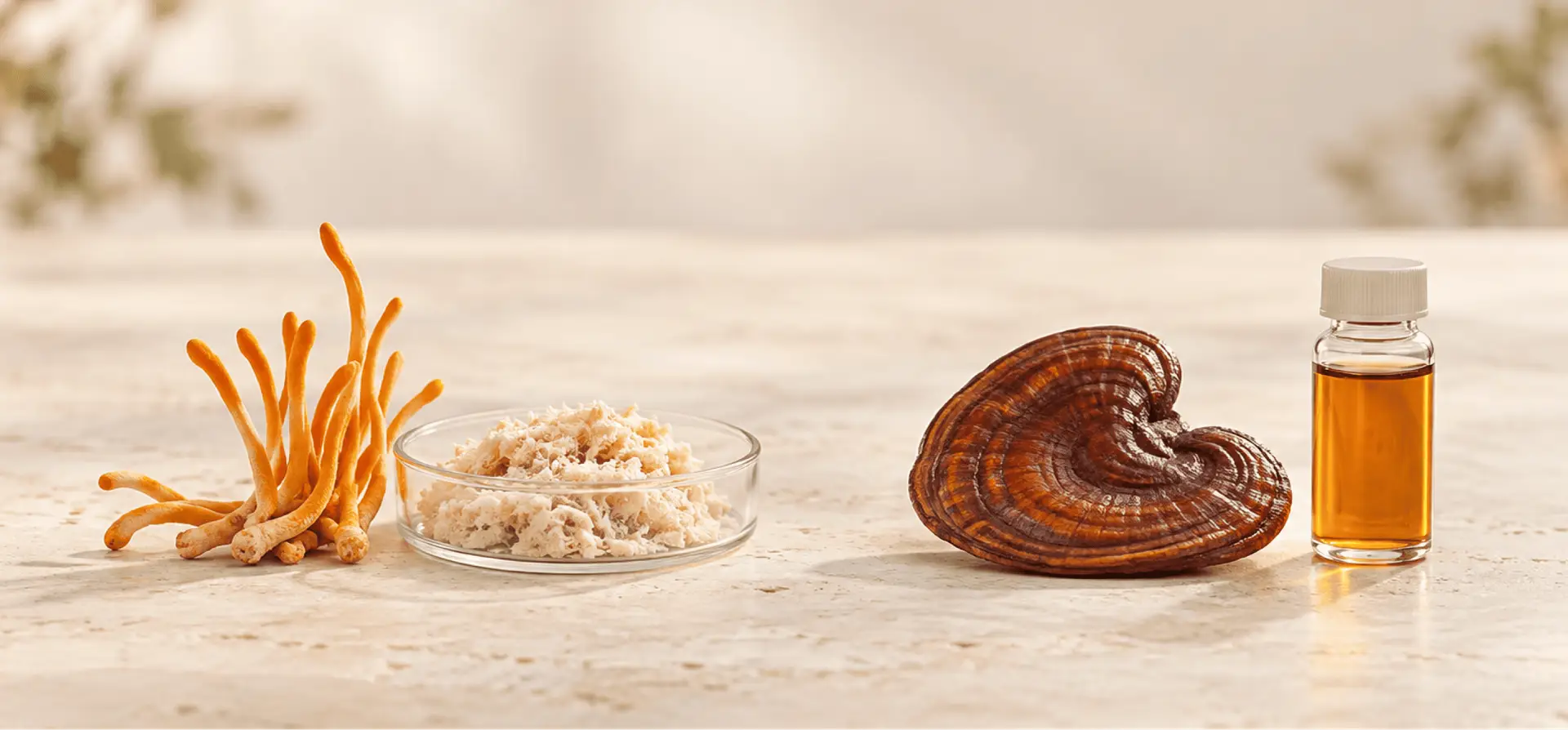
Reishi is one species. Cordyceps is at least two, and the label often will not say which. Ophiocordyceps sinensis, formerly Cordyceps sinensis, is the wild caterpillar fungus of the high plateau, harvested as a stroma still attached to the mummified larva. Cordyceps militaris is a different species, cultivated indoors on grain or silkworm pupae, and it is what most of the cordyceps on open sale actually is.
Cs-4 is the one worth knowing by name. It is a fermented mycelial strain published as Paecilomyces hepiali Chen, and it is the preparation behind most of the Chinese clinical literature on cordyceps. The anamorph of O. sinensis itself is a separate organism, Hirsutella sinensis. A 2015 review of the Chinese cordyceps industry states that the lack of any defined classification system confuses pharmaceutical scientists, and not only consumers.
So a cordyceps capsule can be one of four things: wild O. sinensis, a cultivated C. militaris fruiting body, fermented Cs-4 mycelium, or mycelium grown on grain. Reishi varies by strain and substrate. Cordyceps varies on three axes, and the marker compound changes with each of them.
Beta-glucans, and why the number on the label may not mean what you think
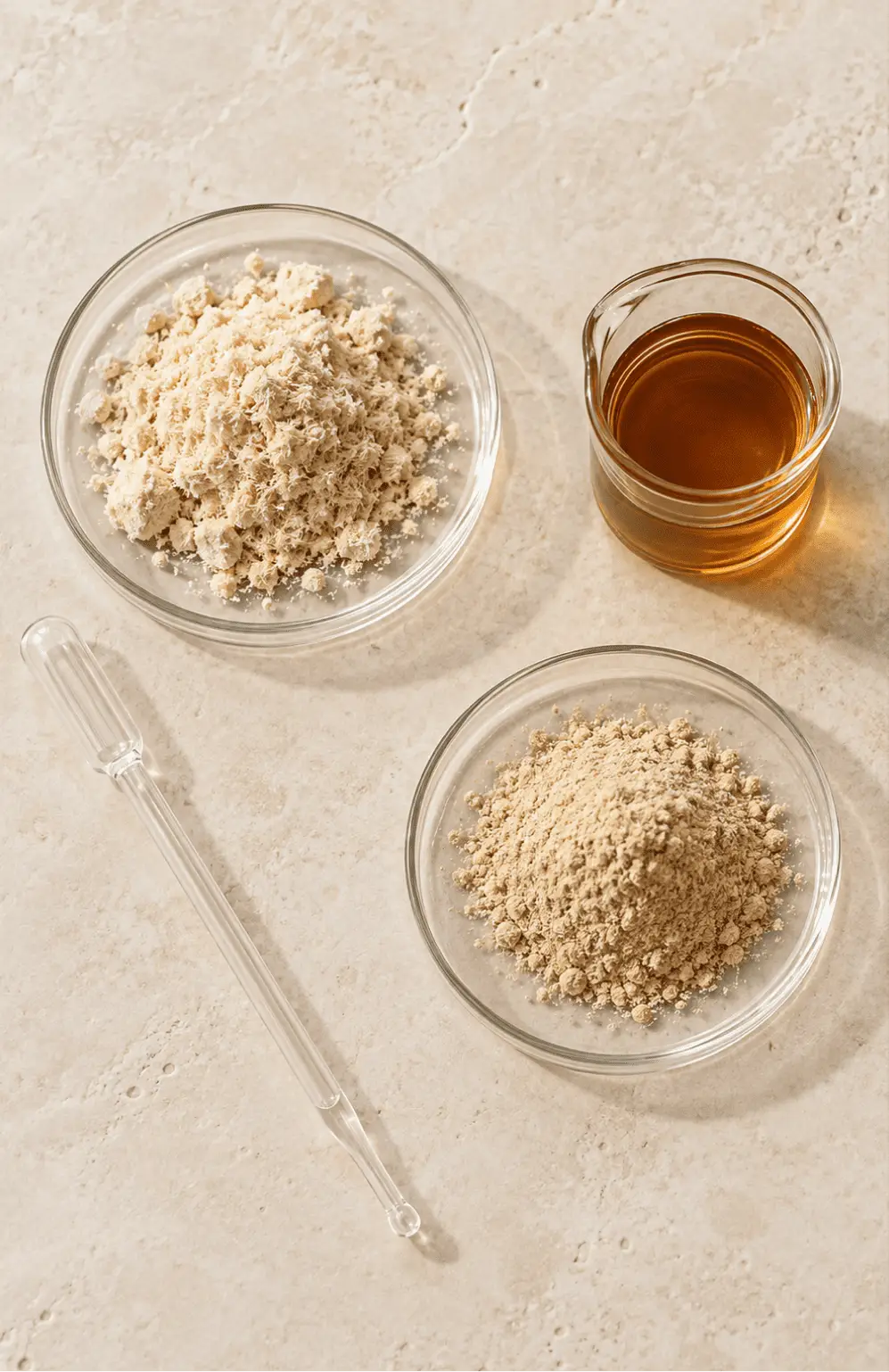
For reishi the headline number is beta-glucan, and it is reported as total glucan minus alpha-glucan. The subtraction exists because grain starch registers as alpha-glucan and would otherwise inflate a crude polysaccharide figure. Ganoderma lucidum fruiting bodies grown on five wood substrates measured 47.5 to 55.9 percent beta-glucan of dry weight on that assay.
Cordyceps is not standardized that way. The Chinese Pharmacopoeia standardizes O. sinensis on adenosine, while Cordyceps militaris is characterized by cordycepin, which is 3′-deoxyadenosine: adenosine with one hydroxyl removed from the ribose. The marker the Pharmacopoeia was written around is not the marker that defines the cultivated species. A product declaring a cordycepin figure is telling you it is militaris.
Neither is a rich source of nucleosides in absolute terms. An HPLC survey of six fungi found total nucleosides and nucleobases from 0.14 to 26.57 mg per g of dry matter, with Cordyceps sinensis, Cordyceps militaris and Ganoderma lucidum all below the three culinary species tested, and under 1 mg per g in the stipe and cap of G. lucidum. Within one fungus, spore-bearing tissue carried far more than the rest.
What the human evidence shows
Cordyceps
The 12-week trial behind cordyceps used Cs-4, not a fruiting body: metabolic threshold rose from 0.83 to 0.93 L/min, p below 0.02, in 20 adults aged 50 to 75.
In that trial VO2 max did not change in either arm, and the placebo group showed no significant threshold change.
A blend containing Cordyceps militaris at 4 g daily gave no significant interaction for VO2 max, ventilatory threshold or time to exhaustion after 1 week in 28 adults.
In the same trial VO2 max improved after 3 weeks, but only in the 10 participants who continued, too small a group to carry weight.
Reishi
In 132 patients with neurasthenia, a G. lucidum polysaccharide extract at 1,800 mg three times daily for 8 weeks lowered Clinical Global Impression severity scores.
In 84 adults with type 2 diabetes, 3 g daily for 16 weeks, with or without Cordyceps sinensis, moved HbA1c by 0.13 percent, 95 percent CI minus 0.35 to 0.60.
A 2026 review found no Ganoderma lucidum nanoformulation had reached human study, naming poor systemic exposure of its triterpenoids and polysaccharides as the bottleneck.
Look closely at the positives. One 20-person trial moved a submaximal threshold without moving VO2 max. One 132-patient trial moved a clinician impression score. The negatives are cleaner: no glucose change at 16 weeks, no exercise change at 1 week, and no head to head species comparison.
What people get wrong
01Cordyceps means one mushroom.
It names at least two fungi: Ophiocordyceps sinensis, Cordyceps militaris and the fermented mycelium Cs-4, published as Paecilomyces hepiali. Their marker compounds differ.
02Cordycepin is the active compound in all cordyceps.
Cordycepin is the marker associated with Cordyceps militaris. The Chinese Pharmacopoeia standardizes Ophiocordyceps sinensis on adenosine instead, which is a different nucleoside. A product declaring cordycepin is declaring its species.
03Reishi and cordyceps are interchangeable adaptogens.
Chemically they are not close. Reishi carries beta-glucans and ganoderic acid triterpenoids; cordyceps is standardized on nucleosides. The one trial that gave both together found no HbA1c change.
Choosing between them
These two were tested for different things, which is the most useful way to pick. The cordyceps evidence is exercise physiology: one 12-week trial in 20 older adults on Cs-4, a fermented mycelium rather than a fruiting body. The reishi evidence is oncology adjunct work and symptom scores in small, poor quality trials. If cordyceps is the choice, ask which species and whether the extract is fruiting body, Cs-4 or grain-grown mycelium, because one label word covers all three. If reishi is the choice, ask whether both hot water and alcohol were used.
Still weighing up the options? See Lion’s mane vs cordyceps or Lion’s mane vs reishi vs cordyceps. For more background, read our guides on choosing a cordyceps supplement and choosing a reishi supplement. Endoca products related to this comparison: Cordyceps Mushroom Extract.
Legal status and safety
Legal status in the United States
Cordyceps and reishi are both sold as dietary supplements. Under the Dietary Supplement Health and Education Act a structure/function statement is permitted, must carry the disclaimer below, and must be notified to FDA within 30 days of first use. A disease claim is not permitted, and FDA has approved no cordyceps or reishi preparation as a drug. FTC requires any energy or performance claim to be substantiated by competent and reliable scientific evidence, and for cordyceps that evidence is one 20-person trial of a fermented mycelium. The hemp total THC change under Public Law 119-37, effective 11 December 2026, governs Endoca’s hemp range, not these capsules.
Safety
Both were reasonably well tolerated in the small, short trials that exist. The 16-week trial of reishi with and without cordyceps in 84 adults reported no overall increase in adverse events with either active treatment. The pooled reishi cardiovascular review found adverse events 1.67 times more likely than placebo over 4 months, 95 percent CI 0.86 to 3.24, which is not statistically significant, with nausea, diarrhea and constipation reported and none serious.
Beyond that the record is thin: no human safety data in pregnancy, breastfeeding or childhood, and no interaction studies. Anyone taking antidiabetic, anticoagulant or immunosuppressant medication should raise either mushroom with a clinician first, since both have been studied against glucose and immune endpoints.
How Endoca tests for this
Endoca’s certificate of analysis for each mushroom extract covers identity and contaminant testing, with pesticide, heavy metal and mycotoxin screening to GMP standards and third party verification. The figures a buyer would most want are not on it: no adenosine or cordycepin for the cordyceps capsule, no beta-glucan or triterpene for the reishi. Ask for those rather than read a species name as a spec. Endoca works from its own farm, own land and own extraction, since 2010.
Frequently asked questions
Not necessarily. The word cordyceps covers Ophiocordyceps sinensis, the wild caterpillar fungus, Cordyceps militaris, a cultivated species, and fermented mycelial strains such as Cs-4, published as Paecilomyces hepiali. Their marker compounds differ, so the species matters more than the category name.
One hydroxyl group. Cordycepin is 3′-deoxyadenosine, adenosine with a hydroxyl removed from the ribose. The Chinese Pharmacopoeia standardizes Ophiocordyceps sinensis on adenosine, while cordycepin is the marker associated with Cordyceps militaris, so the two markers point at different species, not different grades.
A fermented mycelial preparation published as Paecilomyces hepiali Chen, and the material behind most of the Chinese clinical work on cordyceps. It is not a fruiting body. The 12-week exercise trial in 20 older adults used Cs-4 at 333 mg three times daily.
Reishi has more trials, mostly small oncology adjunct and cardiovascular studies that two Cochrane reviews rated poor quality. Cordyceps has fewer and smaller: 20 adults on Cs-4 for 12 weeks and 28 on a Cordyceps militaris blend. No trial has compared the two.
Yes, they are commonly combined and no interaction is known. No trial has tested the pair.
Cordyceps is the one associated with energy and exercise, while reishi is traditionally taken to relax. Neither has strong human evidence for energy.
References
01
Chen S, Li Z, Krochmal R, Abrazado M, Kim W, Cooper CB. Effect of Cs-4 (Cordyceps sinensis) on exercise performance in healthy older subjects: a double-blind, placebo-controlled trial. J Altern Complement Med. 2010;16(5):585-590.
02
Hirsch KR, Smith-Ryan AE, Roelofs EJ, Trexler ET, Mock MG. Cordyceps militaris improves tolerance to high-intensity exercise after acute and chronic supplementation. J Diet Suppl. 2017;14(1):42-53.
03
Dong C, Guo S, Wang W, Liu X. Cordyceps industry in China. Mycology. 2015;6(2):121-129.
04
Yuan JP, Zhao SY, Wang JH, Kuang HC, Liu X. Distribution of nucleosides and nucleobases in edible fungi. J Agric Food Chem. 2008;56(3):809-815.
05
Klupp NL, Kiat H, Bensoussan A, Steiner GZ, Chang DH. A double-blind, randomised, placebo-controlled trial of Ganoderma lucidum for the treatment of cardiovascular risk factors of metabolic syndrome. Sci Rep. 2016;6:29540.
06
Tang W, Gao Y, Chen G, Gao H, Dai X, Ye J, Chan E, Huang M, Zhou S. A randomized, double-blind and placebo-controlled study of a Ganoderma lucidum polysaccharide extract in neurasthenia. J Med Food. 2005;8(1):53-58.
07
Klupp NL, Chang D, Hawke F, Kiat H, Cao H, Grant SJ, Bensoussan A. Ganoderma lucidum mushroom for the treatment of cardiovascular risk factors. Cochrane Database Syst Rev. 2015;(2):CD007259.
08
Cortina-Escribano M, Pihlava JM, Miina J, Veteli P, Linnakoski R, Vanhanen H. Effect of strain, wood substrate and cold treatment on the yield and beta-glucan content of Ganoderma lucidum fruiting bodies. Molecules. 2020;25(20):4732.
09
Qu Y, Zhao X, Liu H, Ren R, Qu W, Wang S, Ma G. From remedy to therapy: confronting the bioavailability bottleneck in Ganoderma lucidum translational research. Pharmaceuticals (Basel). 2026;19(8):1171.
10
Ko YF, Liau JC, Lee CS, Chiu CY, Martel J, Lin CS, Tseng SF, Ojcius DM, Lu CC, Lai HC, Young JD. Isolation, culture and characterization of Hirsutella sinensis mycelium from caterpillar fungus fruiting body. PLoS One. 2017;12(1):e0168734.
Last reviewed 1 October 2026.
These statements have not been evaluated by the Food and Drug Administration. This product is not intended to diagnose, treat, cure, or prevent any disease.