No products in the cart.

- Shop
- About Us
Our Story
From humble beginnings to a global mission – we grow, harvest, and craft hemp with care for people and planet.
What Is CBD?
CBD is nature’s way to restore balance, calm, and overall well-being – naturally and without the high.
The Process
From seed to shelf, we grow organically, extract cleanly, and follow strict quality standards for purity.
Lab Testing
Every batch is third-party tested to ensure purity, safety, and the exact amount of CBD every time.
Our Values
Sustainability, transparency, and wellness guide every decision – for you and for the planet.
At a glance
What these two actually are
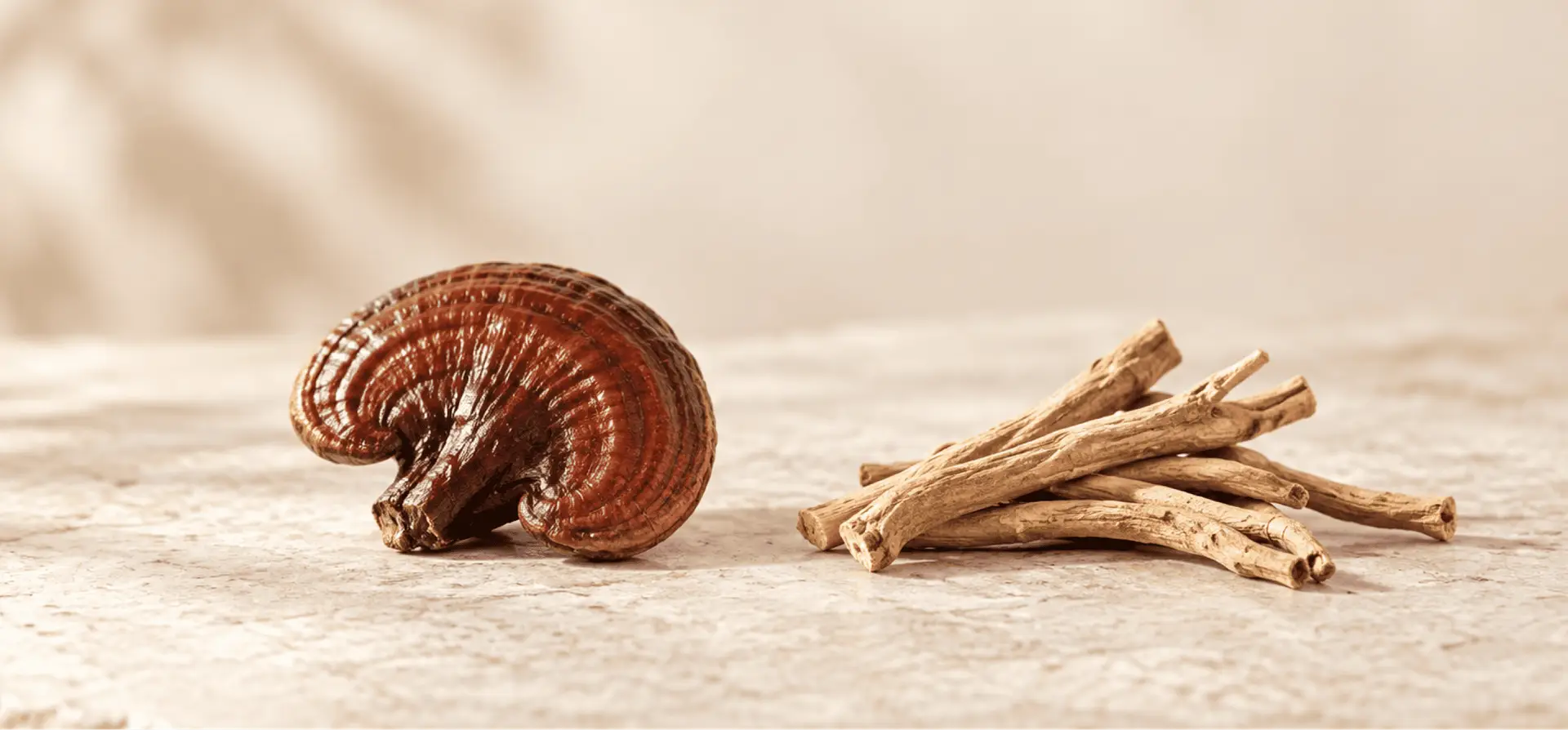
A fungus and a flowering plant, grouped together only by how they are marketed. Reishi is a hard, varnished bracket that grows on wood and is traditionally simmered rather than eaten, so every reishi product is a preparation of some kind. Ashwagandha is a farmed shrub in the same family as tomato and deadly nightshade, and the article of commerce is its root. There is no shared marker compound, no shared assay and no shared pharmacopoeial standard, so a page claiming one is stronger than the other is comparing nothing.
For reishi the quality variable is part used plus solvent. Fruiting body against mycelium grown on grain decides how much of the glucan figure is fungal rather than starch, and because reishi holds two useful compound classes with opposite solubility, a single-solvent extract is incomplete by design rather than by accident or by cost-cutting.
For ashwagandha the variable is withanolide load. Nine marketed Withania somnifera formulations assayed by chromatography showed wide variability in total withanolide content, so two products at the same stated milligram weight are not necessarily comparable materials at all.
Beta-glucans, and why the number on the label may not mean what you think
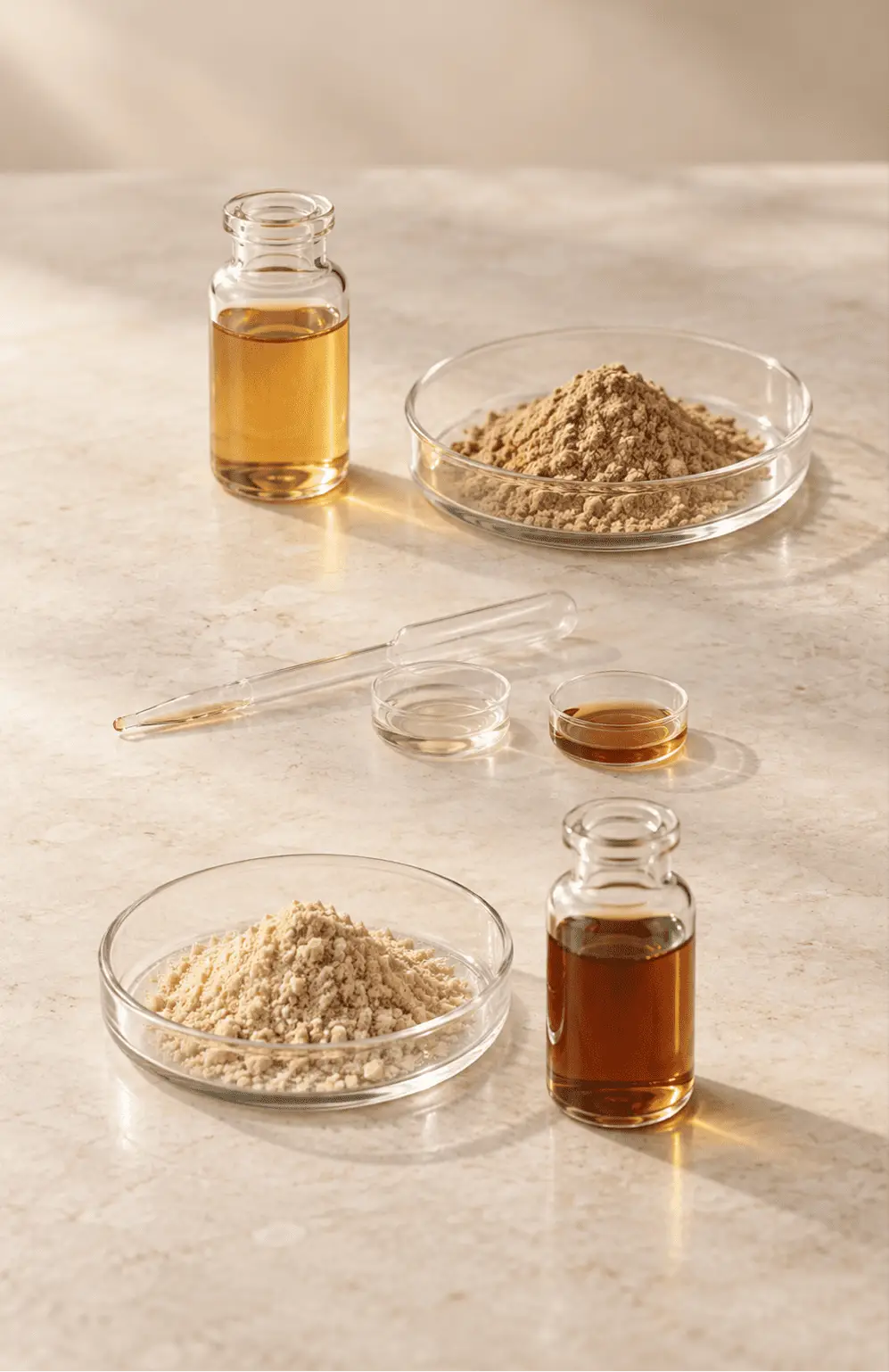
Reishi’s beta-glucan figure is arrived at by subtraction and is unusually sensitive to method. Total glucan is hydrolyzed with acid and read as glucose, alpha-glucan from starch and glycogen is measured separately with glucoamylase, and the difference is reported as beta-glucan. In the validation work for that approach, Ganoderma lucidum was one of only two species where sulfuric acid gave significantly higher values than hydrochloric. Two competent laboratories can therefore publish two different reishi percentages from one powder.
Reishi also loses half its chemistry to the wrong solvent. Beta-glucans come out in hot water and ganoderic acids need alcohol, so a water-only reishi extract has a legitimate glucan number and no triterpenoids at all.
Ashwagandha has no beta-glucan number because a root has no fungal cell wall. Its analogous figure is withanolide content, and solvent governs it just as firmly: in method work on the root, aqueous alcohol mixtures returned the highest total withanolide content. The practical point is the same for both. A percentage without its method and solvent cannot be checked, and a milligram weight tells you how much powder is in the capsule, not how much measured compound.
What the human evidence shows
Reishi
Across 5 randomized cancer trials, tumor response with chemotherapy gave a risk ratio of 1.50 and a confidence interval spanning 0.90 to 2.51.
At 1.4 to 3 grams daily, HbA1c did not move across 130 participants, weighted mean difference minus 0.10 percent, 95 percent CI minus 1.05 to 0.85, nor did total cholesterol, LDL cholesterol or body mass index across 107.
No reishi trial has reported long-term survival, and the cancer trial quality was rated generally unsatisfactory.
Ashwagandha
Pooling 5 randomized trials in 254 adults, Hamilton Anxiety Scale scores dropped 5.96 points, but heterogeneity reached 98 percent.
Pooling 5 trials in 400 adults, sleep measures shifted by a standardized mean difference of 0.59, concentrated above 600 mg daily and beyond 8 weeks.
Quality of life did not change significantly in that sleep review, whose authors stated that data on serious adverse effects remain limited.
These are two different ways of being unproven. Reishi’s clearest trials simply failed, because the cardiovascular endpoints did not move at all. Ashwagandha’s trials mostly succeeded but disagreed with one another so violently that the pooled figure carries very little weight.
What people get wrong
01Reishi and ashwagandha are both adaptogens, so they are interchangeable.
Adaptogen is a marketing category, not an analytical one. Reishi was trialed for tumor response and cardiovascular markers, ashwagandha for anxiety and sleep. No study has compared them.
02Ashwagandha has no real safety issues.
A scoping review to December 2025 found 25 published cases of ashwagandha-associated liver injury. Eighty percent recovered, one received a transplant and three died, all with pre-existing cirrhosis.
03Reishi lowers blood sugar and cholesterol.
It did not. In type 2 diabetes, reishi produced no significant change in HbA1c across 130 participants, or in total cholesterol, LDL cholesterol and body mass index across 107.
Choosing between them
The safety profiles decide this before the evidence does. Ashwagandha is contraindicated in pregnancy and advised against for anyone under 18 and anyone with liver disease, thyroid disorder or heart problems, which rules it out for a large group outright. Reishi has its own hepatic case reports, both involving powdered preparations rather than traditional decoctions, which is a reason to buy from a brand that publishes batch testing. If reishi is your choice and triterpenoids are the reason, confirm a dual extraction. Discuss either with a clinician if you take prescription medication.
Still weighing up the options? See CBD vs ashwagandha, Lion’s mane vs ashwagandha or Lion’s mane vs reishi. For more background, read our guide on the best mushroom for sleep. Endoca products related to this comparison: Red Reishi Mushroom Extract.
Legal status and safety
Legal status in the United States
Both are dietary supplements under the Dietary Supplement Health and Education Act, which allows structure and function statements and forbids any claim to diagnose, treat, cure or prevent disease. Neither is approved by the Food and Drug Administration for any indication.
Ashwagandha is in a different regulatory position abroad, worth reporting rather than omitting. Denmark prohibited it in supplements in 2023 following a 2020 risk assessment that could not establish a safe intake level, Sweden has not prohibited it but its food agency has required companies to demonstrate that ashwagandha products are safe, and the United Kingdom closed a call for evidence on 2 September 2024. Nothing equivalent restricts it here.
Safety
Ashwagandha’s liver signal is the larger of the two and the more important. The first case series described 5 patients, 3 collected in Iceland and 2 from the US Drug-Induced Liver Injury Network, all jaundiced after a latency of 2 to 12 weeks, with cholestatic or mixed injury and itching that persisted 5 to 20 weeks. A scoping review to December 2025 collected 25 patients: 44 percent cholestatic, 32 percent hepatocellular, 80 percent recovered, 1 transplant and 3 deaths, all with pre-existing cirrhosis. Thyrotoxicosis has also been reported, and ashwagandha is contraindicated in pregnancy.
Reishi’s signal is smaller but real. A fatal fulminant hepatitis was reported in a patient taking Ganoderma lucidum powder, alongside an earlier case, and both patients had previously taken boiled lingzhi without incident. Across the cancer trials reishi was generally well tolerated, with nausea and insomnia the only recorded effects and no hepatological toxicity reported.
How Endoca tests for this
Only one of these two is an Endoca product. The Red Reishi Mushroom Extract provides 280 mg per serving in organic capsules, and reishi also sits in the Organic Mushroom Immune Complex at 300 mg per serving. Batches are third-party tested with the certificate of analysis published through the lab portal, covering identity, heavy metals, pesticide residues and microbes. There is no batch data for ashwagandha. Endoca has worked from its own farm, own land and own extraction since 2010.
Frequently asked questions
Only ashwagandha has sleep trials, five of them in 400 adults, with a standardized mean difference of 0.59 and no significant change in quality of life. Reishi has none. That gap matters less than ashwagandha’s liver case reports and its contraindication in pregnancy.
Yes, a smaller one. A fatal fulminant hepatitis was reported in a patient taking Ganoderma lucidum as a powder, with an earlier case described alongside it; both had taken boiled lingzhi without problems first. Across its randomized trials no hepatological toxicity was reported.
A 2020 national risk assessment found no intake level of the root or its extracts below which consumption would carry no risk of harm. Denmark acted on that in 2023, and Sweden has not prohibited it but its food agency has required companies to demonstrate that ashwagandha products are safe.
No. Five trials were eligible and three supplied usable data, all in type 2 diabetes at 1.4 to 3 grams daily for 12 to 16 weeks. HbA1c was unchanged across 130 participants, as were total cholesterol, LDL cholesterol and body mass index across 107.
They are sometimes combined and no direct interaction is known. Both have rare liver safety reports, so anyone with liver concerns should speak to a doctor first.
Ashwagandha has more human trials for stress. Reishi is traditionally used for calm but has little trial evidence for it.
References
01
Jin X, Ruiz Beguerie J, Sze DM, Chan GC. Ganoderma lucidum (Reishi mushroom) for cancer treatment. Cochrane Database Syst Rev. 2016;4(4):CD007731.
02
Klupp NL, Chang D, Hawke F, et al. Ganoderma lucidum mushroom for the treatment of cardiovascular risk factors. Cochrane Database Syst Rev. 2015;2015(2):CD007259.
03
Wanmuang H, Leopairut J, Kositchaiwat C, et al. Fatal fulminant hepatitis associated with Ganoderma lucidum (Lingzhi) mushroom powder. J Med Assoc Thai. 2007;90(1):179-181.
04
Bjornsson HK, Bjornsson ES, Avula B, et al. Ashwagandha-induced liver injury: a case series from Iceland and the US Drug-Induced Liver Injury Network. Liver Int. 2020;40(4):825-829.
05
McIntyre D, Nguyen P, Kim Y, et al. Ashwagandha (Withania somnifera)-associated liver injury: a scoping review of clinical characteristics and safety considerations. Cureus. 2026;18(5):e109764.
06
Fatima K, Malik J, Muskan F, et al. Safety and efficacy of Withania somnifera for anxiety and insomnia: systematic review and meta-analysis. Hum Psychopharmacol. 2024;39(6):e2911.
07
Cheah KL, Norhayati MN, Husniati Yaacob L, Abdul Rahman R. Effect of Ashwagandha (Withania somnifera) extract on sleep: a systematic review and meta-analysis. PLoS One. 2021;16(9):e0257843.
08
Kumar S, Singh R, Gajbhiye N, Dhanani T. Extraction optimization for phenolic- and withanolide-rich fractions from Withania somnifera roots. J AOAC Int. 2018;101(6):1773-1780.
09
McCleary BV, Draga A. Measurement of beta-glucan in mushrooms and mycelial products. J AOAC Int. 2016;99(2):364-373.
10
Vetter J. The mushroom glucans: molecules of high biological and medicinal importance. Foods. 2023;12(5):1009.
11
National Institutes of Health, Office of Dietary Supplements. Ashwagandha: is it helpful for stress, anxiety, or sleep? Health professional fact sheet.
12
DTU National Food Institute, Technical University of Denmark. Risk assessment of ashwagandha (Withania somnifera) in food supplements, 2020; and Danish Veterinary and Food Administration measure prohibiting ashwagandha in food supplements, 2023.
13
Bundesinstitut fuer Risikobewertung. Ashwagandha: food supplements with potential health risks. BfR Communication 39/2024, 10 September 2024.
Last reviewed 1 October 2026.
These statements have not been evaluated by the Food and Drug Administration. This product is not intended to diagnose, treat, cure, or prevent any disease.