


No products in the cart.
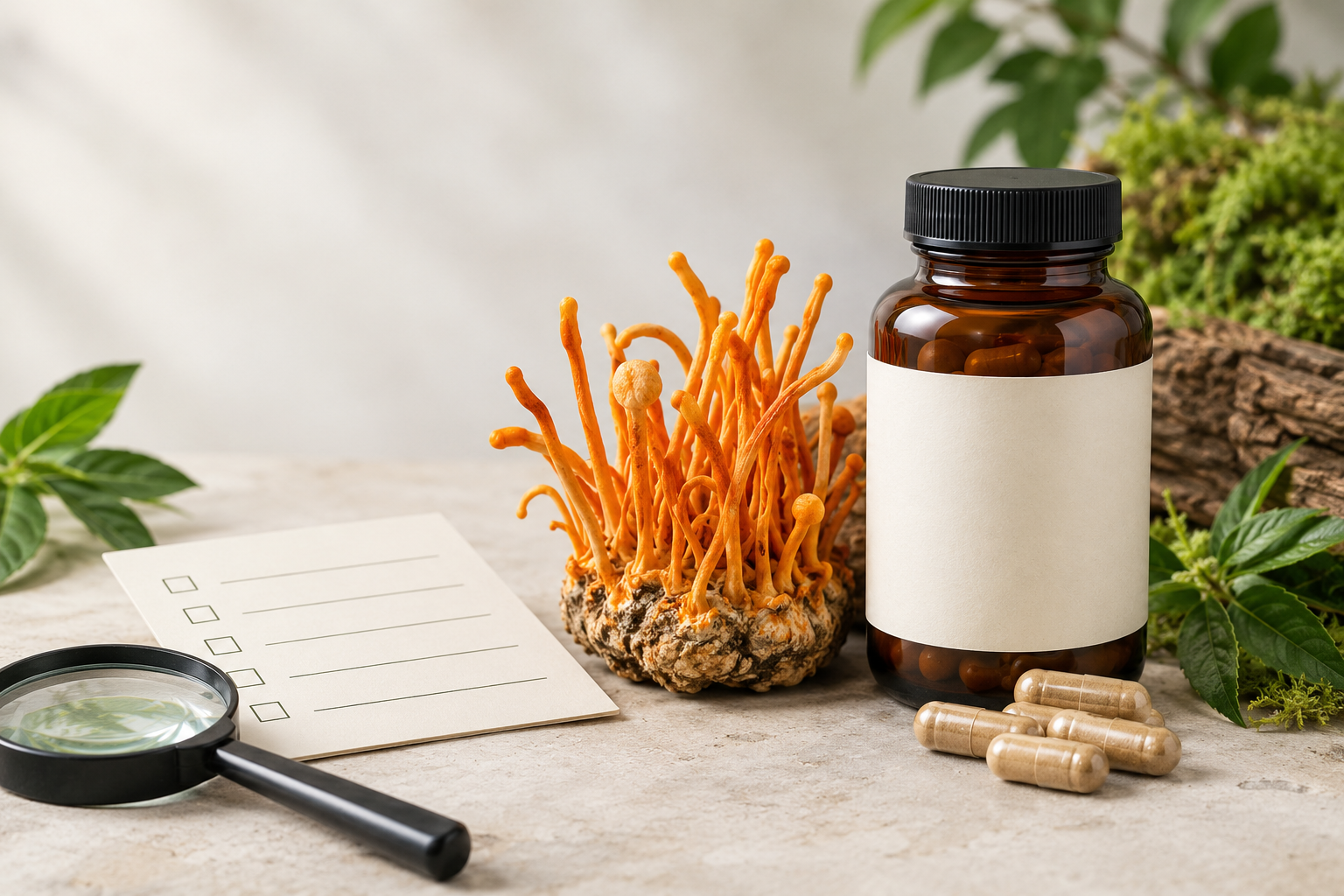
Quick answer: The best cordyceps supplement names its species (usually Cordyceps militaris or a CS-4 mycelium strain), says whether it uses fruiting body or mycelium, states the extract amount per serving, and has a batch Certificate of Analysis. Expect modest, mixed exercise results: some small trials found gains, others found none.
Cordyceps has a big reputation in gyms and on running forums. Ask what is actually in the bottle, though, and the answers get vague fast. If you are comparing options in ourfunctional mushroom collection or anywhere else, a few label checks will tell you far more than the marketing.
This guide covers the difference between the two main species, what cordycepin is, why the growing method matters, what the exercise research really shows (including the studies that found nothing), and who should be careful.
What is the difference between Cordyceps militaris and Cordyceps sinensis?
Cordyceps militaris is a species that can be grown to full fruiting bodies in cultivation. Cordyceps sinensis (now called Ophiocordyceps sinensis) is the wild caterpillar fungus from high-altitude regions, and it is rare and very expensive.
Memorial Sloan Kettering describes the wild fungus as one that grows on the larvae of a moth. A 2025 review in the Journal of Fungi reported that high-quality wild fruiting bodies can sell for 10,000 to 60,000 US dollars per kilogram, and that wild yields in China have dropped by more than half in recent years.
That price explains a lot. Very few affordable supplements labeled “sinensis” contain the wild fungus. Most use a mycelium strain grown in fermentation tanks instead.
What is CS-4?
CS-4 is a fermented mycelium product originally developed as an affordable stand-in for wild O. sinensis. It is not the wild mushroom, and it is not a fruiting body. Much of the older human research on “cordyceps sinensis” actually used CS-4.
The same 2025 review notes that cultivated and wild materials differ chemically. Wild O. sinensis tends to contain more adenosine, mannitol and trehalose, while cultivated material often has more amino acids. So “sinensis” on a label can mean quite different things.
Why militaris has become the common choice
Militaris grows faster and forms fruiting bodies far more readily in cultivation than O. sinensis. It was approved as a novel food ingredient in China in 2009.
For most buyers, that makes it the more practical, traceable option.
What are cordycepin and adenosine, and should the label list them?
Cordycepin is a compound first isolated from C. militaris in 1950, and it is a close chemical relative of adenosine. A label that reports cordycepin, adenosine or both gives you a real way to compare products.
A 2019 review in Annals of Translational Medicine called C. militaris the leading candidate for cordycepin production. It also noted that wild O. sinensis has low cordycepin content, and that the compound cannot be detected when that fungus is grown in artificial media.
Two honest caveats. First, most cordycepin research has been done in cells and animals, so its effects in people are not well established. Second, more is not automatically better; the useful point is that the number is stated and backed by a lab test.
What a cordycepin claim should include
- The amount or percentage of cordycepin per serving.
- The test method, often HPLC.
- A matching batch result on the Certificate of Analysis.
Should you choose fruiting body or mycelium cordyceps?
Choose a product that tells you which part it uses and what it was grown on. Fruiting body C. militaris is easy to verify; mycelium products can be fine too, but only if the growing method is clear.
The concern is mycelium grown on grain, with the grain ground into the final powder. Grain is mostly starch, so the capsule can contain a lot of starch and less of the fungus than you think. A broad “polysaccharide” figure can even count that starch.
CS-4 sits in a middle ground. It is liquid-fermented mycelium, not grain-grown, and it has the longest research history. If you buy a CS-4 product, look for the strain name and a clear amount per serving.
For a wider look at how labels handle this question across species, see our explainer onhow each functional mushroom extract is made.
What should a good cordyceps label show?
A good cordyceps label answers five questions without making you dig: which species, which part, how it was extracted, how much is in each serving, and where to find the test results. If any of these are missing, ask the brand before you buy.
Use this as a quick checklist in the store or on a product page:
- Species in Latin:Cordyceps militaris, or a named strain such as CS-4 if it is a fermented O. sinensis type product.
- Part used: fruiting body, or mycelium with the growing method stated (liquid fermentation or grain).
- Extraction: hot water, alcohol or dual extract, rather than plain “powder”.
- Amount per serving: milligrams of extract per capsule, not only an “equivalent to” figure.
- Testing: a batch Certificate of Analysis covering heavy metals and microbes, ideally with cordycepin or beta-glucan results.
- Other ingredients: no unexplained rice, oats or “myceliated grain”, and no hidden stimulants.
Price is not a reliable shortcut. A cheap “sinensis” product is almost certainly not wild fungus, and an expensive one is not automatically better tested. The label and the COA are what tell you the difference.
Does cordyceps actually improve exercise performance?
The evidence is mixed. A few small trials found modest improvements in markers such as oxygen uptake or time to exhaustion, while a well-designed study in trained cyclists found no effect at all. Treat cordyceps as a possible small helper, not a shortcut.
Here are the main human studies, in plain terms:
| Study | Who took part | What they took | What happened |
| Parcell et al., 2004 | 22 trained male cyclists | 3 g a day of CS-4 for 5 weeks | No difference from placebo in VO2peak, ventilatory threshold or time trial |
| Chen et al., 2010 | 20 healthy adults aged 50 to 75 | 333 mg of CS-4 three times a day for 12 weeks | Metabolic threshold up 10.5% and ventilatory threshold up 8.5%; VO2max unchanged |
| Hirsch et al., 2017 | Recreationally active adults | A daily mushroom blend containing C. militaris | No change after 1 week; VO2max and time to exhaustion improved after 3 weeks |
How to read these results
The trials are small, used different products and doses, and measured different things. The positive militaris study used a blend of mushrooms, so it cannot isolate cordyceps alone. The clearest null result came from trained athletes, who may have less room to improve.
Memorial Sloan Kettering sums the exercise research up as mixed. That matches what we see. If you train seriously and want to try cordyceps, give it a few weeks, keep your training steady, and judge it honestly. Our article onCBD and recovery for athletes covers other parts of an active routine.
How much cordyceps should you take?
There is no established standard dose. Human studies of CS-4 have used roughly 1 g a day (333 mg three times daily) up to 3 g a day, so compare products on the actual extract weight per serving and follow the label.
A few practical points help:
- Start with the serving on the label rather than the highest dose you have read about.
- Compare extract to extract. A 400 mg extract and 400 mg of raw powder are not the same thing.
- Take it at a consistent time for at least three weeks before judging, since the one positive militaris trial saw nothing at one week.
- Many people prefer cordyceps earlier in the day, though there is no strong research on timing.
- Write down how you feel and how training goes, so your judgment is not based on memory alone.
Is cordyceps safe, and who should avoid it?
Cordyceps appears well tolerated in short studies, but it is not right for everyone. Talk to your doctor first if you take blood thinners, diabetes medicines or immunosuppressants, are pregnant or breastfeeding, or have surgery coming up.
Memorial Sloan Kettering reports that no major side effects have been documented, but it notes one case of excessive bleeding after a tooth extraction in a person taking cordyceps daily. It lists these possible interactions:
- Anticoagulants and antiplatelet drugs: cordyceps may reduce platelet clumping and raise bleeding risk.
- Diabetes medicines and insulin: effects on blood sugar may add up.
- Immunosuppressants: the clinical relevance is unclear, but caution is sensible.
MSK also advises that people with myeloid blood cancers avoid cordyceps. In a 2024 eight-week trial of a C. militaris drink in 40 healthy adults, blood sugar, lipids and safety markers did not differ from placebo, and no one dropped out because of side effects.
Mild stomach upset is the most likely issue for most people. As with any supplement, the NIH Office of Dietary Supplements reminds you that products do not need FDA approval before sale, so buying from a brand that tests every batch matters.
How does Endoca’s Cordyceps extract fit?
Endoca’sCordyceps Mushroom Extract uses Cordyceps militaris grown under controlled cultivation. Each vegan cellulose capsule holds 400 mg of organic, hot water extract that has been concentrated and dried into a powder.
It is made for active people who want a steady addition to their routine, not a pre-workout jolt. We have not published a cordycepin figure on the product page, so if that number matters to you, check the batch Certificate of Analysis atlab.endoca.com or ask us directly.
If you are new to reading those reports, our guide towhy third-party testing matters explains what to look for. And if you prefer drinks to capsules, our comparison ofmushroom coffee and capsule supplements sets out the trade-offs. Endoca does not sell mushroom coffee, but the guide is useful either way.
Frequently asked questions
Is Cordyceps militaris as good as Cordyceps sinensis?
They are different species with different chemistry, so “as good” depends on what you want. Militaris is easy to grow as a fruiting body and is a rich source of cordycepin. Wild sinensis is rare and costly, and most “sinensis” supplements are CS-4 mycelium. Human evidence for both is limited and mixed.
What is the best form of cordyceps to take?
A hot water extract in capsules is a simple, measurable option because the label can state an exact amount per serving. Powders and drinks work too if you know the dose. Whatever the form, look for the species name, the part used, and a batch Certificate of Analysis from an independent lab.
How long does cordyceps take to work?
Research suggests it is not instant. In one trial of a blend containing Cordyceps militaris, there was no change after one week, but oxygen uptake and time to exhaustion improved after three weeks. Another study ran for twelve weeks. Plan on taking it consistently for several weeks before deciding if it suits you.
Can I take cordyceps with coffee or other supplements?
Most people can, but check with your doctor if you take prescription medicines, especially blood thinners, diabetes medicines or immunosuppressants. Cordyceps may affect clotting and blood sugar. Adding one new supplement at a time also makes it easier to tell what is helping and what is not.
Does cordyceps contain caffeine?
No. Cordyceps is a fungus and does not naturally contain caffeine, so it will not give you a coffee-style buzz. Any energy support it offers is subtle and builds over time. If a cordyceps product does feel stimulating, check the label for added caffeine, green tea extract or other stimulants.

Comments are closed